
Fr. Gunnar Rosendal on the Office (Part 4) - Bishop and Priest
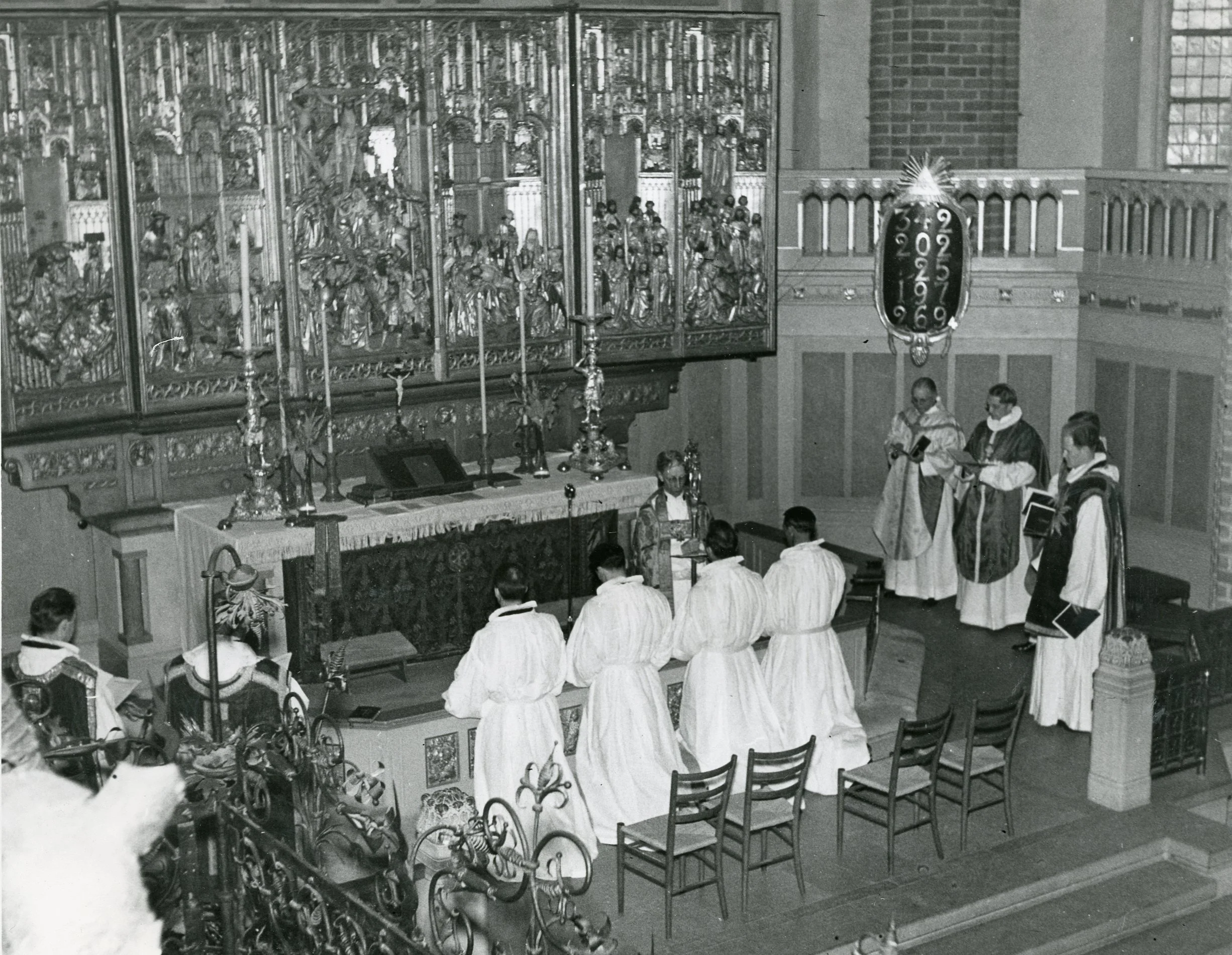
The ordination of four Norwegian priests in Strängnäs Cathedral, Sweden by Bishop Gustaf Aulén on March 19, 1944, during the Nazi occupation of Norway. The ordinands are pictured just before making their priestly vows.
The following is the conclusion of “The Office,” the third chapter in Fr. Gunnar Rosendal’s 1956 book Vårt Katolska Arv (Our Catholic Inheritance), translated by the Rev. Roy Axel Coats of the Lutheran Church of the Redeemer in Baltimore. You can read the first installment here, the second here, and the third here.
Bishop and Priest
Is a Bishop just a priest, or is a priest a Bishop?
If a Bishop has no other ability than the priest, then he is simply a priest. He has a higher dignity, but so does a pröst. [trans. note: This term could be used for a prior, the dean of a region under a bishop, or one who is a pastor in his own parish as opposed to being under a kyrkoherde. In any of these senses it is an honor given to a priest.] A monsignor and a cardinal, an archpriest and an abbot, these are all higher 23 dignities of the clerical estate, but all these high prelates are only priests. And there is a significant group of theologians, who cannot be denied the epithet catholic, in the present day, who believe that the Bishop is a priest. We have made their acquaintance in the most noteworthy article in the fine Nouvelle Revue Théologique, which we have just gone through. The opinion has its seat in the Roman Church and is to some extent codified in Canon 951. But it is even more richly represented in the Churches of the Augsburg Confession and is also there to some extent codified in the Smalcald Articles and the Apology. But on that side, as a rule, one does not have the same clear language, and I fear that we also <150> must, at least in this chapter on the Office, lack the same clear thought, which is the honor and crown of Rome.
If the priest can ordain a priest, then he is a Bishop. That is the Presbyterian thesis. Every priest is a Bishop, and therefore there is episcopal succession, a good Presbyterian would argue.
How complicated the issue is, you can learn and see, if you can read such a chapter as “The Parity of The Ministers” in The Apostolic Ministry by the aforementioned specialist in succession and the Office, Doctor T. G. Jalland. It is not a thing to dismiss either with a condescending, embarrassed ignorance —which often appears on high horses— or with an obscure statement. The interesting thing is that Canon 951 in the Codex Iuris Canonici reckons with two possibilities for ordination to the priesthood. Partly the ordinary consecrator, who is the Bishop, and partly the extraordinary consecrator, who has received the assignment from the Holy See to consecrate but is a priest, not a Bishop. The Holy See must be considered in this case to represent the Church, and we, who cannot accept the supremacy of the Pope, could as well use the word “Church” instead. And then undeniably interesting possibilities open up. Was Bugenhagen's consecration in Copenhagen of the Danish bishops absolutely without validity? That question arises, but it naturally only arises for those who previously considered this ordination invalid, because Bugenhagen was only a priest and not a Bishop. Those who have always considered the consecration to be valid can only be strengthened in their belief by what we have found here. If there is any question there can be no response.
Is the priest a Bishop? I want to answer no. Even if the priest has the ability to ordain priests through his own ordination, he is thus nothing more than a potential Bishop. He must be elected and ordained to this new degree in the Office under normal circumstances. The Augustana retains its authority, it proves to be of good catholicity. Bishops have always existed, there is no doubt that they are kat’olon. And that the office of bishop, whatever it may mean, is instituted by God, it is also Catholic faith and teaching; our Church Order holds the proof. And what now concerns <151> order in the Church of Sweden in this whole difficult mess, what do we have to say about the Catholic heritage?
Not without a sigh of relief, I withdraw from this intricate labyrinth and establish the following Catholic facts: First, the Church of Sweden has preserved a succession through Bishops, which is good Catholic order under any circumstances. Secondly, it is prescribed with us that a Bishop shall ordain a Bishop, one or more may consecrate, but it must be a Bishop or Bishops, and that is how it has always been. Thirdly, it is taught above all in our confessions, I leave the commentaries and tracts to the side, where the matter is discussed, that the office of bishop is de jure divino, so far as it is a spiritual office, and de jure humano only in its eventual feudal function. These are Catholic facts in the Church of Sweden and in the Church kat’olon.
Well, we have priests and Bishops, but do we also have deacons? Certainly we have deacons, deacons in the true, early Church, catholic meaning of the word. It is worth observing that several churches are working to introduce a diaconate of our kind. We could supplement our diaconate by ordaining prospective priests at the appropriate time, that would be catholic and good, but it is not necessary.
But now suppose that one of the Bishops, who have ordained our Bishops without interruption, has had a false doctrine about the Office and did not understand and consent to what it means, what happens to the continuity then? According to the catholic view, the theological view of the consecrator has nothing to do with the validity of the consecration or its value in other respects. The only thing that is required is that the one who consecrates does so with the intention of consecrating a Bishop, a Bishop of the Church, such a Bishop as the Church has always had. Whether he then considered the Bishop and the priest identical or whether he held the office of bishop to be the office in its fullness, it is of no consequence. It matters as little as what the priest celebrating the Lord's Supper believes about the essence of the Lord's Supper. He cannot change it by his false perception, <152> if he has one. It is catholic teaching, and we find it in Augustana, when it is asserts that bad priests do not destroy the effect or essence of the Sacraments.
But then why this complicated story about priest and bishop? On the one hand, it has great ecumenical significance. But we have no reason to concern ourselves with that matter here, where the question is only how we preserved our catholic heritage. However, the problem should be brought forward and highlighted, because it shows that the question of the Office must be worked on. For one thing, it is not without a certain humorous pleasure to note the similarity between the Church of Rome and the Church of Sweden. Both have their doctrine of the height and value of the office of the bishop, both have preserved the office of the bishop, but both also have a troublesome clause, not in the confession, but Rome in its canon and we in some of our commentaries. It is quite funny to note.
Since this was written, we have read the lively and instructive debate in the Svensk Kyrkotidning. One harbors the most sincere gratitude to both participants: to Wingren for giving Gärtner reason to write and to Gärtner for making the most brilliant entry in the Exegesis of the Office that I have ever read. Gärtner opens up new paths in the exegesis, paths that have regrown and narrowed into forgotten paths during times of indifference to these chapters of theology and to the gifts of grace they treat. He shows the Biblical origins of the Office in a new, fresh and scientifically convincing way. He teaches us both prudence and boldness in an excellent union.
The last word has by no means been said on this difficult subject. In the international periodical literature, one meets promises of great works, dedicated to the Office. The latest issue of Irenikon has an editorial that mentions several upcoming books, and contains an article that is very noteworthy. Openness and clarity, firmness and soft opportunity for development and growth should be united in all those who want to fulfill the extremely important task of researching the theology of the Office.
I hope that this chapter has proven profitable to the reader, most especially in giving voice to many of the concerns that still arise today. More writings on this subject will be forthcoming on this blog, particularly from the period of Lutheran Orthodoxy. - SG