
Fr. Gunnar Rosendal on the Office (Part 2) - The Bishop
The following is the continuation of “The Office,” the third chapter in Fr. Gunnar Rosendal’s 1956 book Vårt Katolska Arv (Our Catholic Inheritance), translated by the Rev. Roy Axel Coats of the Lutheran Church of the Redeemer in Baltimore. You can read the first installment here.
The Bishop
Is the Bishop now the source of the Office? Is it so that the Office is a bishop's office, the Bishop has the entire Office and gives deacons and priests a different share of his Office?
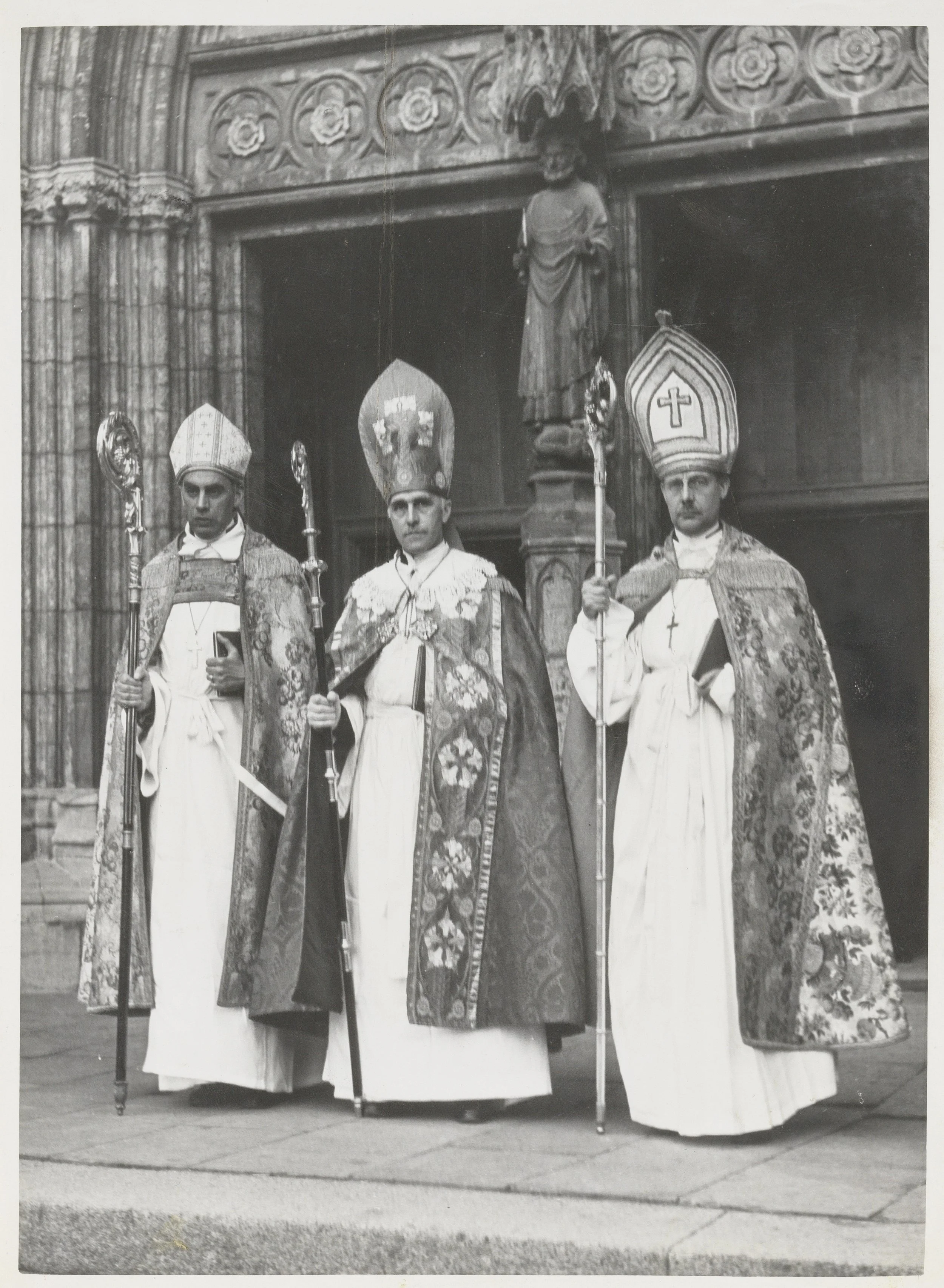
That is what I have always believed. About this I have always been convinced. The strange thing is that I never thought that it is called, even in the best Catholic terminology, the PRIEST office, not the BISHOP office. I don't know why I didn't think of that. I believe that it is due to inadequate teaching during the preparation for the Office. Such things were never spoken of. That was not done in Germany at the time, and therefore it should not be done in Sweden. What an incredible amount of German books, as big as the thickest telephone books, I read to be both a candidate and a licentiate! But there was never anything about the Office in them. It was later, when I began my wandering on my own carefully into Anglican theology, that I found books on the subject. And when I found them, there was a form in a mitre, cope, and crozier that overshadowed everything else: the Bishop. I came to be a faithful Episcopalian for decades, because everything about the Ministry was left out in my theological education. The office was a vacuum, which I filled as best I could, and it was the Bishop who got the vacant place. And was this so crazy? If you want to draw a <134> caricature of the episcopal concept of the office, as Gustaf Wingren recently did in Vår Kyrka, one can always do it, but it will be a caricature, and in Wingren's case a talented caricature, and it is not so worthless with talent. The problem is that talented mistakes are far more dangerous than simple craziness, because some people believe that talent and genius are always true. In the relevant article (16/55), Wingren writes: “In short, many priests in the Church of Sweden take the same position against the Swedish Free Churches, as Rome takes against the Protestant churches (including the Swedish Church). This means a permanent inability on our part to express the essence of the gospel. They circle around the Office. An immense number of our church's best and most zealous servants have an image fixed in their hearts. In that image, Rome is placed a little above them. From Rome emanates a disapproval towards us, and from us a disapproval emanates towards the free churches. This is a vicious circle and standing inside it means losing power in relation to Rome's ideal: the whole time they adopt an alien view, which dissolves the meaning of the word they are to maintain. The central concept is and remains the office, as long as they remain in this circle.” This is pleasantly written, but it's a misrepresentation of the situation. I have met possibly up to five people under the age of twenty-five who have had the attitude described, and they have all been laymen. Most of them have become Roman churchmen. No priest that I have not met has such a view of the office. That there would be “immense numbers” of priests with this view seems to be a highly exaggerated claim, to put it politely. When I am unwilling to recognize a Free Church preacher as a priest, that is, a steward of the Word and Sacrament with full apostolic authority, it is not because Rome would disapprove of him. It has its cause in the fact that his denomination lacks a connection backwards, in time, in history, in an incarnate manner <135> with Christ and the apostles. This denomination may have any idealistic connection whatever, it may reproduce the Christian doctrine ever so correctly, yet as a denomination it is new, it is founded in opposition to the Church kat’olon, the Church founded on the apostles and prophets. A new foundation, that is what was sought to be laid, and a new foundation can no one lay. You can reform the only Church that exists, but you cannot found a new one and call the only Church the great harlot or anything else along those lines. Therefore, I can recognize the Free Church denominations, as perhaps very effective and praiseworthy religious associations and their preachers for these associations without any doubt are often exceptionally skilled officials, but any Church’s priest they are not. First because they belong to an association and not the Church. Second, because, as a rule at least, they have no sacramental view of the Sacraments. This came out plainly and clearly, without any controversy, at a weekend in Osby rectory a few years ago. I regretfully spoke that I could not admit that my free church guests had any real presence of Christ's Body and Blood in the Eucharist, since they did not have the Catholic Church's mission to administer the Sacraments, but only the call of a sect or association to do so. To this, one of the participants, a prominent and sympathetic Free Churchman, replied: “Do not be worried about this thing. We do not ourselves believe in any real presence. The Lord’s Supper for us is an ordinary meal, which we eat in memory of Jesus' suffering and death." Baptism is considered to be an act of confession within the Free Church, perhaps not always but often enough. And when the other minor Sacraments are not used, no sacramental kat’olon life remains. Where there is no sacramental life, there are no priests in the catholic sense.
No, it is not because of that relationship that the distance between the Free Churches and Rome would be greater than the distance from Rome to us. This distance is of no interest at all in this context. It may mean a lot in ecumenism, but not in terms of our administration of the Catholic <136> heritage. But when it comes to this administration, then it is important to be able to determine in part what this heritage is and in part how we have preserved it. What I now wanted to ask my benevolent reader for is this: Can we agree that for decades what I held as self-evident, namely that the office of bishop with apostolic succession is the very basic substance or source of everything called Office in the Church, so that all office flows, as it were, from the episcopate, which is its fullness, is the Catholic heritage in the question regarding the Office. That there are three degrees in this Office, deacon, priest and bishop, is also Catholic but in this regard quite immaterial. But let us agree, as a hypothesis in any case, that the Catholic heritage stated as a main point implies that the bishop’s office is the very core and most important part of the Catholic office. Have we then preserved this heritage? We have already seen that the Church Order is completely clear on this point. It speaks of the difference between priest and bishop as inspired by the Holy Spirit. It further asserts that this difference must persist as long as the world exists. It also stipulates that a bishop must be consecrated by a bishop with the laying on of hands. This is how the succession is preserved. It is pretty clear. The Church Order everywhere speaks of the Office as a divine order. It is not present in the Church only because someone has to lead. The priesthood is not a vocation like any other. One cannot, if one wants to be faithful to the Church Order, not say that just as some learn to sew clothes and become tailors and others to operate a locomotive and become train drivers, so some learn to preach and administer the Sacraments and become priests. The office is a divine institution, this is asserted in numerous repetitions in Church Order. And this is what the Church Kat'olon teaches about the Office. We can serenely leave the Church Order, pleased in all respects, when we have seen how it administers our Catholic heritage.
Yet there is an article that is always timidly passed over, the twenty-eighth in the Augsburg Confession. We shall <137> linger here in detail. We must sincerely seek to understand what it has to say. We shall seek to read it, without losing hope that it will preserve the Catholic heritage, but by all means without attempting to reinterpret it or force ourselves upon it.
About the Office in general it is said in the fifth article that it has been instituted (institutum est) to proclaim the gospel and provide the Sacraments, “for through the Word and the Sacraments the Holy Spirit is given as through instruments.” The office is then instituted, it is not a human institution made for reasons of convenience. The twenty-eighth article deals with the bishop. This fact alone is quite remarkable. It is clear that it is a matter of just the bishops who existed at the time when the article was written. It therefore does not apply to any new office. This applies to the old office, as kat'olon it remained in the Church from the beginning with its roots in the Apostolic Office. This is important to establish, and it is easy to do. For the whole article talks about the spiritual and temporal power of the bishops, and it was precisely characteristic of the medieval episcopate that it had these two sides. In the criticism of worldly power, which the article contains, there is no difficulty in recognizing the office of the bishop, which received its shape during the Middle Ages, but has always existed in the Church. What is said in the article about the bishop does not therefore apply to any new species of bishops, it applies to the Catholic office of bishop, the one that kat'olon has always been found in the Church.
Now where does this Office come from? The Church, as a whole, without exception, in her doctrine and life ever since the new foundation of the Office in the New Testament held the opinion that the office of bishop came from God. It was a divine institution. What does Article 28 say? [trans. note: see note 12 of A. C. Piepkorn on Rosendal’s interpretation of this in “Suggested Principles for a Hermenteutics of the Lutheran Symbols.”] This is what it says: "The power of the bishop, according to the Gospel, is the power and mandate of God — Postestatem episcoporum iuxta evangelium potestatem esse seu mandatum Dei." The possibilities of reinterpreting these words seem extremely small, they are far too clear, lapidary, free from all <138> complicated and ambiguous statements. But now, for ages, people in the Church have spoken about the Bishop's power using two technical terms. They held, as Melanchthon says in the Apology, vetus partitio potestatis in potestatem ordinis et postestatem iurisdictionis, that is to say, that the Bishop's power consists partly in the administration of the Word and the Sacraments, and partly in a certain governmental power. This governmental power included the forgiving of sin, the rebuking of the ungodly, and excommunication, as well as the administration of worldly possessions. In some cases these possession could be very large. Now then arises in the question in Article 28: How far does the divine office of bishop extend? Does the administration of these medieval feudal rights also belong to the God-given office?
It is in the treatment of this question that one sees how clearly the Catholic opinion that the office of bishop was of God and not a human institution was cherished and defended. Proclaiming the Word and providing the Sacraments, that was obviously a divine mandate, but what about the jurisdiction, the governmental power? To this the article replies, that if the bishops have the power of the sword, they have it not by the mandate of the Gospel but with temporal and human right. (Si quam habent episcopi potestatem gladii, hanc non habent ut episcopi mandato evangelii sed iure humano, donatam a regibus et imperatoribus.) Here we encounter two other ancient technical terms: De iure divino and de iure humano. Nor can they be misunderstood. That which God has ordained, that is de iure divino, according to divine right, but that which men have ordained is de iure humano. For example, if a Bishop has been given power over a certain territory by a king or emperor, who is in the indicated place, such worldly governmental power is not from God but from men. “But”, the article continues quite solemnly, “the governing power (jurisdiction) that the bishops have as bishops, in that they have the Office of the Word and the Sacrament and the task of forgiving sins, rejecting teachings that deviate from the Gospel and excommunicating the impenitent without human violence but through the Word, that power the bishops have according to the Gospel or, as they say, de iure divino, by divine right.” (Proinde secundum evangelism seu, ut loquuntur, de iure divino, haec iurisdictio competit episcopis ut episcopis, quibus est comissum ministerium verbi et sacramentorum, remittere peccata, reiicere doctrinam ab evangelio dissentientem et impios, quorum nota est impietas, excludere a communione ecclesiae, sine vi humana, sed verbo.) Here, with all the desired clarity, is listed what belongs to the office of the bishop by divine mandate. There cannot be for a moment a question of whether the office of bishop according to Augustana is something indifferent or superfluous. It is de iure divino. When one quotes Article 14, where it says that no one should teach in the Church or exchange her Sacraments without being rite vocatus, so should one have Article 28 in mind if one wants to understand the fourteenth article properly. If someone were to suggest, which seems most arbitrary, that is is fine to read into both the earlier and the latter passages of the Augustana that a bishop and a priest here would be one and the same, must remember that the German parallel text to the cited place has the following passage: “Und desfalls seind die Pfarrleute und Kirchen schuldig, den Bischofen gehorsam zu sein.” The priests must obey the bishop. Of this it is written in the Latin text that this obedience is de iure divino. It is God's will.
The context with the apostles, indeed a certain degree of identity with the apostles, is evident in this passage. For here it is said that according to God's order we must obey the bishops according to the words in St. Luke’s tenth chapter: “He that heareth you heareth me.” It is a word given to the apostles that is here applied to bishops. The bishops have a certain apostolic grade. Not only a certain likeness but a certain identity with the apostles. This is also occurs with another passage in the same article. Here the power of the bishop is named in conformity with (“according to”) the Gospel and God's mandate. The text continues with an extremely notable reason: “For, with the following mandate Christ sent the Apostles: <140> As the Father has sent me, so I send you.” (St. John 20:21) In the same place, another sending of the apostles is mentioned, namely in the sixteenth chapter of St. Mark's Gospel: Go out and preach. One must notice the remarkable construction of the argument: The Office of Bishop is a divine mandate, because Christ sent his apostles so and so. The apostolic character of the office of bishop clearly lies here. It is catholic doctrine and it is splendidly well preserved.
Bishops exercise their power in that they preach the Gospel and administer the Sacraments, and they then handle eternal things, eternal righteousness and the Holy Spirit, which people cannot obtain except through the Office of the Word and the Sacraments. This is a real and particularly strong emphasis on the place of the Office in the saving work of the Church! More of an emphasis on the Office can one hardly think of in a confession than what is found in the Augustana. Let us now seek to summarize and consider the conclusions we have come to at from a fairly thorough examination of its twenty-eighth article.
First of all, it is clear that the Office that is treated here is the kat’olon office of the bishop, the office of the bishop, as it has always been in the Church. Broadly speaking, we face certain criticism of the shape of this Office during the Middle Ages. The feudal governmental power, which bishops have received through the grants of earthly goods to certain bishoprics from kings and emperors, is certainly not rejected as ungodly or unworthy. Yet they are declared to be of a purely temporal and human nature, there is no godly appointment in such an order of things. This criticism does not reject any Catholic doctrine. It is certainly possible to support the opinion of some theologians that even the feudal power of the bishops is from God, but that is not a universal opinion, it is not kat’olon and never has been. The criticism is justified and without doubt in many respects peculiarly Catholic. But apart from this slight and, spiritually speaking, healthy limitation of the power of the bishop, it is claimed that the bishop has his Office and the power <141> of that Office from God. This office is placed in such close relation with the apostolic office, both in its origin and in its practice, that a certain degree of identity between the apostles and the bishops seems to be taught. However, his identity is in no way precisely understood, but as far as it goes it is in well conformed to the traditions in the Church. These maybe are not able to claim to be called catholic, however they have an ancient place in the Church. The importance of the office in the order of salvation is emphasized in an extraordinarily strong way, the necessity of the Office is highlighted in a particularly strong manner. This is our final conclusion. Suffice it to say the Augsburg Confession has preserved our Catholic heritage on this point with unbroken fidelity.
Here, where I sit in the sun on the lawn, it is very close to thirty or over thirty degrees [Celsius], and I therefore want to mention that I came to exactly the same conclusion at the review of Article 28 many times before at significantly lower temperatures, so my closing summary cannot be due to the heat wave. I have often wondered how in the world it happened that the German Churches lost the episcopate, when their lead document that reformed the Churches has such a chief article about the episcopate. It is surely the fact that once the office of bishop was lost, they never dared to bring up Article 28. It is too good. It cannot be true. But that is that. Alas, if the Churches of the Reformation in Germany had been faithful in regards to this—they and our neighboring churches in Norway and Denmark!—so much ecumenical fuss would now be unnecessary! Now I want to repeat again that these Churches are not at all to be compared with the free church congregations. After all, they were not formed in opposition to an existing Church, they arose out of a reformation. This sometimes went astray, but there is an absolute difference between founding a new Church and seeking to reform the only Church and some cases failing. In the last case, it is the same Church that continues to live, and she can be reformed once more and regain what she has lost. In the former case, something new has been founded, the principle of division is established as a principle [knäsatt] <142> and the whole situation is different. Continuity is gone, where a new congregation is formed, but it continues, albeit with weakness, where the one Church remains, however deformed and deficient.
Yet perhaps there is another answer to the questions that can end this chapter? Perhaps we may, at least to some extent, understand why the office of bishop fell away in the Churches of Germany, when we read the next section.
The remainder of the chapter will be published in two further installments: “The Priest,” and “Bishop and Priest.”