
Fr. Gunnar Rosendal on the Office (Part I) - Apostolic Succession
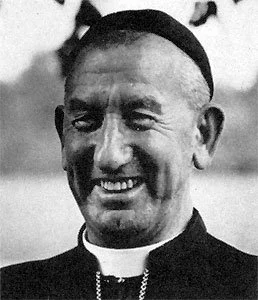
Fr. Gunnar Rosendal
Fr. Gunnar Rosendal (1897–1988), was a Swedish Lutheran priest and a leading figure in the liturgical movement of the Church of Sweden, both publishing many works and leading by example in his parish in Osby. He was also a fierce opponent of “women’s ordination,” as can be seen in this excerpt from his open letter to parliamentarian Jarl Hjalmarson in 1957:
It is, of course, well known that the professors of theology at both faculties had previously taken a dismissive stance toward the idea of women as priests, with roughly the same reasoning as the committee and the overwhelming majority of the holy, catholic, and apostolic Church. […] You seem to argue that while a strong press opinion, the women's rights movement, and the secularized people's opinion demand that women gain access to the priesthood, the church should give it. [...] Allow me, with all the pathos and conviction I possess, to say this: What is prudent is not to abandon one’s convictions and one’s Christian heritage in order to follow the gods of the age. What is prudent is not to seek popularity. What is prudent for the Church is to stand firm by its eternal standard, the Word of God, and by its own order, won through the centuries and now prevailing throughout the whole world, with few exceptions. What is prudent is sometimes so far removed from popularity that it may mean a cross. Christ, the cornerstone of the Church, did not win the approval of His contemporaries. He was crucified. (translation from Frida Mannerfelt, “Digging for Roots: Perceptions of Secularity and Biblical Assemblages in the 1957–58 Public Debate on Women’s Ordination in Sweden” in Biblical Interpretation 34 [2026]:13–36).
Fr. Gunnar’s legacy survives most especially in the Swedish Missionsprovinsen, with whom the Lutheran Church—Missouri Synod is currently in dialogue, and so his writings are helpful in understanding the tradition of confessional Lutheranism in Sweden, which obviously has a substantially different history than the Germanic heritages out of which the LCMS was first formed.
Reproduced below is a portion of his 1956 book Vårt Katolska Arv (Our Catholic Inheritance), namely the beginning of the third chapter, in which Rosendal discusses the Office of the Holy Ministry. This marks the first time, as far as I am aware, that this work has been translated into English, and was kindly done by the Rev. Roy Axel Coats of the Lutheran Church of the Redeemer in Baltimore, MD. The remainder of the chapter will be published in further installments, and I think it will prove helpful to ongoing discussions regarding Church and Ministry in the LCMS.
Chapter III
The Office
A couple of days after my ordination, I was standing outside the window of the Sydsvenska Dagbladet in Lund, reading the news on a sunny May morning, when a comrade came up to me and asked: "Well, how does it now feel to have the character indelebilis?" It was 1922, liberal theology was in its heyday, and it was in good taste to joke about such things. I fell into the jargon and answered effusively that it did not feel as if, as far as I noticed, I had received the indelible character of the Office. I added that I considered the matriculation degree much more important than the priestly ordination. When I think back now, I must admit about myself that I at least lived as I had learned, because I reluctantly took off my student cap at night, but I wore my kaftan neither day nor night, except when necessity required it. I wanted to be a priest, there was no question of that, I was deeply moved by my priestly ordination, I really longed to work in the Office, but I knew fantastically little about what that entailed. Thanks be to God that I did not need to know that either, any more than a baptized child needs to know that he is baptized. Quite right! I was very childish.
I came to Väsby vicarage at the end of May, and yet today I can see with my inner sight how the warm air rippled over the fields around the church village's heavy foliage and pointed church tower, and I also remember that I first walked past the prästgard in the belief that it was a large herregård, so magnificent it was. The indescribable summer beauty of Kullabygd, which still enchants me in this moment of memory and recollection, <124> filling me with silent jubilation, subdued me, and I timidly wished: "If I could stay here!" When I came into the parsonage dining room, the doors stood open out the garden, the crowns of the apple-trees rested like white drifts motionless in the sun between the huge, tall chestnut hedges out on the plain, and driven beyond all bounds of self- control, I cried out rapturously: "Here I stay." I understood also that this was my missive, only to that was tacked on that Höganäs was also my missive, and the question was, would I be allowed to live in Väsby. Around my two years in this parsonage there will always be a shimmer of complete poetry in the experience and a warmth of affection in existence. The vicar and Mrs. Hallén were wonderful, R.I.P. But when, immediately after the Mass, I changed into my lion-colored summer suit to go out on one of my countless bicycle trips in the countryside, which were always as absorbing and alluring as painful in my inability to to write down what I saw and felt, Mrs. Hallén sometimes shook her head with concern and said: "Do you really like to be a priest?, you are so quick as to take off the koftenetten." She was the first, I think even the only one, I heard use this old-fashioned diminutive, and I do not think she herself knew that she was preserving an old usage from generations of priests, where kaftan meant the foot length cassock (prästrock) and koftenetten meant the knee length kaftan.
No, the theology of the Office was completely unknown to me, except to the extent that I read a little about it, though very little, in practical theology. It took a long time before it became a problem for me. I do not know myself how it happened that I started to be curious. But I became just that, I hungered for knowledge, I asked and no one could answer, I groped and searched and finally found. And when I had found, I came to a peace and a joy that made me think that all questions about the Office were somewhat answered, only details remained, and they were of little weight. The view I was eventually able to express and which I embraced with the warmth of my whole heart <124> and with the approval and delight of my whole mind, I could express in a single word: The bishop. Many years passed before I came to read the Church Fathers—how can I help it, no one taught me. But when I found in the Apostolic Fathers the expression “ubi Episcopus, ibi ecclesia”, “where the Bishop is, there is the Church,” I thought that I, as rarely before in my life, understood what Socrates meant by recollection. I thought of that sentence, that I formed myself, as a confession of my innermost conviction, long before I encountered it in the first doctor fathers of the Church. Article XXVIII of the Augsburg Confession, which others either neglected or passed by with a little embarssment, became for me a holy place. In all the editions of the confessional writings, whether in Swedish, in German, or in Latin, which I got into my possession, I passionately underlined this passage. This article became half a bright intellectual joy and half a devotional text for me. As the years went by, I became able to briefly and concisely state my view on the Office. And when one can state one's convictions that way, it is always ripe and clear. My formula read like this: The Bishop is the only one who has the whole Office, from him all others get a greater or lesser participation [delaktighet] in the Office. I was convinced, without a shadow of a doubt, that this was the only possible Catholic conception of the Office. Of course, I was not unaware that other views existed, but folly is all over this fallen and darkened world so why should folly not be found in views about the Office? They did not concern me. I was convinced that the Church of Sweden, but unfortunately not all Swedish priests, stood on a solid Catholic foundation, and that this foundation extended just as far as the sentence formulated above. This sentence could need an addition for the uninitiated: No one is really and truly a bishop, who is not consecrated by a Bishop in the apostolic succession, so that without interruption the consecrated are bishops right down to the apostles. Here the succession <126> problem emerged, but it was a problem only for those other churches, not for the Church of Sweden.
In this belief and perception I lived until I came into contact with Tom G. A. Hardt.
So what did he have to say? He said: "A priest can ordain a priest." Now I understand that for the second time on this page, dear reader, you think this is an anticlimax, you say that I cannot be so ignorant that I have not heard that claim before. Right, right and true! I have, but then the spokesmen has always claimed to be defending the case of Protestantism or Lutheranism or Calvinism or the Free Church, and I have listened respectfully and attentively with courtesy, but frankly without much interest. Now it was something completely different. Tom G. A. Hardt claimed that he made the case for catholicity, that his statement was the Church's own kat'olon, that it was the WHOLE Church's meaning and view that he expressed. And he sent me a copy of the Nouvelle Revue Théologique, and I don't want to reveal the point here, but that much was clear, that the whole proof was Catholic, kat'olon. If I did not want to lock my bishop in and shut myself out of an inevitable theological debate, unless I chose isolation from Catholic thought, I must think through the question of the Office once more. And that is one of the reasons why this book was written. It has been a lot of fun to write these sunny, hot July days among the tall lindens and flaming lupins and with the view of the close-cut lawn down to the vicarage terrace. If the book were to be dedicated to someone, it should be to Tom G. A. Hardt and Gustaf Wingren, mentioned in alphabetical order, who both inspired it.
Yes, Gustaf Wingren comes into the field of view, because his debate in Svensk Kyrkotidning with Jan Redin and his later contributions on the ecumenical question in Vår Kyrka are efficient causes behind large parts of this book. At first I was just thinking of writing an entry in Sveriges Kyrkotidning with the title "Our Catholic Heritage," but it was more fun to write a book, and you have more space and can speak freely. Though it was awful to begin with, I must say, the pleasure of going on has been special. Therefore, though I did not put a dedication on the title page, I take the opportunity to heartily thank both the professor and the student for inspiration and opposition, for benefit and pleasure, for stimulation in thought, will and feeling.
And now I think it is best to think about the outline of this chapter. First I must talk a little about what apostolic succession is, then I will explain Article XVIII of the Augsburg Confession. Then we come to the thrilling question: Can a priest ordain a priest? Lastly, I shall attempt a summary, a synthesis, a consensus of the two points of view, but do not expect too much from it. This chapter will probably be mostly analytical, the synthesis may have to wait. But I can try, without needing anything else.
The Apostolic Succession
<128> One could divide the Churches of Christendom into two groups: Those who possess the succession and those who have lost it. Those who have lost it, as a rule, seek in their theology to prove that it works just as well without succession. They are often deeply hostile to the idea of apostolic succession, and they do not infrequently declare that they would not accept succession at all, even if they were offered it. And it turns out to be quite true. Many events in church life these last decades, since the succession came up for debate, show how anxiously a part of the churches make peace with succession. One cannot regret enough these judgements of an ecclesiastical inferiority complex, even if one does not consider the apostolic succession to be the only legitimate connection between the apostolic church and the Church in our days.
The form of apostolic succession is the unbroken laying on of hands from the days of the apostles to our time, so that a line of bishops stands through the centuries in a series, with the apostles as the first in the series and the newly ordained bishops of our day as the last in this series. If this chain of laying on of hands has been broken somewhere, if a single bishop in the series is absent and replaced by a priest, the form of succession is broken and the content of the succession is spilled. Continuity is no longer at hand. The one who was ordained by someone other than the bishop was never fully catholically ordained himself, and the one he ordains is never fully catholically ordained either. Only the bishop has the power to consecrate and the capacity to consecrate. If a person who is not a bishop performs the consecration, then the consecrated person is not kat’olon a bishop. This also means that all priests who are ordained <129> of this man, are not kat'olon priests. They will not be catholic priests, they become deficient priests, doubtful priests.
This is short and sharp and pointed, so pointed that I myself protest the doctrine of the succession. Few things can set the mind racing more than a truly in-depth debate on this question. Those who have the succession can sometimes become intolerable in their complacency, and there is no reason to defend this, because even the priest, who without the slightest doubt stands in the succession, can have every reason to beat his chest in remorse and correction and humiliation, and a Church that has preserved and highly values the succession, may have so many flaws that it makes complacency not only ridiculous but downright tragic. But since this has been said, and since it has been added to that that there are churches without succession which compel us to humble admiration and devoted acclaim, then of course it must also be admitted that it is a very strange manner of asserting oneself, when they reject gifts which could remedy a deficiency in the constitution of the church. In Denmark, it has long been an extremely easy matter to introduce the apostolic succession from Lund for the easy price of a second-class round trip ticket between Lund and Copenhagen. Even the distances between Oslo and Karlstad are, geographically speaking, not a deterrent. It is apparently other kinds of distance that create the difficulty. And I would like to say that, in all modesty, that distance cannot be approved from a catholic point of view. That the Church in Denmark and Norway lost the succession in the fifteenth century, no one in these countries can help today, but on the other hand, it can be helped that resistance is raised, when succession is offered on several occasions in our time. That is the unreasonable thing. If it is now found to be catholic, that the continuity of episcopal consecration must be maintained, why not restore it, if you want to continue to be a Catholic Church, which the Churches of Norway and Denmark both are and want to be. It may seem pretentious to say what I have dared to say here, but our catholic heritage must be defended, preserved and, where it has been lost <130>, be reinstated. That is why these pages are written, and if I am not allowed to claim this, even when it concerns concrete situations, I might as well refrain from writing at all. In any case, what has been presented is not an attempt to show off. Neither as an individual priest nor as a priest in the Church of Sweden do I have reason to feel superior, but the truth, the catholic truth, must be said.
Let us now in a couple of pages analyze apostolic succession! What is its innermost thought? Its deepest content is this: The Church is a living organism, which preserves its continuity, its connection with the past. The church begins in the eon of the new testament with Christ being made man , she is the body of Christ, she is historical, because the incarnation was a historical event, and moreover timeless and eternal, because the incarnation was the SON OF GOD being made man [mandomsanammelse]. The church is therefore GOD's presence here and now, but on the other hand God's HERE AND NOW. If one says that the Church is only God's constant creation senkrecht von oben [vertically from above], one denies the historical, the human nature of Christ, the horizontal line of the cross. If one makes the Church a merely human institution, you have denied that it was God who was made man, the vertical line of the cross. The succession expresses in an outstanding way the organic, living context of Christ made man. “As the Father hath sent me, so send I you.” In the same way, with the same purpose, as the Father sent his Son to earth, vertically, the Son sends his apostles into the world, horizontally. The historical context in the ordination of the apostles and their successors, the bishops, cannot be dismissed as superfluous. It can just as easily be rejected as insignificant and unnecessary, as Baptism can be rejected. The Church has always valued succession, and why should we reject any gift of grace? How can we reject someone, however lowly they may be, that the Church has found to be of importance over the centuries? Even if more could be said without including formulas that have already been covered, it seems to be enough <131> as motivation for the restoration of the succession, where it has been lost, and its careful preservation, where it already exists, to show that it is an incomparable means of continuity, the living, organic continuity of the Church, and that it is a gift of grace.
Now, however, it is undeniable that there are more ways of preserving continuity than succession, even if it is the best. To be, to BE the same Church, as the apostolic one, and not a newly founded community or a later created association, is of course the essential, the crucial, factor. The Pentecostal movement is a new denomination, it is no Church. The Danish Church, even without succession, is undeniably the same Church as the ancient Apostolic Church. It is the continuation of this Church in Denmark. This cannot be denied. And this identity, this continuity, is of course the crucial factor. If it is missing, there can be no question of connection. All denominations founded in opposition to the one true Church, the one that has connection with the apostles and is therefore apostolic, they are not Churches, whatever else they may be. Nor can they be called Church. Rather the Church is at hand where there is the remembrance of the incarnation. And this connection can be expressed in many ways. So the agreement in the canonical writings of the Bible is a sign of Catholic continuity. That the great Sacraments are used, that Confession is kept alive, that the three ecumenical confessions are preserved, these are all expressions of continuity and identity with the Church, as it was founded by Christ on the apostles in the New Testament era, even though she existed long before. The better this continuity is preserved, the stronger the connection is with the WHOLE Church, the Catholic Church, the more Catholic a Church is. I have often heard Anglican theologians explain that a Church is either Catholic or non-Catholic, the degrees do not exist. I can not think like that. There are non-Catholic denominations, such as the Pentecostal movement which, however, have splashes and patches of the Catholic heritage—of course!—and there are <132> more or less Catholic Churches. The Church of Denmark is Catholic, because it is identical to the one Church, but it is less Catholic than the Anglican Church, which in turn is not as Catholic as the Orthodox Churches, which I would think are the most Catholic Churches in the world. Succession does not belong to the esse of the Church, so that where there is no succession, there is no Church. The succession belongs to the Church's bene esse, to her good order, her fullness and prosperity.
Have we in the Church of Sweden preserved the apostolic succession? First, what do our confessions say? The three ancient creeds are wholly silent about this, of course. Article XXVIII of the Augsburg Confession implies the succession, but it is not directly mentioned. Only when we come to the Church Order do we find it clearly stated that the succession must be preserved and must be preserved in the Church of Sweden. The difference between the bishop and the priest is de jure divino, of divine institution, it is “undoubtedly issued by God the Holy Spirit and so the episcopacy was generally approved and accepted throughout Christendom and has since remained so and must remain so, as long as the world stands.” The difference between bishop and priest is here stated to be of divine origin, and therefore note well: THEREFORE this order was universally adopted, CATHOLIC, kat'olon, throughout the world. It is also necessary. So much is said about the office of bishop. The Bishop's duty includes, “that he shall ordain in his diocese.” He is the one who has the duty to ordain and the ability to ordain [vigningsuppdraget och vigningsförmågan]. And then how will he himself be consecrated [vigas]? The Church Order does not leave us in the dark about this: “He shall in the cathedral or wherever it is suitable for him, by another bishop, one or more, be publicly consecrated by the laying on of hands.” Bishop consecrates bishop, there is no doubt about that. Furthermore, it is said that no one may exercise the office of priest unless he has been ordained through prayer and the laying on of hands, because thereby the Holy Spirit is given. Indeed, it would be very reckless if someone wanted to despise the laying on of hands and prayer, “especially as it has been this way all the way back to the time of the apostles.” The Church Order <133> stands guard over the Catholic heritage found in the succession, therefore we must not be in doubt. Nor has anyone disputed that the Church of Sweden has in practice preserved the apostolic succession. Even Roman writers like van Haag and Reformed writers like Hoffmann concede this. In this respect, the Church of Sweden stands among all other Catholic Churches as equals. It is cause for great gratitude but not at all for arrogance.
The remainder of the chapter will be published in three further installments: “The Bishop,” “The Priest,” and “Bishop and Priest.”