
Fr. Gunnar Rosendal on the Office (Part 3) - The Priest
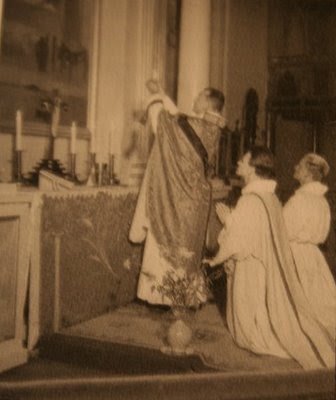
Fr. Gunnar Rosendal celebrating mass.
The following is the continuation of “The Office,” the third chapter in Fr. Gunnar Rosendal’s 1956 book Vårt Katolska Arv (Our Catholic Inheritance), translated by the Rev. Roy Axel Coats of the Lutheran Church of the Redeemer in Baltimore. You can read the first installment here, and the second here.
The Priest
Once upon a time, I stood at the altar in Trelleborg's church together with Axel Malmberg, who is now the vicar in Klippan, and he greeted the congregation with the ordinary liturgical salutation: “The Lord be with you.” It was a situation that I had often experienced before and never thought anything about, but this time the question came to me: “Shall I answer with the congregation? Shall I answer with the words ‘With you also the Lord ’, [trans. note: the traditional response in the salutation in Sweden is Med dig vare ock Herren] or am I one liturgical person with the other priest at the altar, so that instead I should receive with my brother in the office the congregation's response.” Then the question arose in my mind of a deacon and celebrant. These were not at all question regarding ceremonies. There is probably just as much ceremony, just as much splendor, with two priests in identical chasubles [mässhakar - trans. note: Often in the Church of Sweden when there were two priests at the altar they would all wear matching chasubles.] as one priest in a chasuble and one of his assistants in surplice [röklin] and stole. But it was a matter of consequence. There must be consistency in church action, the liturgy must be logically structured, otherwise it nullifies its inherent meaning and proclamation. It was actually from that experience that much of my liturgical rambles and investigations had their starting point.
And now, many years later, I have been faced with the same desire <143> for consistency in a completely different context. This time the question is as follows: "If ordination is a Sacrament, if the Office is the Office of the PRIEST, how can it be that the Bishop has the fullness of the Office?" This is where Tom G. A. Hardt comes in. He taught me by putting the appropriate literature in my hands to formulate the question more precisely: "Is the consecration of a bishop [biskopsvigningen] a Sacrament?"
The complex of problems that this question brings to the fore is extremely serious. It seems to nullify and destroy the whole solid foundation laid in the preceding section. And if the truth demands it, it also must be exploded. Because the demand for truth overrides everything else. Although the foundation is laid with solid blocks from the Augsburg Confession, we must undoubtedly blow it up, if the truth demands it. There is no choice. On the other hand, it is sensible not to rush into danger which I naturally like to do. May we therefore impose upon ourselves an asceticism of patience and look at the matter calmly and comprehensively.
So I received from my Stockholm friend after a lecture in the KGF in Stockholm an issue of Nouvelle Revue Théologique. It was number four in 1954. There was one article by a Jesuit father named J. Beyer [trans. note: Fr. Jean Baptiste Beyer, S.J., (1914–2002) was a Belgian professor of moral theology and canon law who taught at Louvain and then the Gregorianum in Rome.] on the subject of “Nature et Position du Sacerdoce” — the nature and position of the priesthood. [trans. note: NRT 76-4 (1954), pp. 356–373, continued in the next issue, NRT 76-5 (1954), pp. 469–480.] A little later I received from Una Sancta, the famous ecumenical association in Germany, its periodical of the same name, and there was an article on almost the same subject, which was entitled “Die Stellung des Laien in der Kirche.” The last article highlighted the subject, but did not address it. It spoke of the fatal division into laymen and priests, and emphasized the Catholic doctrine of the universal priesthood, which the Church kat’olon has always embraced. This article talked about lay preaching and lay confession in the Middle Ages and many other interesting things. It thus became a component of the whole study of the Office of some importance in understanding the article in the Nouvelle Revue Théologique, but it shall not <144> be further discussed here. However, the French article should be further discussed. Then everyone has to judge for themselves. At least this much everyone must admit, that the matter is not quite as simple as we often thought.
The question is, then, whether there are three degrees of sacramental nature in the Ministry: deacon, priest and bishop, or whether there are only two, namely deacon and priest. Is the ordination of a deacon a Sacrament, is the ordination of a bishop a Sacrament? Or is only the ordination of a priest a Sacrament?
I now follow this article in the Nouvelle Revue Théologique, which I look at with much eagerness for closer study. We must create a theology of the Office in the Church of Sweden, and here is an interesting starting point. Just as old Herrmann [trans. note: Johann Georg Wilhelm Herrmann (1846–1922), German Lutheran Neo-Kantian professor of theology at Marburg] in his time explained in a rather snooty manner to Gustaf Aulén, [trans. note: Bishop Gustaf Emanuel Hildebrand Aulén (1879–1977) was a professor of dogmatics at Lund University and then in 1933 became the bishop of the Diocese of Strängnäs] when he was a docent in Uppsala, that in Germany they did not have time to deal with such bagatelles as the Church in theology, so for a long time in Sweden they rejected a theological treatment of the Office, perhaps not so much with snootiness as with an irritated fear of waking a sleeping bear. They thought that it was better to be as silent as death, because if we start talking, unpleasant truths would always emerge. These pages do not contain the last word, not even the first, but they possibly humbly prepare a theological beginning for developing a theology of the Office.
Fr. Beyer goes to Thomas Aquinas and Peter Lombard and finds that with them there is no thought of episcopal ordination as a Sacrament. From his review of various instances, it seems to be common, both in the past and in our day, that episcopal consecration is not considered a Sacrament. The priestly ability or power is ontologically exactly the same in the bishop and the priest. The priest can do everything a bishop can do, but in the Roman Church he may not confirm or ordain priests. However, according to Beyer's presentation, this seems to be more a matter of how things were regulated than an ontologically necessary relation. He points to the fact that Pius XII on September 14, <145> 1946 issued permission so that every vicar in his parish may confirm those who, in danger of death, wish to be confirmed. This permission is of course interesting as an elucidation of the question, of which we previously spoke, of whether a priest or bishop may confirm. But it is even more interesting to see that the priest really, by virtue of his ordination, has the ability to confirm, even if he does not have the right to do so. Thus, he is no different in his essence, ontologically, from the bishop. Whether he is allowed to confirm or not, that is a jurisdictional question, a church law question, a question of regulation. It is clear that the priest CAN confirm, and that he received this ability with his ordination, otherwise a permission to confirm would be pointless and unreasonable. Beyer says: “We must draw the conclusion that these interventions by the ecclesiastical authority are nothing more than a regulation of the exercise of the power which the priests have received through their ordination.” Such a concession by the Pope is technically called an indult.
And now it appears that the Pope has on various occasions given such indults not only regarding the question of confirmation but also when it came to ordination. There are papal permissions for priests to ordain both deacons and priests. It must mean that the priest himself, through his ordination, has the ability (förmågan) or the power (kraft) or the potency (makt), or however you want to express it, to ordain, even though he is prevented by ecclesiastical law and discipline from making use and exercising it. It is not the case that the Bishop, through his ordination, gets an ability or power that the priest does not have, the Bishop only gets such a position through his episcopal ordination, that he can exercise his ordination ability, which he already received in his priestly ordination. It is thus about regulation, not ontology.
Here I will now mention some picturesque cases of such papal indults. There rests an ancient atmosphere over them, but they are filled with a completely lively vitality, relevant even today, and one senses the indescribable charm of the Church's timelessness and eternal youth. <146>
Pope Innocent VIII granted the abbot of Citeau, Jean de Cirey (1476–1501), the right to ordain subdeacons and deacons among all his spiritual subordinates, and the same privilege was granted by this pope to the abbots of Ferté, Pontigny, Clairvaux, and Morimond. But there are even older such permissions. The permission to confirm has always been liberally given to priests in the Roman Church until our time. The priest always confirms in the Orthodox Churches.
A rather remarkable bull is the Sacrae religionis, which Boniface IX issued on February 1, 1400. In this bull he gives the abbot of the Augustinians in St Osith Cloister in Essex not only permission to ordain deacons and subdeacons, but also the right to ordain priests, and this right is given without time limit. Now the Bishop of London objected. He cited the so-called Gratian decree, in which the abbots are forbidden, among other things, to visit the sick, administer the anointing, sing public Masses, consecrate altars, and ordain priests. The Bishop of London does not say a word that the Abbot of St. Osith did not have the ability or power to ordain priests. He only states a given rule. The abbot could, of course, sing a Mass, but it was a matter of the rule that he was not allowed to do that. It was the same way with priestly ordination. It was a privilege that the bishop of the diocese had, and regarding that privilege the abbot was not allowed to make any claims. To avoid a dispute with the Bishop of London, Rome revoked the bull after three years, on February 6, 1403. But the consecrations that took place did not become invalid. No theological error is admitted. The whole thing was a political question about peace in the Church.
Pope Martin V gave the Cistercian abbot of Altezellen in Saxony the right to ordain to all degrees, including the priesthood. The bull by which this indult is given has recently been discovered. Its authenticity has not been disputed by anyone.
But even if we have no more authentic documents for such indults, we do have extraordinarily tangible declarations of similar rights, announced at various <147> times. Vasques states in his 1620 Disputationes on St. Thomas’ Summa, that similar rights were given to Benedictine abbots and Franciscan missionaries in India. There are other instances, and those who investigated this matter believe that it is likely that more facts will eventually come to light, which show how often such pardons have been granted. And this permission has not been abolished by the Tridentinum. It still applies today.
Indeed, it is even confirmed. Rome now has its Canon 951 in the Roman Canon Law, where these historical events were codified and given legal validity. In the Roman Church, a priest can ordain a priest, if he has the consent of the Church. It is rumored that this canon shall be used in Russia, where, if it happens, a Roman priest could then ordain another priest. [trans. note: From the Codex Iuris Canonici of 1917 (1917 CIC 951), Chapter 1: On the Minister of Sacred Ordination: “The ordinary minister of sacred ordination is a consecrated Bishop; the extraordinary [minister is one who], although lacking episcopal character, either by law or by special adult of the Apostolic See takes up the power of conferring certain orders.” See 1983 CIC 1012 where this canon was changed so as to limit the minister of sacred ordination to consecrated bishops.]
All of this is quite astonishing. I have said it as sober and understated manner as I could, without any thought of its effect. I have believed that the facts themselves are so captivating that any attempt to spice them up in the presentation would be a little tasteless. All this in itself is quite astonishing. This means that the office of the priest is really the office of the PRIEST, that the priest has the office in its fullness, that the priest, with the consent of the Church and on her behalf, can continue the office. The bishop is, as Beyer very rightly points out, only a higher degree, a higher honor or dignity, in the Office.
It has also been suggested for investigation whether a priests may have ordained priests before Nicaea, which was then not allowed to happen without a special indult. Einar Molland would then have presented a completely normal procedure, as he assumes that St. Irenaeus was not consecrated by the Bishop to the Bishop of Lyon. It is a fascinating question, but much remains to be investigated before we can say anything that has the slightest whiff of certainty in it.
Is this order, as described here, Catholic? It is impossible for me to say. Whether such or similar cases occurred <148> in the Churches of the East is unknown to me and it is important to know if this is the case when talking about the Church's kat’olon. Some signs point to a similar procedure during a certain period in Alexandria, but it would take too long to examine these instances more closely here. Here it must be sufficient to emphasize that such a prominent contemporary theologian as Fr. Congar, O.P., [trans. note: Fr. Yves Marie-Joseph Conger, O.P. (1904–1995), was a professor of fundamental theology at Le Saulchoir in France. He was noted as an ecumenist.] in the treatment of these ordinations, performed by priests, says that if the Church did this, she could rightly have done it. And of course, the indult has always been looked at that way. They have not been regarded as something separatistic, as a sectarian act, as something un-Catholic. Nor has anyone claimed that they were uncatholic. But the question is, whether this has not happened among the Anglicans. Dr. Jalland, [trans. note: Rev. Trevor Gervase Jalland, D.D. (1898–1975), Vicar of St. Thomas the Martyr, Oxford and then lecturer in Theology at the University College of the South West in Exeter.] the famous specialist in the question of succession, known from his distinguished essay in The Apostolic Ministry, [trans. note: Jalland’s essay in The Apostolic Ministry: Essays on the History and the Doctrine of Episcopacy, prepared by the Rt. Rev. Kenneth E. Kirk, was entitled: “The Doctrine of Parity of Ministers.”] would well object and say that Rome has degenerated and allowed a degeneration in the theology of the Office. My highly valued and dear friend, Professor Fairewaether at Holy Trinity College in Toronto, who recently wrote a book about and against the Cambridge theologians' collection “The historic Episcopate”, has vigorously emphasized that the concentration of all power in the hands of the Pope, already in the Middle Ages and even more so in our time after 1871, when all bishops turned into "the Pope's adjutants", and that Rome therefore has a completely corrupted the theology of the office and that one has no reason to be astonished if one finds Presbyterianism in Rome. But I cannot be completely convinced that this is simply true and correct. What is certain is that in many post- reformation practices, people have acted exactly as Rome acted in its indult. And our commentaries and theological treatises, above all the Smalcald Articles, contain much that bears a marked likeness to Canon 951. We arrive at an extremely controversial issue. It is clear that the episcopal line has been increasingly underlined in the contemporary ecumenical debate. But no matter how much you love that line, and I myself do so with all <149> my heart, one cannot close one's eyes to the facts that have been produced here. Beyer says, “The theologian must accept these facts.” And that is exactly what we must do. What shall we do with them? For one thing, we can wait and be patient, it is not necessary to be finished with one's estimation immediately. As long as you do not seek evasions or vague claims or try to wave the problems away with superiority, it is all right if you have to say, “I do not know for certain that what we have here is right." No one has the obligation to know everything. But everyone has a duty to clearly confess their limitation and ignorance, thereby promoting clarity and truth. But in addition to that, we can of course try to get an overview of the situation. We will begin with that task in the next section.
The remainder of the chapter will be published in a final installment: “Bishop and Priest.”