

"Dignified Worship Centered on the Cross of Christ"

Why do some entrepreneurs and businessmen debase themselves? Why would a grown man put on a chicken suit, or go on late night TV waving his arms about ranting (yet again) that “everything must go”? Why do lawyers put up sleazy and lurid billboards?
Because it works!
When you’re selling a product, you may have to cut through the clutter to get your potential customer’s attention. And as P. T. Barnum famously quipped, “There’s a sucker born every minute.” Some customers would prefer to be sold based on the quality of the product, but in the world of marketing, there are always suckers who are swayed by gorilla suits and bikinis (though hopefully the twain shall not meet). Every now and then this strategy backfires, as in the case of Bud Lite. While scantily-clad women may sell beer, most drinkers of “Lutheran beverages” are not interested in seeing Dylan Mulvaney in swimware (ELCA and some LCMS folks excepted).
But when it comes to drumming up business for oneself, gimmicks and undignified self-abasement can be an effective tool for capturing market share. They wouldn’t do it if it didn’t work. It is practical, and its “success” is measurable.
Of course, it destroys the reputations of others in the same field. Most entrepreneurs understand that to sell a product one must actually serve his customers with quality. Goofiness, gimmicks, and gorilla suits can only go so far. Most lawyers aren’t the unctuous ambulance-chasers shouting their 800 numbers and promises of getting rich on late night TV. But there they are: those who are willing to do whatever it takes to increase their customer base and draw attention to themselves. And what it does to the reputations of others is the last thing on their minds.
The Rev. Walt Kallestad was one of the fathers of the church growth movement. He was also a Lutheran pastor. He agreed with the premise of the Rev. David Luecke that we could combine Lutheran doctrine with Evangelical style to bring more people into the church. He saw the large numbers of people attending professional sporting events on Sunday, and wanted to see those kinds of numbers in church. He became an entrepreneur of sorts, ditching the liturgy and mothballing the organ in favor of, what he openly called “entertainment evangelism” (and his 1996 book of the same name is quite the read). In fact, all of his books and blubs were filled with numberlust and hype, being the “pastor of the fastest growing” blah blah blah, the “x-thousand member church,” where x is an ever-increasing number.
From the introduction:
“What most churches do on Sunday morning is not working,” wrote Rev. Walt Kallestad. “On the other hand, entertainment oriented churches are growing.” Kallestad, whose Lutheran church is known as Community Church of Joy, reaches a Sunday morning congregation of nearly 3,000 by using this entertainment approach. “We may have a stage band, a comedian, clowns, drama, mini-concerts, and other entertainment forms,” he said in his column.
More about Pastor Kallestad and his congregation - which today boasts a weekly attendance of 22,000 - later. It is truly an American success story that the church growth guys in the LCMS have clearly missed out on.
In 2025, we have a cadre of LCMS pastors and congregations that have embraced the same view as Pastor Kallestad, and among (Neo-)Evangelical churches, what was once rare and exotic has become rather normalized. Here is a service from last year from Prestonwood Baptist Church.
None of our biggest, fastest-growing, and most successful LCMS congregations have gotten here yet.
But we do have a cadre of pastors and congregations that are all-in in the LCMS. In fact, the Rev. Zach Zehnder of King of Kings in Omaha is a big believer in what others call “gimmicks.” In this own words, “I had the privilege to lead the fastest-growing church in any mainline denomination in the 2010s.” He says:
Some people have called things like my world record speech or helicopter egg drops as gimmicks. Truthfully, I didn't care. And I still don't care. Jesus said it's our responsibility to let our light shine for the world. And if through these gimmicks, I can preach the good news of Jesus for 53 hours with the promise that every time his word goes out, it doesn't return void. And if on top of this, we can raise money for a charity. And if we can provide a great family event in a time of great disconnection and some excitement, some candy, some helicopters, something the kids love that families want to share. And ultimately through it all, more people get connected to our church and to Jesus. Then put me on the list to sign me up for more gimmicks.
Pastor Zehnder does not officiate over this level of gimmickry every week, but his congregation’s services are, well, you can watch for yourself.
And yes, as he said in his own words, he “doesn’t care.” He is concerned about growing his own franchise, and what it does to our reputations doesn’t matter to him, like the smarmy lawyer bringing disrepute upon the legal profession, or the unctuous businessman who makes ordinary people appalled and jaded when they hear a salesman speaking. Pastor Zehnder uses the LCMS label, but doesn’t walk with us. His congregation doesn’t use the hymnal. It doesn’t use our 500-year corpus of hymnody. It doesn’t use the Western Mass to which Pastor Zehnder committed himself at his ordination. It doesn’t recognize the fact that we are in fellowship with members of other LCMS congregations and our international church partners, opting instead to practice a form of fellowship that doesn’t walk with us or our sister church bodies.
Other than nostalgia, I don’t see why Pastor Zehnder and King of Kings remain as members of synod. And other than money, I don’t understand why the district wants this congregation to taint the rest of us.
And even by their own metric, entertainment worship is cashing in now, but having a negative effect on future members. By their own admission, our church growth gurus admit that the young are seeking after traditional forms of worship. And I can confirm this trend. I teach high school students, both confessional Lutherans at Wittenberg Academy, and cadets of every background in Civil Air Patrol. Their generation is more traditionalist, more conservative, and more cynical toward being manipulated by marketing.
I really love hanging out with them. Not only because they don’t regale me with the latest unpronounceable pharmaceutical products, technical details about their body parts, nor the follies of their latest colonoscopies or catheter removals. I’m with Taki Theodoracopulos :
Avoiding bores is a lifelong pursuit of mine, because one bore is equivalent to three fun ones, and three bores can ruin a party of thirty. Women embalmed with Botox are bores by definition, and as my friend Michael Mailer recently pointed out, we had a lady for drinks whose last frown was registered 25 years ago. I also try to avoid men who have grown soft and feminized and were shaped by computers, movies, and rap music. Bores can be dangerous to one’s health, but even bores will run for their lives when confronted by the woman who recently wrote an article in an American neo-con monthly about what really happens to trousers that don’t fit and are returned. Seriously. People my age tend to be boring because they talk about health or lack thereof, hence I invite only the young.
Another advantage of hanging out with the young is that they know when they are being played. They resent it, and they are looking for the objective truth, for something transcendent and timeless - something you won’t get in Christianity outside of the reverence one finds in the timeless, transcendent liturgy.
Maybe I see myself in decades past in these young people. For I was baptized and became an LCMS confessional Lutheran at the age of 18. I was raised Baptist (and this was well before the guitars and drums and flying drummer boys became a thing). We had not-so-great hymns, no liturgy to speak of, and no sacraments - but we took the Bible seriously, and I learned about Jesus and the Gospel. But after four years of Roman Catholic high school, I learned to appreciate what I was missing: the history of the church, the sacraments, and the liturgy (which grows out of the sacraments).
I took my long-haired leather-jackeded blue-jeaned self on my motorcycle to the local LCMS church, and asked the pastor, “What do Lutherans believe?” He gave me the Augsburg Confession. I visited the Divine Service. I was catechized, baptized, confirmed, and took first communion within a few months. Our parish was “low church bronze.” The pastors didn’t chant. They were vested in alb and stole. We had no chalice. But we had a wonderful organ, The Lutheran Hymnal in the pews, and the best hymns in Christendom! We had solid preaching, and a confession - like the Baptists - that the Bible is inerrant. Though it leaned modern, we had an altar, a font, and a pulpit. There was no drum kit, no guitars. We had the Real Presence, and even without a lot of ceremony, the celebrants were reverent. I recognized the service as the Mass - only with improvements over Rome’s version. In the narthex, there was a tract on the Lutheran liturgy that described it as "dignified worship centered on the cross of Christ.” And, of course, that dignity comes from our Lord.
Not long after I became a Lutheran, the newer hymnal came out, and it included “This is the Feast.” I don’t think it was wise to equate it with the Gloria in Excelsis, nor am I fond of the non-biblical refrain (which has unfortunately become its title). But the verses of this canticle come from the Book of Revelation. It is historically known by its Latin name, Dignus est Agnus. And in that title, we see that Jesus is the Lamb, and that He is worthy, He has dignity - and thus our worship should be centered on the Lamb and be carried out with joyful and reverent dignity. The Augsburg Confession and the Mass is what I believed, and I had found my heavenly home in the Divine Service.
Even though the speakers on my bike were typically blaring out Aerosmith, Van Halen, and AC/DC, had that Lutheran church that I first visited been King of Kings or another one of our Entertainment Worship Centers, the last that I would have seen of that, or any other Lutheran church, would have been in the rearview mirror of my Suzuki. I would have probably gone to the Anglican Catholic Church next (and, by the way, they have zero “contemporary worship”).
And this is a number that the church-growthers haven’t crunched, because it is immeasurable: visitors whom have we lost because they were looking for reverence and transcendence only to find a clown-show. For we have something today that my teenage self didn’t have in the eighties: the Internet. How many young people google “Lutheran” and come up with either an ELCA witch coven, or an LCMS variety show? And how many of those people make their way to the Eastern Orthodox or Roman Catholic churches - or perhaps to the Anglican Catholic or other continuing Anglican communions? In economics, this is what Frederic Bastiat called “the unseen.” And this is also a demonstration of “the law of unintended consequences.”
Eighteen years after my baptism, I was a seminarian. I was ordained 21 years ago. I celebrate Mass at my parish twice a week. I have never done so (even at my ordination) without genuflecting and elevating. The only times that I have spoken the Words of Institution (as opposed to chanting them) have been those times when I get laryngitis, and there are a couple notes that just won’t come out. But the last time that happened, I found a workaround: I chanted the Lord’s Prayer and the Verba on one note. So there are times when “age and guile” (thank you P.J. O’Rourke) beat out “youth, innocence, and a bad haircut.”
So why do I chant the Verba, genuflect, elevate, and ring bells? Because I actually believe this stuff. What I read in the Confessions and learned that Lutherans at least say they believe, I believe it. The Holy Sacrament is a miracle of Jesus on the altar. The sanctuary is the throne-room of heaven, and we who attend are in the position of Isaiah in Chapter 6. It is the Gate of Heaven, where the veil is at its thinnest. God Himself breaks through space and time and deigns to be with me, His unworthy servant, and what’s more, He gives me - lowly me - the privilege to officiate over this celebration, speaking His words on His behalf by His command and His authority. I have never forgotten the tract that says: “dignified worship centered on the cross of Christ.” So, no, President Kieschnick, it is not because I am a “Romanist.” Shame on you!
Neo-Evangelical churches who worship in a casual way, or in a way that takes the spotlight off of the Lamb and onto a performer, do so because they don’t believe this stuff. They are non-sacramental. They believe in the Real Absence, that Jesus is far, far away in Heaven, and we are just talking about Him here.
So when Lutherans - who speak “passionately” about “Lutheran doctrine” while being casual at the consecration, sometimes dressed in a costume, rushing through it, or turning it into one more performance of the praise band (even having the singer chant the Verba while the pastor puts on a show) - ape the Real Absence worship of the Evangelicals, at best, they give a confusing witness about what we believe, and at worst, they show contempt for our Lord in His miraculous presence. It’s one thing when our (neo)-Evangelical brethren worship this way (which is consistent with their theology), but when those doing it bear the name “Lutheran” (even when they so often leave that part out) - and when they are LCMS members - it reflects back upon all of us. I cannot just be silent about it in good conscience. And I am not alone. We should not have to live like this. These people are not walking with us. They are stabbing us in the back. If they had integrity, they would do what some of them already have done, and leave the synod, and become non-denominational congregations. We just believe different things.
At best, such pastors lack maturity, wisdom, and discernment. They just refuse to grow up. They are playing at church, and LARPing at being pastors. Can you imagine Moses at the burning bush demanding to be entertained? Can you imagine Isaiah in the heavenly throne-room being casual (and this vision is, of course, where the Sanctus in our liturgy comes from)? In Dr. Eckardt’s Liturgical Observer column in the latest print issue (“The Results Are In: Evangelical Style and Lutheran Substance Are Not Compatible”), he analyzes the “traditional” service of one of these “missional” congregations, only to find that there was no Sanctus at all (nor Kyrie, nor Gloria, nor Creed, nor Preface, nor Proper Preface). Can you imagine the shepherds coming to the manger and goofing off? Can you imagine watching our Lord raise Lazarus from the dead and being flippant about it? Can you imagine standing at the foot of the cross or in the empty tomb and not being reverent? Can you imagine being John and receiving the apocalyptic vision from the angel and trying to get him to high five you, or inviting him to pull your finger?
These pastors who insist on slovenliness, casualness, or buffoonery at the consecration and in the Divine Service either don’t believe what they say they believe, or they are incredibly self-unaware. More likely, they are just so consumed with numbers and treating holy things like a marketplace with branding and marketing and monitoring “sales” data that they have lost touch with the very idea of holiness, imitating the “successful” non-sacramental churches around them. Indeed, that’s the best construction for why a pastor would hand out slices of pizza in a holy sanctuary.
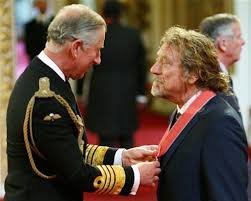
This senseless self-unawareness and lack of reverence isn’t even as bad in the secular world, where there are still threads, however worn, of respect and dignity. When Robert Plant (yes, Robert Plant of Led Zeppelin) was given the title of Commander of the Order of the British Empire (CBE) by then-Prince Charles, he did not show up bare-chested with blue jeans. He did not break out into a spontaneous performance of “Whole Lotta Love.” He wore a suit and followed the protocol, the rubrics, of the ceremony. And so did the prince. There is a time and place for frivolity, for entertaining music, for casual attire - but this is not how one behaves at times when something extraordinary is happening, when reverence is called for. If only our pastors would be so reverent in the extraordinary and miraculous presence of King Jesus!
So when these churches engage in gimmickry, showmanship, irreverence, and non-liturgicalism, when they ape the worship style of churches that have no sacraments - even when it makes them bigger and richer - they are hurting us. But they don’t care. They’re gettin’ while the gettin’ is good. And since they are typically located in fast-growing suburban areas with new subdivisions and lots of middle class white-flight, their numbers will grow whether they open a barber shop, a Taco Bell, or a church. Good for them. And they don’t care what they are doing to us. They demand our acquiescence. They covet our approval and acceptance. Maybe the big question we need to ask is, “Why?” Maybe we should be asking, “Cui bono?” as the classically-trained kids say.
But what about Pastor Kallestad and his successful congregation that exploded from 3,000 to 22,000? Pastor Kallestad, after teaching us that we could be confessionally and faithfully Lutheran while worshiping like Pentecostals, was “lex orandied” right out of Lutheranism. Today, his church is called Dream City Church, and he and his congregation are members of the Assemblies of God. They have replaced the belief in the Real Presence and the efficacy of Sacraments with fake tongue-speaking, and his congregation boasts a number of people being taught falsely that rivals the numbers of a professional sports event, just like the vision that he had cast so many years ago. Now you know the rest of the story.
Maybe that would not have happened if he had shepherded his people with “dignified worship centered on the cross of Christ.”
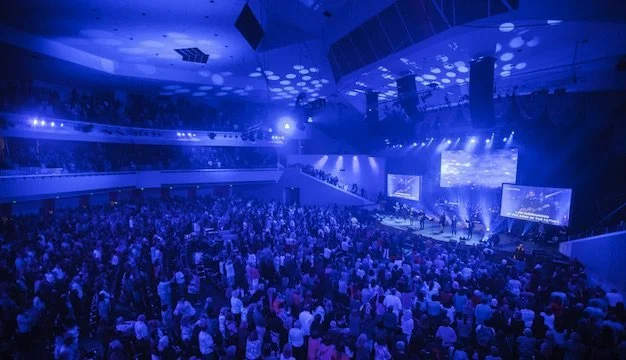
Dream City Church