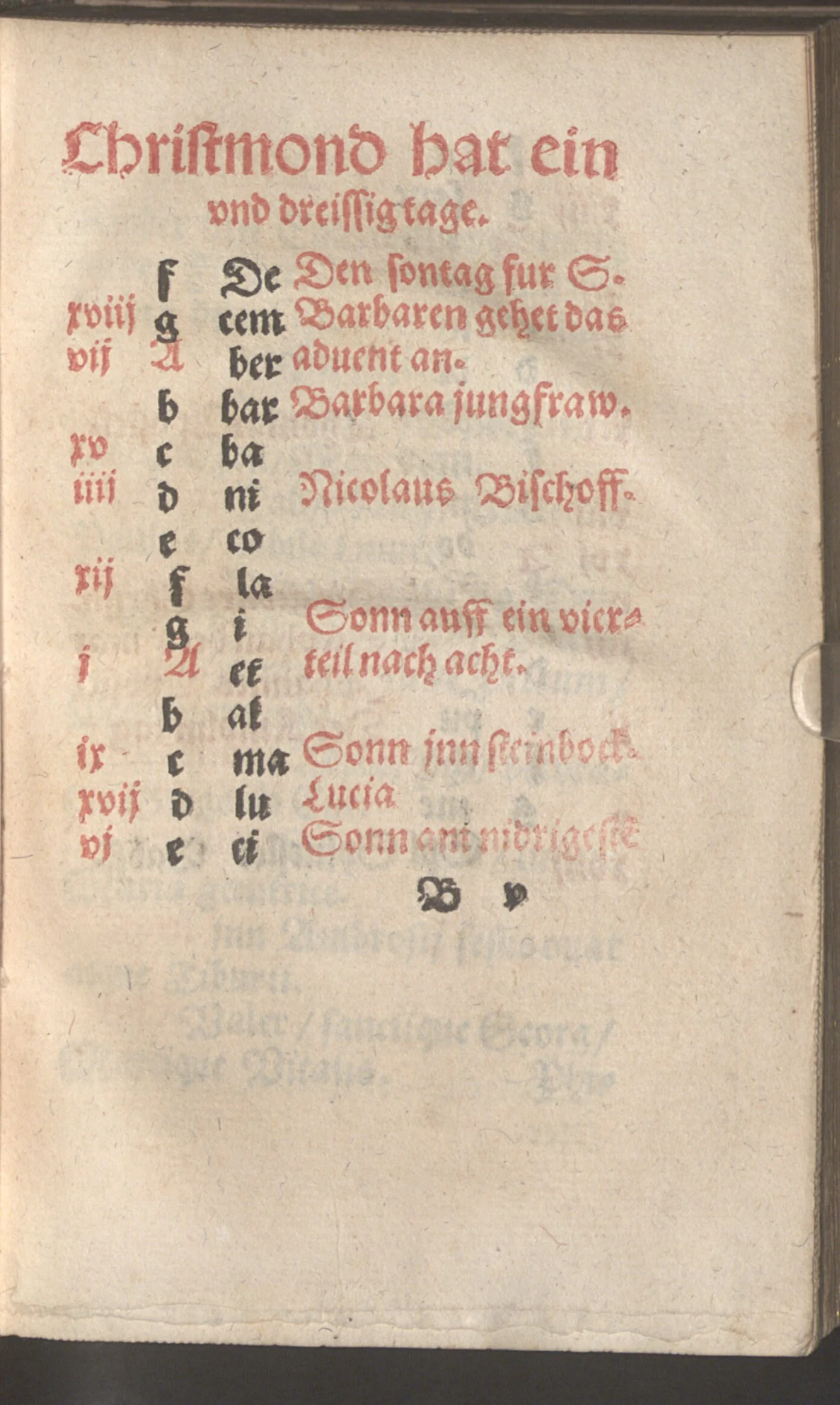
This year has seen the appearance of at least two new Advent calendars in Lutheran circles, both of which are well worth your time.
The first will make a welcome addition to the Advent routine of any language enthusiast.
Read More
A blog of the Evangelical Lutheran Liturgy
This year has seen the appearance of at least two new Advent calendars in Lutheran circles, both of which are well worth your time.
The first will make a welcome addition to the Advent routine of any language enthusiast.
Read MoreFor free download. Check it out!
Read MoreShortly before Luther’s death, Johann Spangenberg, an early supporter of the Reformation and pastor at Nordhausen, wrote the following in his 1545 commentary Der Apostel Geschichte: Kurtze auszlegung—Für die jungen Christen, in Frage verfasset (pg. 190): “Dear friends, do you imagine that it causes no anguish to a preacher when he learns that within his own congregation, among the very sheep entrusted to his care, there are found open blasphemers, usurers, idle swindlers, misers, adulterers, profligate drunkards, and similar scoundrels? Have you not heard what God declared to the prophet: that He will require their blood at the hands of those who failed to preach and punish their sin?” Here Spangenberg alludes to Ezekiel 3:18, 20 and 33:6, 8, where the Lord warns His shepherds that they will be severely judged if they neglect to lead their flock according to His law and truth. Notably, in this brief catalog of scandalous sins demanding pastoral attention in 1545, Spangenberg includes usury. Perhaps he was inspired by Luther’s words half a decade prior in his public admonition to brother pastors.
Read MoreIt is not a mistake or a sin to act on one’s beliefs. Our actions flow from our beliefs. My Baptist friends and brothers in Christ who don’t officiate over the Lord’s Supper the way I do are not making a mistake. They are acting on their sincerely-held beliefs. And if you don’t believe in the sacred mystery of the Holy Eucharist, if you believe the elements are only symbolic - you will simply act differently than we who do. The sanctuary will also look different.
Read MoreDo I have your attention? Outstanding. She knew the scriptures better than you. She prayed more than you. She fasted harder than you. Which means she was more of a man than you. Something is wrong with that.
There is a time for everything and now is the time to fix that. Now is the time to fast. Our Lord has called us to fasting—especially while the bridegroom has ascended to heaven (Matt 6:16-18; Mark 9:29; Luke 5:35). Our prophets have called us to repent with fasting and to do so in the right spirit (Joel 2; Is. 58). Fr. Eckardt has taught us about the Lenten fast. Fr. Petersen has taught us about the Advent fast. Fr. Braden has taught us about the Ember Days Fast. The Apology has taught us that “We should undertake these exercises not because they are devotional exercises that justify but as restraints on our flesh, lest satiety overcome us and render us complacent and lazy. And that haec diligentia debet esse perpetua” (AP XV.47).
Read MorePlato records the argument of Socrates that writing things down would harm, not help, the memory. Becoming overly dependent on hymnals and printed bulletins for the ordinaries of the Mass is a case in point.
Read MoreI had the opportunity to sit down with the Rev. Bryan Stecker, host of the podcast On the Line (OTL) back in July, and the episode dropped earlier this week. OTL features a wide range of guests, both Lutheran and from many other traditions, with recent episodes covering C.S. Lewis and J.R.R. Tolkien, Mormonism, infant Baptism, artificial intelligence, and much, much more. Many of the guests will be familiar names to readers of this blog, and many will be less familiar, but all will be thoroughly interesting.
Read MoreThis kind of thing is inevitable once the substance of reverence is removed from a place of worship and replaced by the style of the world.
Read MoreThroughout the past century or so, several references to usury in Luther’s works have been put forward as evidence that the reformer actually did permit certain interest rates on loans. The first such reference appears in a June 18, 1524 letter to John Frederick I, son of John the Steadfast (WA, Br 3: 305–8). The difficulty, however, is that some interpreters have thoroughly misconstrued what Luther is actually addressing in this correspondence. In the letter, Luther is speaking chiefly of Zinskauf, rather than interest-bearing loans. Moreover, what he says here is precisely what he had already affirmed in his Long Sermon on Usury, which was republished in Trade and Usury the same year that this letter was penned. The following is a translation of the pertinent section of the letter, rendered with due regard for both its context and the proper understanding of the business of rental-income purchases (pg. 307).
Read MoreThe daily liturgical calendar for the upcoming year has been made available from The Lutheran Missal. It is available in two forms, the first in a Google Sheet with readings noted, easy for pastors and musicians to copy and adapt for their service planning purposes, to print for a ready reference, or to distribute to altar guilds for their use. The readings listed are for the mass, not the daily office, though one could also use them for that purpose if desired. The TLM calendar is also available in a Google Calendar format for ready and easy access on one’s computer or other devices.
Read MoreHere (within the link) is a well-done reflection upon why liturgical formality is preferable to casualness in worship.
Read MoreMan alone, out of all God’s creatures, stands erect, for man alone is made in God’s image.
Read MoreWhy all people, Christian or not, should want Christian leaders.
Read MoreThe Reformation is supposed to be all about the militancy of a confessional faith! It’s about Luther boldly retorting to the emperor, Here I stand!
Read MoreA popular sentiment in our divided synod is that the problem is “lack of trust.” But that is not the problem. That is rather a symptom of the problem.
Read MoreIn response to my contribution to the discussion, a Roman Catholic traditionalist dismissed me as a “heretic” and included a “quote” from Martin Luther - authoritatively presented by means of a meme, complete with a portrait of Luther, no less (who can argue with that?) - in which Luther is attributed with the following quote: “I am absolutely convinced that the handicapped are merely demonically possessed pieces of meat without souls which should be drowned.”
Read More