

The ULC In Their Own Words
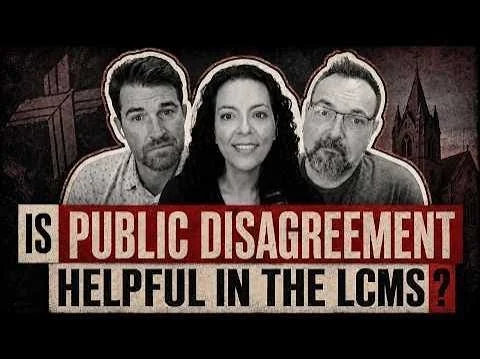
Unite Leadership Collective is an organization that seeks change within the LCMS. They are open about it. Through their communications - mainly their podcasts Lead Time and The Tim Ahlman Podcast - they have identified several areas where they believe the LCMS should - if not must - change.
They believe that we need to reform the way we train and form pastors. They believe that in addition to our residential seminary formation, we need to expand the SMP program, and also look to other alternatives, such as an online MDiv option. They also believe that we all need to be open to, and accept, “contemporary” and “modern” worship forms and music, and see it as just as authentically Lutheran as the traditional Divine Service and hymns. They also believe that we need to increase the role of the laity - including women - in the leadership of the church, based on the Priesthood of All Believers.
While the faces of ULC are the Rev. Dr. Tim Ahlman (pastor of Christ Greenfield Church) and Mr. Jack Kalleberg (Christ Greenfield’s executive director), ULC’s director is Mrs. Tania Hilton. She is also the editor of ULC’s newsletter “The LCMS Current.” She has an MDiv degree, is pursuing her Doctor of Ministry degree, and is a biblical counselor.
The podcasters Dr. Ahlman and Mr. Kalleberg interviewed Mrs. Hilton on a recent episode of their Lead Time podcast.
This was a helpful look into the ULC and their worldview in their own words. ULC’s director explains that her vision of the LCMS includes an MDiv option (not leading to ordination) for both men and women. It is a curious desire, especially given that she holds an MDiv herself. The MDiv is not an academic, but rather a vocational, degree. Our seminaries currently offer MA degrees that don’t lead to ordination for both men and women. Deaconess students receive such an MA. Anyone is welcome to pursue the MA. The MDiv is specifically designed to train pastors. It includes field education, two years of pastoral fieldwork, a one year vicarage that is a pastoral internship to prepare a man (or in some churches, women) for pastoral ministry. It also includes coursework in homiletics (preaching) and pastoral care. The MDiv not only covers the theology of worship, but also instruction in how to conduct the Lutheran liturgy. The MA program doesn’t involve these things unique to the pastoral office. Mrs. Hilton doesn’t explain why she believes an MDiv for men and women is needed in the church in addition to our MA program that we already have. Nor did she mention her own MDiv degree, why she chose the MDiv, nor that she recently earned her MDiv from Luther House of Study - whose CEO is a lady “pastor.”
She explains, in a recent article for the Luther House of Study, that ULC continues to partner with Luther House of Studies:
We do leadership development training for churches, mostly in a Lutheran context, and then we teach leadership development through Luther House of Study—we have a leadership development class and a missions class. We’re very passionate about pastoral formation. There are so many churches that need pastors, so we want to help create alternative pathways for equipping leaders. But at the heart of it, the ULC is equipping the priesthood of all believers. We believe that every congregation member, every lay leader, any Christian is the priesthood of all believers, and we want to fully equip them so that they can go out and do whatever God’s work is in their life, whether that’s in ministry or in their vocation.
While Mrs. Hilton is clear that she does not favor women’s ordination, she went on to explain (in the above video) that the impetus for her own theological studies was being frustrated that a laywoman could not consecrate the Lord’s Supper or preach at a women’s retreat.
Let me give you a little bit of background on this. I went to a women’s retreat several years ago, about three years ago, and and we wanted to have communion, and they said no, we can’t have communion. We don’t have a pastor, can’t come, so we can’t do it. And I was like, that is such a shame that we can’t experience the grace that’s given for us every single day. We can’t experience this right now because there’s not a male pastor that’s able to come. And that was when I first started getting into wanting to to broaden my theology. And so I think that women should be equipped just like male pastors to be able to preach in women’s conferences, Bible studies for women, women’s prisons. There’s so many contexts where women should be equipped, fully equipped, and I think the Masters of Divinity program would be amazing for that. So I don’t understand why we don’t do that.
Dr. Ahlman, whom I believe is Mrs. Hilton’s pastor, replied:
The Lord’s Supper is very intimately connected to the office of holy ministry. The LCMS has a history of emergency situations, right? And then this is always a debate: is that retreat an emergency situation that one of our female leaders should be able to? Because maybe no one’s confusing that she’s the pastor there in that space. I think it’s preferable that a pastor is there. But baptism and the Lord’s supper, there have been these emergency cases, and we kind of go back and forth on that a little bit. Obviously, in the LCMS, you know there are very strong views, I would say to put women down, and I do not think that means be in the home, don’t work, don’t speak, or even vote in in the congregation. And I am not a fan of that at all, and I have biblical examples for where women, obviously, the first evangelist of the resurrection is Mary Magdalene, right? So there are numerous places where women can teach you. I see. I think if we were to, so, to round back, I agree with you. I think we should have some sort of a leadership theology degree for men and women, that leads toward being a deacon or a deaconess in the church.
Mr. Kalleberg added his thoughts:
Yeah, I agree. You know, in my particular case, I’m very interested in seeing the formation of the executive director role in the church. In the non-denom world, they call that an executive pastor, but it could, or it might or might not be, a person that needs to be ordained, because it’s very much a strategic administrative role. I don’t have to get up and preach to be able to do the job that I’m doing, and so thinking of it in terms of like an executive deacon is a really great way to do that. So, you know, what do you want for that type of role? I go back to Acts chapter six. They’re looking for people filled with wisdom and spirit. So to me, that means that there’s a strong theological training that goes with it, but also very much a strong administrative and practical leadership, strategic leadership part of that as well. So that’s a big vision that I have for our church. I’m, you know, I’m leaning into it personally, and you know the goal is to develop. You know, keep your eye on the horizon here because the future will be creating cohorts specifically for that hosted by the ULC. But that’s a big thing that I’m championing for. It seems like we retreated from deacons, maybe because deacons became something more than maybe if you just looked at what the biblical definition of it was, and it was really pastors, maybe that was the reason for doing that. But I do think that as a national church body, we need to address the need to embrace the role of deacon and deaconess, and do that in a way that says both men and women can play in this field, and doesn’t downplay the role of women. Now, in terms of women in general, this is very important.
Women are part of the entire priesthood of all believers, at least half of them, right? Right. And so, again, the role and the voice of women, in my opinion, is extremely important. Needs to be elevated, and I do believe that our national and local church bodies need to be equipping women to enter into quote unquote their priestly role, which, read Luther, is sharing the gospel with people and praying for them at a very minimal, right? This is the role of every single priest, and there’s no gender distinction on that, right? Just like there was no gender distinction on the deacon and the word for deacon in the Bible wasn’t a gendered word and it was applied to men and women, right? So yeah, I think we we need to be very careful about marginalizing the role of women, even as we honor the the male leadership in the role of the pastor. It’s very easy to kind of apply a type of we did recently a podcast about how certain things an adiaphora can lead to through humanistic thinking into forms of justification. Right, so are we justified because we have you know a male doing this role and a woman doing this role? You know, no, I think it’s good for good order of the church, but you have to be very careful about marginalizing people and and actually disrespecting their role as the priesthood of the church.
Mrs. Hilton replied:
Yeah, I was doing some light reading in Luther. Luther’s, some of his. I remember when I first started studying. One of the things that caught my eye was that Luther mentioned that the sacraments, even remission of guilt is not something that should be held for just the bishop and/or the pope. It should be something, and he does even go on to say anybody, every Christian whatsoever, should be able to do this, even a woman and a child. Like he made a point to specify that this isn’t his response to the papal bull, and then in his letter to the Christian nobilities, the Germans, he again he doubled down and said, Yes, even children and women could baptize. And so I think sometimes, and again, there is tremendous respect for the organization, the LCMS, because I know that there’s going to be comments to be like, You need to just leave, become ELCA, whatever. It’s like, okay, but I think sometimes we forget our Lutheran roots that Luther argued against authority often when he saw something that he didn’t think was right, and I don’t think it takes away from the call to be a pastor in a church, the the call that’s given from the congregation to the male pastor by equipping men and women to do other things within their context. I think sometimes we get so stuck in, well, this is a pastor’s job. That’s the the trap that we fall into, because if we think everything’s a pastor’s job, then you’re not raising up leaders to lead Bible studies, to do home visits and things like that. So I think sometimes maybe we need to go back to our origins and just remember what Luther fought for, and we should be trying to equip every single believer to be able to preach the gospel. When I say preach the gospel in their context, I’m not saying it on Sunday in front of the congregation. But if I have somebody that I’m meeting with that’s broken and that they’re suffering, shouldn’t I be giving them the forgiveness of sins and reminding them how much they’re loved by Christ and how much Christ is for them? I just, it is a disservice to not be able to give somebody who’s broken and suffering, or should I say, Well, hang on a second, let me let me see if the pastor is available to remind you of how much you’re loved by Christ? You know, it just seems silly when we say it out loud. So again, I don’t want this to be misconstrued. Male pastors is something that we honor very closely and dearly in our congregation, and it doesn’t take away from our pastors by equipping the priesthood of all believers to come alongside him and help where they can.
Later on, Pastor Ahlman added:
There are things which I believe the role of a woman in the church. If we can agree, female ordination is not where we’re going. That’s not even what we’re talking about. But what does her role in the life of the church look like? I would say that’s more of an adiaphora in a contextual conversation that needs to take place, so that the priesthood of all believers, like an offense, is offense going to be given? If so, we need to be sensitive to that. And this is where context is like very different too, because like a woman, say reading scripture in a Midwest small rural congregation probably is offensive. Do you know what’s offensive here at Christ Greenfield? If she doesn’t read Scripture, I mean, [if] they’re told they can’t.
I appreciate ULC’s candor and honesty. They are clear about the kind of changes they want to see in the LCMS, and why.