

Ceremonies Teach, and Sesame Street Ruined Christian Worship
I’m being hyperbolic and a bit anachronistic in saying that Sesame Street ruined Christian worship. But only a bit. For Sesame Street started in 1969. And this was five years after the Vatican II novus ordo Mass was implemented in English. So Sesame Street was not the cause of liturgical change, but rather a concurrent change reflected in the zeitgeist, and it continued to transform a lot of things that touch upon education. For as we confess in the Augsburg Confession (24:3), ceremonies are catechetical (lerne/doceant). Vatican II changed the way Roman Catholics - and later, Lutherans - worshiped. And Sesame Street changed education.
Both sought accessibility over and against what was increasingly seen as stodgy and stifling. Songs and skits and puppets made their way into school lessons - and later on, into Christian worship as well. Ritual and tradition gave way to spontaneity and iconoclasm. Formality was relaxed. Nuns traded their wimples for blue jeans and played guitar. Rote recitation was replaced by games.
I was in kindergarten when Sesame Street started. I literally remember my teacher joyfully telling us about it, and sending a note home with our parents. My folks dutifully put the show on that evening. My grade school education was a period of transition, with some teachers still following the old traditional paradigm, and others adopting the novus ordo of Bert and Ernie pedagogy.
Interestingly, my freshman year of high school - at a Jesuit Roman Catholic boys’ school - was the first year that Latin had been discontinued. My Jesuit teachers: priests, who for the most part, ditched the collar, were enthusiastic about the recent Vatican II reforms. Masses in the chapel in the early eighties featured acoustic guitars and then-modern praise songs by the St. Louis Jesuits, with a little Bob Dylan thrown in.
When I started attending the Lutheran church at age 17, our 1941 TLH hymnals still had the names of the Sundays of the church year - and the names of the ordinaries of the Mass - in Latin. We were still singing chorales and hymns with the organ. Sesame Street had not yet made it to my congregation. The St. Louis Jesuits were not part of our Divine Service (though within a few years, we did start with the wretched Chicago Folk Service). At some point, we did start using both the Worship Supplement (published 1969) and LBW - the 1978 ELCA “green weenie” Hymnal - in my congregation. And that did Vatican II things up quite a bit.
When I started seminary at age 36, we still had both TLH and LW (1982) in the pews of Kramer Chapel at CTSFW. We also had Hymnal Supplement ‘98. I was there right after Dr. Reuning’s tenure as dean of the chapel, and right at the beginning of Dr. Just’s term. But it isn’t the ritual in the chapel that I’m reflecting on here, but rather a ceremony in the classroom.
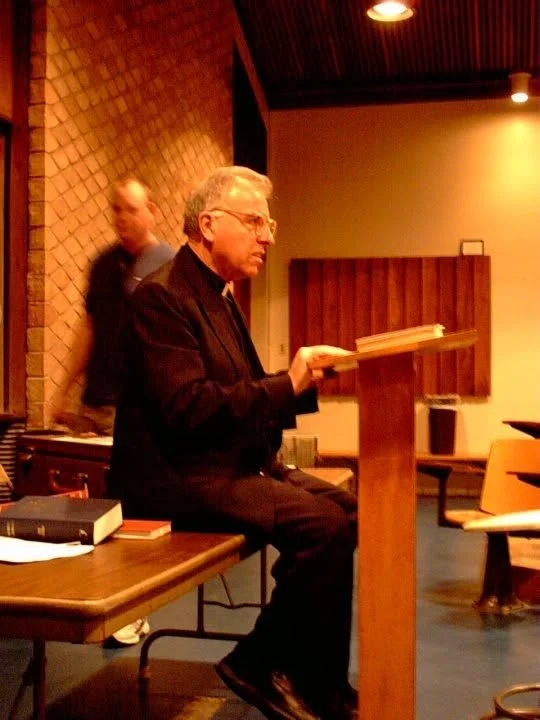
The Rev. Dr. David Scaer, while entertaining as a professor, was not a Sesame Street-style instructor. He wrote on a chalkboard. He did not use PowerPoint slides. He did not show videos. He would expect you to read your assignments and come prepared to discuss them (with your Pieper’s Dogmatics and Greek New Testament) - using his own phrenetic, Brooklyn-style Socratic dialogue to make you think on your feet. Some guys - used to being spoon-fed Sesame Street style, and perhaps never having lived in New York - were ill at ease with Dr. Scaer’s antics. Some openly complained that his methods were of no use.
They could not have been more wrong.
We had a classroom ritual that did not seem to have a purpose at the time. At the beginning of class, as soon as Dr. Scaer would walk through the door, the class stood up and began to join him in a recitation of the Nicene Creed, in Latin. At first, we all read it off of a sheet of paper. But within a few weeks, nobody needed it any more. “Credo in unum Deum…” we would all intone in unison as Dr. Scaer bellowed it out New York style while getting himself situated at the front of the class.
Of course, there are considerations of esprit de corps and morale in such rituals. Schools know this. Sports teams know this. Companies in Japan know this. The military knows this. There was also the sense of connecting us to the church of the past. The Creed was written in Greek in Nicaea in 325, and added on to in Constantinople in 381. The Greek of the East was quickly translated to the Latin of the West, and with the exception of the addition of the word “filioque” (“and the Son”) being added later (making its way to Rome in the 11th century), these very same words that we recited had been spoken and chanted and recited and studied in monasteries and classrooms for centuries. It gave us a bond of connection to the “una, sancta, catholica et apostolica Ecclesia” of the past - our fathers’ church of Sts. Ambrose and Augustine, of Anselm and Aquinas, of Luther and Melanchthon, of Walther and Pieper.
But there was also a pedagogical reason that I think few of us seminarians understood at the time. I figured it out pretty quickly as we continued to study in Dr. Scaer’s classes and others. For these Latin phrases formed the basis of our theological understanding and expression - especially regarding our christological vocabulary. After all, it was Dr. Scaer’s axiom that “All Theology is Christology.” In the same way that constitutional lawyers and judges speak in shorthand of clauses: the Supremacy Clause, the Establishment Clause, the Free Exercise Clause, the Necessary and Proper clause, the Due Process clause, etc., and the same way that they speak concerning case law: Marbury, Miranda, Brown, Roe, Obergefell, etc.. The study of theology has its own ways of speaking. And Latin is still the dominant shorthand in theology.
So we continue to speak of the filioque (of course), the Una Sancta, the consubstantialem Patri, the incarnatus est, the homo factus est, the passus et sepultus est, etc. These phrases had became burned into our psyches, so that when we ran across these untranslated terms - in systematics and historical theology classes and texts - we didn’t have to look them up, learn what they meant, or memorize them. Creedal Latin became for us, a living language. And it made other terms more accessible with a little thought, and easier to memorize: things like the English words Patripassionism, carnal, and dominical, and such concepts as the procession of the Spirit, not to mention the Reformation “solas.” For these are all based on Latin words found in the Creed.
I think a lot of guys just assumed Dr. Scaer was just being quirky and eccentric. He has a classroom schtick to be sure. But he is a wise professor. There is a method to his madness. He knows exactly what he is doing. And I’m grateful for it. It was old-school rote. No cartoons or puppets or singalongs with guitars. But it was fun in its own way: meaningful, useful, and ever-relevant. We never knew exactly what to expect at any moment. He made us truly think. This kind of teaching is antithetical to the dumbed-down programmatic intersection of Vatican II and Sesame Street.
And now we find ourselves more than fifty years after Big Bird and lay readers made their debut, and what we have all found is that the experiment was a failure (if the goal was to teach) or a success (if the goal was to stultify). We are biblically and verbally more illiterate than ever. Theologians are less inclined to use the old terms - or to be able to understand them when they encounter them in old books. Some folks in our congregations want “fun church” (as the daughter of one of my former members put it): a Sesame Street experience where there is no rote learning, no boring repetition, and no work expended to read or learn the Scriptures. Some expect worship to be singalongs, puppets, and funny stories. Certainly no reflection on things like justification, atonement, or the sacramental union - even without the terms themselves necessarily being used from the pulpit. Better to just tell bland stories and encourage people to “be like Jesus” - meaning “be nice.”
Or as a board member at my first call to a Lutheran high school put it: “These kids don’t need to know all that Book of Concord stuff,” (meaning the Small Catechism, the only “Book of Concord stuff” that I was teaching them), because “they just need to know that Jesus loves them.” While I led the students in chapel using Matins and hymns from the TLH hymnals that were in the pews, the principal insisted on leading chapel himself with a life-sized Sponge Bob plush toy and other gimmickries.
And here we are today, as some of those kids who first watched Big Bird on TV are now grizzled pastors in Hawaiian shirts presiding over churches with massive TV screens on the wall, cutting steak on the altar during the consecration, and trying desperately not to read the Words of Jesus by rote. We now have adult Lutherans who have never worshiped liturgically in their lives. Some have never even heard of the Nicene Creed. Instead, there are singalongs and skits, and men and women speaking to congregations as if they were a kindergarten classroom.
But I am happy to report that the old ways are roaring back to life. Classical education has revived (note the word “vivicantem” in the Creed). My old Jesuit high school has long since restored Latin to the curriculum. Many of my Wittenberg Academy high school students are now teachers serving in classical LCMS schools. I’m delighted that some of them are teaching Latin (and they know it far better than I do)! They make school fun, not by dumbing it down and catering to that which fries the attention span and dulls the imagination, but rather by restoring the joy of learning - truly learning - by getting to the root of what words mean, and being able to read and understand and articulate them across contexts. I’m grateful to the CCLE, having started with a handful of people a quarter century ago, bucking the trends against all odds, to today being leaders in LCMS pedagogy for children (and adults!) of all ages.
I'm also grateful to all of my professors at CTSFW, especially to Dr. Scaer. He knew exactly what he was doing with that ceremony. For as we believe, teach, and confess: “Nam ad hoc unum opus est ceremoniis, ut doceant imperitos.”
Postscript: Thank you to the seminarian who shared this quote with me from Neil Postman’s classic 1985 social analysis, Amusing Ourselves to Death, (pages 142-143):
Parents embraced “Sesame Street” for several reasons, among them that it assuaged their guilt over the fact that they could not or would not restrict their children’s access to television. “Sesame Street” appeared to justify allowing a four- or five-year-old to sit transfixed in front of a television screen for unnatural periods of time. Parents were eager to hope that television could teach their children something other than which breakfast cereal has the most crackle. At the same time, “Sesame Street” relieved them of the responsibility of teaching their pre-school children how to read—no small matter in a culture where children are apt to be considered a nuisance. They could also plainly see that in spite of its faults, “Sesame Street” was entirely consonant with the prevailing spirit of America. Its use of cute puppets, celebrities, catchy tunes, and rapid-fire editing was certain to give pleasure to the children and would therefore serve as adequate preparation for their entry into a fun-loving culture.
As for educators, they generally approved of “Sesame Street,” too. Contrary to common opinion, they are apt to find new methods congenial, especially if they are told that education can be accomplished more efficiently by means of the new techniques. (That is why such ideas as “teacher-proof” textbooks, standardized tests, and, now, micro-computers have been welcomed into the classroom.) “Sesame Street” appeared to be an imaginative aid in solving the growing problem of teaching Americans how to read, while, at the same time, encouraging children to love school.
We now know that “Sesame Street” encourages children to love school only if school is like “Sesame Street.” Which is to say, we now know that “Sesame Street” undermines what the traditional idea of schooling represents. Whereas a classroom is a place of social interaction, the space in front of a television set is a private preserve. Whereas in a classroom, one may ask a teacher questions, one can ask nothing of a television screen. Whereas school is centered on the development of language, television demands attention to images. Whereas attending school is a legal requirement, watching television is an act of choice. Whereas in school, one fails to attend to the teacher at the risk of punishment, no penalties exist for failing to attend to the television screen. Whereas to behave oneself in school means to observe rules of public decorum, television watching requires no such observances, has no concept of public decorum. Whereas in a classroom, fun is never more than a means to an end, on television it is the end in itself.