

A New Eucharistic Prayer and Rubrics for the COW to Consider
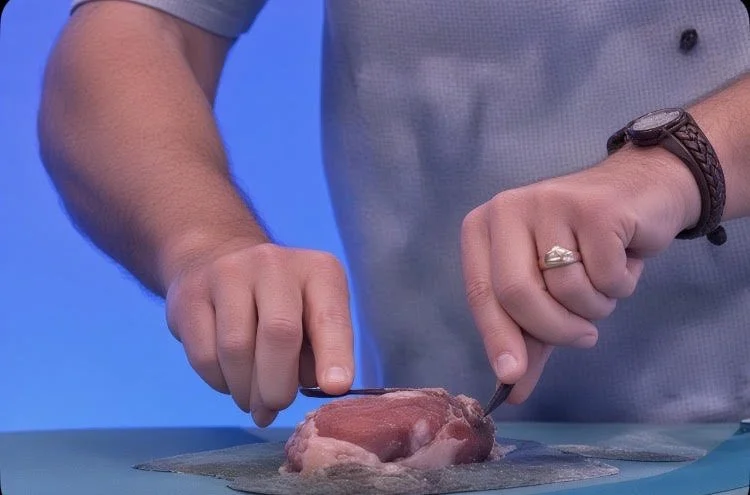
This creative consecration involving a filet mignon on the altar, and additions to the Words of Institution, was posted on YouTube by an LCMS congregation. Since it has been taken down, I am removing the dead-linked video and the reference to the name of the congregation. I have no oversight over this pastor and congregation, and whatever the DP does or doesn’t do is above my paygrade.
But it is within my paygrade to encourage LCMS pastors and congregations not to monkey with the consecration.
Preachers are to proclaim the Gospel in their own words - and to do so with fidelity to the text. Pastors often say ex corde prayers. But not even the most outlandish CoWo congregation practices ex corde readings of Scripture. They have enough respect for God’s Word not to monkey with it, add to it, subtract from it, or insert stories or analogies or explanations based on the food they like to eat or some such. I have never seen a CoWo congregation in which the pastor or the lay lector doesn’t just read the readings right out of the book. There is no sense that doing so is boring or placing limits upon the Holy Spirit.
But when it comes to the Words of Institution, CoWo celebrants sometimes do monkey with the words. They change this or that, or try to make it sound spontaneous. Why they do this with the Sacrament but not the Word is beyond me. It suggests that they hold the Word with more reverence than the Sacrament. And this is truly bizarre, given the origin of the Words of Institution: they are a conflation of the words and actions of Christ from the four Biblical texts in which the consecratory narrative is found.
I’m not writing for the sake of the pastor of this church. I have learned that there is a reason for the line in the movie The Matrix : “We have a rule. We never free a mind once it’s reached a certain age. It’s dangerous. The mind has trouble letting go.” Rather, I’m writing to pastors and laity who already have the blick and who are more able to consider why just sticking with the words in the book is best.
The Verba as found in LSB pages 162, 179, 197, 209, and 217 are the same. Whether you speak them or chant them, you’re saying the same thing without mentioning knives and forks. The rubrics in LSB - though admittedly minimalistic - are the same: two signs of the cross to indicate which bread and which wine are being consecrated. There is no reason to reinvent the wheel with the consecration any more than there is reason to reinvent the wheel when the pastor (hopefully the pastor) reads the appointed Gospel for the day.
In fact, our confessions speak to this (FC Ep 7:7-9):
[7] 2. We believe, teach, and confess that the words of Christ’s testament are not to be understood in any other way than the way they read, according to the letter. So the bread does not signify Christ’s absent body and the wine His absent blood. But, because of the sacramental union, ‹the bread and wine› are truly Christ’s body and blood.
[8] 3. Now, about the consecration, we believe, teach, and confess that no work of man or recitation of the minister produces this presence of Christ’s body and blood in the Holy Supper. Instead, this presence is to be credited only and alone to the almighty power of our Lord Jesus Christ.
[9] 4. At the same time we also believe, teach, and confess unanimously that in the use of the Holy Supper the words of Christ’s institution should in no way be left out. Instead, they should be publicly recited, as it is written in 1 Corinthians 10:16, “The cup of blessing that we bless” and so forth. This blessing occurs through the reciting of Christ’s words. [Emphasis added]
The last part reads in the original (German): “durch das Sprechen der Worte Christi geschiet” and (Latin): “fit per recitationem verborum Christi.” This means to speak the Verba out loud, to recite, not to put it into one’s own words.
This is not the place for creativity. The black is to be read (or sung). The red is to be done. There is a reason why none of our hymnals have ever said: “Here the celebrant just makes up his own consecration.” Pastors, when you use the pronoun “My” in the consecration, you are not the antecedent: Jesus is. These are the words of Jesus. These are not your words. So read them straight and don’t monkey with them. Whatever you do will not be an improvement over Holy Scripture.
There is also a good reason why there isn’t a rubric in the hymnal telling the celebrant to put a dead animal on the altar. Think about those optics. It should go without saying that Christian altars are eucharistic, they are not intended for animal sacrifice, or even the hint of such a thing. And when Jesus speaks of the cup, there is good reason to actually put wine in it rather than just using it as a pretty prop. And when the priest’s host is used, there is a good reason for the celebrant to consume it, and not leave it broken on the altar and just walk away from it. There is also a good reason that for as long as we have been having eucharists, the celebrant had the elements on the table to consecrate, and then distribute from there - rather than having elements scattered willy-nilly all over the place. How can anybody be sure that his individually-held elements were consecrated at all? And if we simply assume for the sake of argument that they were, what happens to them after? The pastor cannot steward the mysteries in such a case. Could someone pocket the consecrated elements and save them for later? And what of the reliquiae? What happens to the blood of Christ remaining in these disparate cups? Hopefully, they were collected somehow and treated reverently, and not just shoved into pockets or dumped in the garbage.
We have been consecrating bread and wine according to the words and example of Jesus for nearly two millennia now. We don’t have to reinvent the wheel.
And I’m quite certain that this is the only pastor in the history of Christendom that has ever used a steak as a prop during the consecration, or inserted the words “fork” or “knife” in the Words of Institution. There is a good reason that our confessions are adamant that we Lutherans are not liturgical innovators, that we have retained the Mass, that we believe in decorum and reverence and dignity in our worship, as opposed to spectacles.
Since the video was taken down - and I’m more interested in using this as a cautionary tale rather than to call attention to this congregation and pastor (again, the DP will either do something about it, or he won’t. Not my district, not my circus) - what follows below is a transcript of how this consecration went. Let it be a warning against the temptation to correct or improve on what Jesus, the apostles, the Holy Spirit, and generations of pastors have bequeathed to us. If it ain’t broke…
And I’m disappointed that nobody picked up on the COW reference. All gallows humor aside, some commentators were whining about the re-creation of the Commission on Worship. The fact that there are so many liturgical monkeyshines - even regarding the Holy Sacrament itself - should convince everyone that we need the return of the COW.
The Eucharistic Prayer
The Improper Preface
The altar shall be set with an empty chalice, a paten, a priest’s host, a small host, a shot glass of wine, a filet mignon on a plate, a fork, and a knife. The celebrant says:
Probably my favorite thing to eat is filet mignon. I just love a great steak.
The celebrant picks up the steak. And waving it around, he says:
Nothing does it for me quite like it. It’s awesome.
The celebrant places the steak back on the altar and says:
But you know what I’ve noticed is that when I have eaten all day long a bunch of junk food and just kind of nourished myself in all the bad things, when something really good is presented, I find myself not all that hungry. I just kind of pick. I don’t really think I need this because I’m so full already of all the stuff I shouldn’t have eaten. But when it is served, and because I love it so much, I always want to eat it, no matter when or what. And so what I do is go to the table and I take a knife and a fork,
Here the celebrant takes up the knife and the fork, and says:
and I cut myself a piece, usually not raw.
Here the celebrant slices into the steak with the utensils. He continues:
It will be cooked. I have myself a bite.
The Uncomfortable Words
The celebrant brings the steak towards his mouth with the fork, but stops short of eating it. He places the knife and fork back on the altar, and motions to the steak with his hands and says:
This is much what communion is like. When you came in here this morning, you received this little chalice, and on one side was a little piece of bread, and the other is wine. And as a church, we take communion together as a family, all at the same time.
The celebrant picks up the fork, and continues:
And why I use this analogy is because what God gives us in this meal is something that satisfies and fulfills and offers spiritual nourishment unlike we’ve ever had. And God also gives us the means,
The celebrant picks up the knife, and continues:
the vehicles, if you will, to take this gift
The celebrant taps the knife and fork on the steak, and says:
and to feast in communion.
The celebrant removes the paten from the chalice, and says:
God takes a different means:
The celebrant removes the priest’s host from the paten, and says:
a piece of bread, a cup of wine.
The celebrant touches the empty chalice.
They’re the means by which we receive the feast. They are the knife and fork, if you will, that God uses to bring us the fullness of Himself in body and blood.
So this bread and this wine is not special at all. It’s just bread and wine. What makes it unique is it’s connected to the Lord, to the promise of God’s Word, that this is His body and blood. And so, what this knife and fork of bread and wine become is the vehicles, the means by which He feeds us the sustaining grace that is ours through Christ.
Now let me warn you: if all week long you’ve been tasting and filling yourself on a bunch of junk food, you’re not going to see the need for this meal. You’ll be like the Pharisee and think of all the good things you do. You’re not all that hungry for something you really need. But Jesus knows you and says you’ve been eating a lot of junk food this week. You put a lot of the promises of the world in you, thinking you were satisfied.
But there’s a meal that not only satisfies, but it gives grace and fills. You become more deeply spiritual through this means.
The Words of Our Lord - Kinda Sorta
On that night when communion was first celebrated, Jesus celebrated it with the disciples. On that table would have been a number of different chalices, cups. Each one had a very unique meaning, and they would read parts of Scripture and talk about that particular cup, and this one.
And there was this cup in the middle, and no one ever touched it because it was the cup of promise that whoever would take from this cup one day would be the promised Messiah, and that’s how He would identify Himself was through drinking from this cup. And so that night, everyone is going through the ritual of the Passover, and the Bible then says, “Our Lord Jesus Christ on that night, He took bread, and when He broke it,
The celebrant breaks the priest’s host in two, holding out his arms, and continues:
He gave it to the disciples, and He said, ‘Take and eat. This is My body given for you. Do this to remember Me.’” So pick up your fork, the bread, and receive the body of Christ.
Here the celebrant communes on the wafer, and not on the pieces of the priest’s host, and continues:
And then Jesus reaches for that cup, the cup of redemption, which would identify Him as the promised Messiah,
The celebrant holds up the empty chalice and continues:
and He says: “Drink of it, all of you. For this cup is the New Covenant in My blood, poured out for you, for the forgiveness of all your sins.
The celebrant replaces the empty chalice on the altar, and continues:
As often as you drink this, remember Me.” So pick up the knife. This is the blood of Jesus given for you.
The celebrant communes from the small shot glass.
The Merciful Ending
The celebrant invites the congregation to pray, saying:
“Let’s pray. Father we pray that through this meal we become satisfied. We feel comforted and assured that Your grace is always sufficient, that no matter what, Lord, that You will be enough. No matter the junk food we’ve eaten all week, no matter how far we’ve run, no matter how much we’ve hid, Lord, You’ll find us at this table, and You feed us and you fulfill us and wrap Your arms of grace around us and remind us that we are Your dearly loved children. So Father we thank you again for feeding us at Your table. We pray this in the name of Christ. Amen.
Here the celebrant departs, leaving on the altar the empty chalice, the two consecrated halves of the priest host, the small cup with the reliquiae, the steak, and the fork and knife.