

The Convention Did Not Practice...
By Peter Scaer
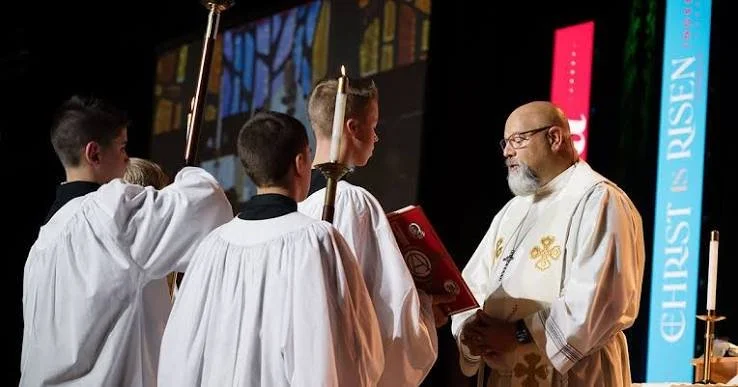
Note: An LCMS podcaster recently claimed that the communion practice in his large church was the same as that of the synod convention. However, the synod convention Divine Service did not open the altar to those who were not in communion with the LCMS. Indeed, the establishment of communion (altar and pulpit fellowship) between the LCMS and other church bodies is always a cause of great joy in synod conventions, complete with the singing of the Doxology. But what does full communion between church bodies mean, if anyone is welcome to commune at our altars anyway, so long as they are baptized, believe Jesus is present, and are sorry for their sins? This makes no sense at all. What follows is a social media post by the Rev. Dr. Peter Scaer, published with permission. — Ed.
The convention did not practice close/open communion, or anything like it. Admittedly, in a large church, it’s hard to keep track of everyone. But the idea is simple enough. Communion is open for all who are members in good standing of an LCMS congregation, or in a body with which we are in fellowship. This is not all that difficult to understand, but those who teach differently make matters more difficult, and perhaps unwittingly sow division.
It is not enough to have a short address, asking whether people believe in the real body and blood, and whether they confess Jesus as Savior, whether they are sorry for their sins, and so forth. If a person believes as we do, he should be invited into catechesis, into preparation for membership. To that teaching, all are invited. But asking a few questions beforehand doesn’t cut it. The heart that is set on the true body and blood cannot then approach an altar where it is treated as a symbol. The confession speaks of Christ as conceived by the Holy Spirit cannot also receive communion with a church that is ok with abortion and gay ‘marriage.’
Communion is not dating, but is akin to a marriage. And so our confirmands pledge to keep the faith even unto death. For the one who makes such a pledge, it would be unthinkable to join in communion where the truth is denied. Closed communion may be a barrier, but so also is it an opportunity. Does it matter that a Presbyterian might come to our altar, as if there is no difference? Should he not denounce the idea that Christ died for some, but not for all? Is it ok for a Roman Catholic to come to our altar (perhaps much less likely)? Should he not denounce the practice of masses for the dead, as if Christ's atoning work were not enough? If the bread is for God’s children, then should not those who receive it also confess the truth of God’s work in Baptism, that it is He who makes us His children, He who gives us new life and forgiveness?
And so on, and so on, and so on. This is not hard stuff. But when leaders of the church do not understand, they make it all very difficult for pastors who wish to be faithful. When those who should know press for something else, they put doubt and suspicion into the minds of the people, who are led to turn against pastors who are simply tending the flock as our Lord has instructed. I suppose, I was naïve in thinking that the practice of close communion (defined by asking a set of questions before the service — that sort of thing) was not so great a deal. But then I hear story after story of people who are led to anger at a faithful pastor, simply because he is striving to be faithful. And when the doctrine of closed communion is undermined by those who are prominent, great and unnecessary confusion ensues. The flock is left confused, and the faithful pastor is suddenly the bad guy, branded a meanie, simply for doing what's right.