

On this Rock: Pride Masses, the SSPX, and Apostolic Succession
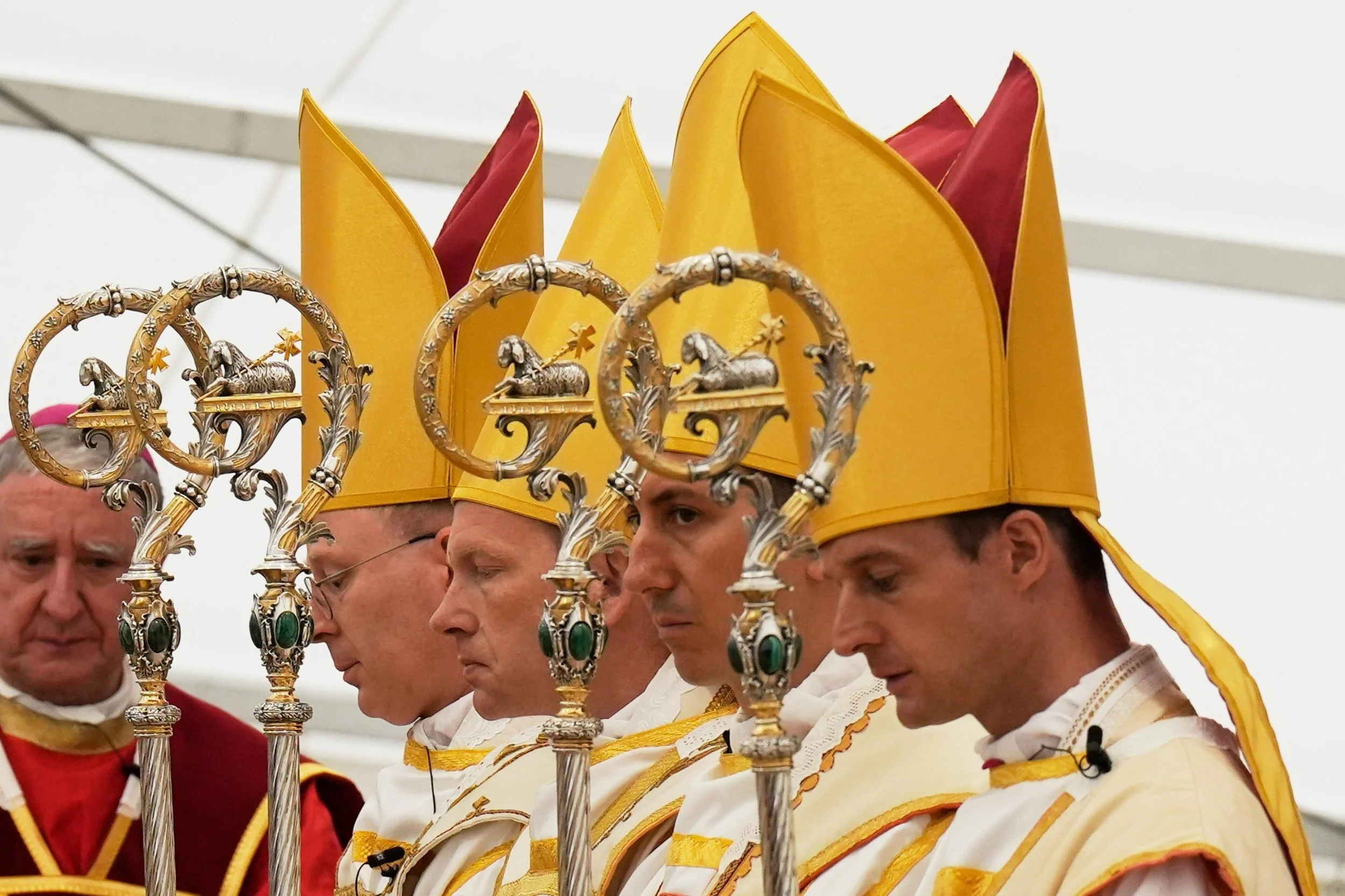
The episcopal ordination of four new bishops on July 1, 2026 by the Priestly Fraternity of Saint Pius X.
Simon Peter answered and said, Thou art the Christ, the Son of the living God. And Jesus answered and said unto him, Blessed art thou, Simon Bar-jona: for flesh and blood hath not revealed it unto thee, but my Father which is in heaven. And I say also unto thee, That thou art Peter, and upon this rock I will build my church; and the gates of hell shall not prevail against it. And I will give unto thee the keys of the kingdom of heaven: and whatsoever thou shalt bind on earth shall be bound in heaven: and whatsoever thou shalt loose on earth shall be loosed in heaven. (Matthew 16:16–19)
The Roman Problem
I wrote recently on some of the liturgical material pertaining to the Feast of Sts. Peter and Paul, and how it demonstrates quite a different understanding of Matthew 16 than that commonly held by those within the Roman Church today. This was subsequently made all the more clear by the Epistle appointed for ferial days within the octave of the aforementioned feast, which is clearly meant to interpret the mass of the feast itself. While the Gospel for the feast included the confession of St. Peter, "Thou art the Christ, the Son of the living God," and the declaration of Our Lord: "Thou art Peter, and upon this rock I will build my church; and the gates of hell shall not prevail against it," the Epistle for the ferial days within the Octave is from St. Paul's letter to the Ephesians: "Ye are built upon the foundation of the apostles and prophets, Jesus Christ himself being the chief corner stone." The Epistle for the days following the feast is, unmistakably, identifying "this rock" as Christ Himself, leaving no room for the observant faithful to draw any other conclusion.
After writing the previous article, I began reading a very interesting (and lengthy) speech from the 19th century by Peter Richard Kenrick, the first Roman Catholic archbishop of St. Louis. He writes in light of the discussions of the First Vatican Council regarding the nature of the papacy, which would culminate in Pastor aeternus and the fourfold definition of Petrine primacy, the continuation of that primacy in the bishops of Rome, the further definition of that primacy as supremacy, and, most infamously, the definition of the dogma of papal infallibility.
Kenrick relates in some detail how the patristic witness overall vastly prefers the interpretation of “this rock” in Matthew 16 as Christ Himself, or the correct confession of Christ, and I will take the liberty of quoting him at length. All emphases in bold are my own.
"The primacy of the Roman pontiff, both in honor and in jurisdiction, in the universal church, I acknowledge. Primacy, I say, not lordship. But that the primacy is vested in him as the successor of Peter, all the tradition of the church testifies, from the beginning. And on the sole strength of this testimony I accept it as an absolutely certain principle and dogma of faith. But that it can be proved from the words of Holy Scripture, by any one who would be faithful to the rule of interpretation prescribed to us in that profession of faith which we have uttered at the opening of this Council, and so often on other occasions, I deny. It is true that, following the principles of exegesis, I held the opposite view…. But on a closer study of the subject, I judge that this interpretation must be abandoned. My reason for this change of opinion is the following:
The rule of Biblical interpretation imposed upon us is this: that the Scriptures are not to be interpreted contrary to the unanimous consent of the fathers. It is doubtful whether any instance of that unanimous consent is to be found. But in this failing, the rule seems to lay down for us the law of following, in their interpretation of Scripture, the major number of the fathers, that might seem to approach unanimity. Accepting this rule, we are compelled to abandon the usual modern exposition of the words, "On this rock will I build my church." (pp. 106–107)
Kenrick then goes on to relate a summary of the patristic witness stemming from a pamphlet distributed to the council fathers regarding the five different interpretations of the word “rock” in the passage “upon this rock I will build my church”, and I will somewhat condense his summary in the bullet points below
“the church was built on Peter” — 17 fathers, including Origen, Cyprian, Jerome, Hilary, Cyril of Alexandria, Leo the Great, and Augustine
"the church was built on all the apostles, whom Peter represented by virtue of the primacy" — 8 fathers, including Origen, Cyprian, Jerome, Augustine, and Theodoret
"the words 'On this rock, etc.’ are to be understood of the faith which Peter had professed — that this faith, this profession of faith, by which we believe Christ to be the Son of the living God, is the everlasting and immovable foundation of the church." — 44 fathers and doctors, including Gregory of Nyssa, Cyril of Alexandria, Chrysostom, Theophylact, Hilary, Ambrose, Leo, and Augustine
“the words, ‘On this rock,’ etc., are to be understood of that rock which Peter had confessed, that is, Christ—that the church was built upon Christ.” — 16 fathers and doctors
the rock is “the faithful themselves, who, believing Christ to be the Son of God, are constituted living stones out of which the church is built” [no names or numbers specified]
Kenrick summarizes:
“Unless it is certain that by the rock is to be understood the apostle Peter in his own person, and not in his capacity as the chief apostle speaking for them all, the word supplies no argument whatever, I do not say in proof of papal infallibility, but even in support of the primacy of the bishop of Rome.”
He then goes on to deal with the particular arguments circulating in his own time, which I will leave you to read at your leisure. I quote all of this at length to remind the reader that not only papal infallibility, but even the primacy of the Roman see, were very much matters under debate within the Roman church only a century and a half ago, and that the clear witness of Holy Scripture and the consensus of the church fathers against the machinations of Rome was fully recognized by many at the time. But with the definitions of Vatican I, all of this was washed away and the conversation was closed. Because no matter the lip service that the Roman Church may pay to Holy Scripture, the church fathers, or the tradition of the church, it is, finally, built upon the claim of Petrine supremacy. The rock on which that church is built is explicitly not Christ, but the line of bishops extending down from St. Peter. And when Scripture and tradition stand in the way — as they so often do — they can be swept away by the magisterial authority, purportedly drawn from St. Peter, and no one can stand in the way of the Roman pontiff without facing dire consequences.
Take, for example, the events of the last week. The last few days have seen episcopal consecrations performed apart from papal permission by the traditionalists of the SSPX, which has incurred an automatic and instant (latae sententiae) excommunication for the bishops, clergy, and any laity who participate in their masses — some 600,000 in all — for one reason and one reason alone: they dared to ordain bishops without approval from Rome. Meanwhile, headlines last week prominently featured Roman priests in New York City who yet again unabashedly celebrated a rainbow flag-bedecked "Pride Mass" in front of the Stonewall Inn with no apparent consequence. A denial of the clear doctrinal and moral teaching of Holy Scripture and all of the history of orthodox Christianity in full public view in the most prominent city in the world received no meaningful response, while the utterly doctrinally serious and staunchly conservative SSPX saw over half a million excommunicated. These abuses are so numerous and so routine that "if they should be written every one, I suppose that even the world itself could not contain the books that should be written." Anything — anything at all — can be overlooked in the Roman church, so long as you acknowledge Petrine primacy.
Because papal supremacy is the only doctrine of the Roman Church that truly matters, and everything — yes, even Christ Himself — can be swept aside when the papacy so pleases. See, for example, the functional universalism of Nostra aetate (1965), which claimed that adherents of Islam "adore the one God, living and subsisting in Himself; merciful and all-powerful, the Creator of heaven and earth." Rather than building a Church upon the One who said, “I am the way, the truth, and the life: no man cometh unto the Father, but by me,” the “conservative” Pope John Paul II infamously bowed to and kissed the Qur'an, and his even more “conservative” successor Pope Benedict XVI prayed alongside a mufti in a Turkish mosque.
This is the logical result of a church that, by its own definition, is built upon the frail human successors of Peter and not on the Rock, namely Christ Himself. While our Lutheran forebears identified this problem quite clearly in the Treatise on the Power and Primacy of the Pope, I think that even they would be shocked at the way in which those seeds have come into hideous flower. Because all of this poisonous fruit is from one seed — making St. Peter the rock upon which the church is built, rather than Christ Himself, an assertion which flies in the face of Holy Scripture, the broad patristic witness, and the liturgical tradition of the church.
The Lutheran Problem
Looking outside, of course, is easy. But a form of the same sickness has been growing in some parts of our own communion, as various bishops in our partner churches, leaning heavily on their claims to apostolic succession, have declared full communion with the increasingly troubled Anglican Church in North America, established a rival Lutheran church in South America, and served as bishop to a liberal Anglican sect in Thailand. Even if it is only the first cell, it is the same cancer that has terminally infected the Roman Church — that the church receives its authority and identity from a line of human succession, and not its identity from the person of Christ Himself, the Shepherd and Bishop of our souls, and its authority from the Holy Scriptures.
In contrast, the true office of bishop, Dr. Luther says, is one quite different from that espoused by the Roman faction, and one that is truly to be desired:
Both the Old and the New Testaments give sufficient evidence of what a divinely wholesome thing it would be if pastors and Christian congregations might be visited by understanding and competent persons. For we read in Acts 9[:32] that St. Peter travelled about in the land of the Jews. And in Acts 15[:2] we are told that St. Paul together with Barnabas revisited all those places where they had preached. All his epistles reveal his concern for all the congregations and pastors. He writes letters, he sends his disciples, he goes himself. So the apostles, according to Acts 8[:14], when they heard how the Word had been received in Samaria, sent Peter and John there. Also we read in the Old Testament how Samuel travelled around, now to Ramah [1 Sam. 7:17], now to Nob [1 Sam. 21:1], now to Gilgal [1 Sam. 10:8; 11:14; 13:8; 15:12] and other places, not out of delight for taking a walk but out of love and a sense of duty in his ministry and because of the want and need of the people. Elijah [1 Kings 17–21] and Elisha [2 Kings 2–13] did the same, as we read in the books of Kings. More than any, Christ has done this kind of work on behalf of all, and on this account possessed no place on earth where he could lay his head or which he could call his own. This began even while he was in the womb, for he went with his mother over the hills to visit St. John [Luke 1:39].
Formerly, in the days of the ancient Fathers, the holy bishops diligently followed these examples and even yet much of this is found in the papal laws. For it was in this kind of activity that the bishops and archbishops had their origin—each one was obligated to a greater or lesser extent to visit and examine. For, actually, bishop means supervisor or visitor, and archbishop a supervisor or visitor of bishops, to see to it that each parish pastor visits and watches over and supervises his people in regard to teaching and life. And the archbishop was to visit, watch over, and supervise the bishops as to their teaching. (Instructions for the Visitors of Parish Pastors in Electoral Saxony, 1528)
In contrast to the modern Roman episcopacy and other aberrant episcopal patterns of behavior, this episcopacy is one rooted in the faith of the church and the love of the neighbor, one firmly founded on Christ, not on the lineage of one’s ordination or consecration, and one called to the care of souls, not to the imperious wielding of power. The natural instinct in such times and circumstances as these is to shrink back, to cast it all aside and lament what once was. But it is in just such times as these that we ought to define once again a true episcopacy, one rooted and grounded in Holy Scripture, a supervision in both faith and love.
The words of Dr. Luther in the 1528 Saxon Visitation Articles above about the work of bishops describe exactly the responsibilities outlined in the constitution of the Lutheran Church—Missouri Synod for the offices of synod president and district presidents. The President of the Synod is charged with the duty of “supervision regarding the doctrine and administration” of all officers, employees, districts, and district presidents of the Synod (Const. Art. X B 1) and district presidents are to “especially exercise supervision over the doctrine, life, and administration of office” of the pastors and teachers under their care, as well as to “acquaint themselves with the religious conditions of the congregations of their district” by means of visitation (Const. Art. XII 7). They are also tasked with the ordination (either in person or by proxy) of candidates for the pastoral office. All of these duties have been the primary responsibility of the Synod President (and later district presidents) since the very first constitution of the Synod in 1846/1847.
This shouldn’t be all that surprising, as the Lutheran dogmaticians are utterly clear in their assertion that the office of Superintendent (on which the Synod President is clearly based) is nothing other than a bishop. (cf. Hollaz, David. Examen Part IV Ch. II [On the Ecclesiastical Ministry] Q. X Obj. III) And when it comes to matters of succession, our Lutheran tradition is crystal clear, as in Gerhard:
After all, whom did Christ succeed? Whom did the apostles succeed? The Epistle to the Hebrews shows that Christ is a priest after the order of Melchizedek. Therefore He succeeded Melchizedek. Therefore the true succession can be interrupted, provided that it has the succession of doctrine connected with it. Paul says in 2 Tim. 1:3 that he serves God "from his forefathers," that is, from Abraham, Isaac, Jacob, etc. Therefore he is proving his faith by an interrupted succession through his forefathers, who had belonged to the sect of the Pharisees.
When Stephen was accused of false doctrine (Acts 7), he appealed to Abraham, and beginning from him, he went down to the time of the Babylonian captivity, and then to the very times in which he had lived, covering about four hundred years.
The apostles were the true successors of the prophets because they both received and spread the prophets' pure doctrine. They were the true successors of Aaron because they followed his faith. Yet they succeeded neither the prophets nor Aaron immediately with regard to place. In the same way, those people who sincerely embrace the faith and doctrine of the apostles, as comprehended in their writings, must be considered the true successors of the apostles, even though they do not have that external, local succession.
With reference to the apostles, heretical priests, gravely erring in faith, most recently preceded them. Yet this does not at all oppose the doctrinal succession by which the apostles succeeded the prophets, Aaron, and other devout priests with regard to the ecclesiastical ministry. In the same way, the doctrinal succession was interrupted by a corrupt ministry. Yet this does not at all oppose that doctrinal succession by which the devout and orthodox ministers of the church succeed those who sincerely embrace the apostolic faith.
The apostles appealed to the internal, doctrinal succession over a local, external succession, of which Caiaphas could boast, when they bore public witness that they were teaching "nothing but what the prophets and Moses predicted would come to pass" (Acts 26:22). They also did not ask Caiaphas for ordination. In the same way today, in the Evangelical churches we correctly appeal to the doctrinal succession over a local and personal succession. We ask for neither ordination nor confirmation from the Roman pontiffs, who boast of a succession from the apostles but are actually imitating Caiaphas.
- Johann Gerhard, Theological Commonplaces, “On the Church”, Section V, paragraph 190
The succession of bishops and clergy in the Evangelical Lutheran Church is not the same as that in Rome, because their foundation is not the same. The foundation of the Roman Church, a personal succession descending from St. Peter, has led to a great deal of mischief thus far, and will no doubt continue to produce still more. Down this road lies only ruin, and any Lutherans looking hopefully down the path of personal succession for a sense of ecclesial certainty will only sow the seeds of their own destruction. Because the Church of the Augsburg Confession, together with the ancient witnesses of the church, is instead defined by a succession of doctrine, by the confession of the faith that St. Peter uttered: “Thou art the Christ, the Son of the living God,” ever laying her foundation firmly on the Rock, which is Christ.