

Petrine Supremacy? Bede and the Treatise on the Power and Primacy of the Pope
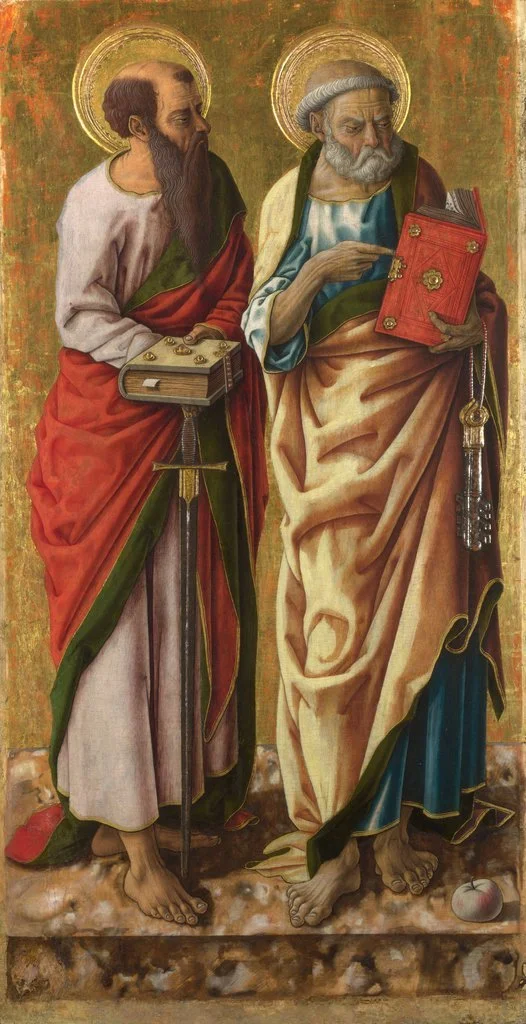
However, as to the declaration: Upon this rock I will build My Church, certainly the Church has not been built upon the authority of man, but upon the ministry of the confession which Peter made, in which he proclaims that Jesus is the Christ, the Son of God. He accordingly addresses him as a minister: Upon this rock, i.e., upon this ministry. [Therefore he addresses him as a minister of this office in which this confession and doctrine is to be in operation and says: Upon this rock, i.e., this preaching and ministry.]
These words from the Treatise on the Power and Primacy of the Pope (25) lay out one of the central exegetical arguments of the Lutheran confessors against the claims of the Roman pontiff — that the rock upon the church is built is not St. Peter himself, but his confession: that Jesus is “the Christ, the Son of the living God.” This is still one of the texts on which claims to papal supremacy rest, and the identification of St. Peter himself — rather than his confession — as the rock upon which the Church is built is often painted by Roman apologists as the unanimous (or nearly unanimous) consensus of the church in all times and places.
Which is patently absurd.
See, for example, this collect, appointed for today, the Vigil of Sts. Peter and Paul:
Grant, we beseech Thee, almighty God: that Thou suffer us not to be shaken by any disturbance, whom Thou hast firmly established on the rock of the apostolic confession; through Jesus Christ, Thy Son, our Lord, who liveth and reigneth with Thee in the unity of the Holy Ghost, ever one God, world without end.
Præsta, quæsumus, omnipotens Deus, ut nullis nos permitas perturbationibus concuti, quos in apostolicæ confessionis petra solidasti. Per Dominum. (Corpus Orationum 4506)
This prayer, in continuous use for well over a thousand years, even as recently as the 1962 Missale Romanum, clearly identifies the rock as the confession of St. Peter rather than his own person.
Further digging into the appointed texts for the vigil and feast of Sts. Peter and Paul also shows that the homily appointed for Matins in northern and Germanic medieval breviaries is taken from Bede’s Homilies on the Gospels (I.20) on the Gospels, and while the appointed text at Matins stops well before this passage, Bede is quite clear about his interpretation of Matthew 16:
There follows: ‘And I say to you that you are Peter, and upon this rock I will build my Church’. Peter, who before this was referred to as ‘Simon,’ received from the lord the name Peter, because of the strength of his faith and the constancy of his confession., for he clung with a stable and tenacious mind to him concerning whom it was written, and the Rock was Christ. And upon this Rock the Church is built — that is, upon the Lord and Savior. To his faithful one who recognized him, and loved him, and confessed him, he granted a share in his own name, so that he was called Peter from [the word for] ‘rock’....Many are the gates of hell, but none of them prevails over the Church which has been founded upon the rock. One who has received the faith of Christ with the inmost love of his heart very easily scorns whatsoever tempting danger threatens him from outside.
This is just what the Treatise, more than 800 years later, would reiterate — the “rock” is the clear confession of Christ. And Bede will also continue on to confess precisely what the Treatise confesses concerning the giving of the keys. First, the Treatise:
In all these passages Peter is the representative of the entire assembly of apostles [and does not speak for himself alone, but for all the apostles], as appears from the text itself. For Christ asks not Peter alone, but says: Whom do ye say that I am? And what is here said [to Peter alone] in the singular number: I will give unto thee the keys; and whatsoever thou shalt bind, etc., is elsewhere expressed [to their entire number], in the plural Matt. 18:18: Whatsoever ye shall bind, etc. And in John 20:23: Whosesoever sins ye remit, etc. These words testify that the keys are given alike to all the apostles and that all the apostles are alike sent forth [to preach].
In addition to this, it is necessary to acknowledge that the keys belong not to the person of one particular man, but to the Church, as many most clear and firm arguments testify. For Christ, speaking concerning the keys adds, Matt. 18:19: If two or three of you shall agree on earth, etc. Therefore he grants the keys principally and immediately to the Church, just as also for this reason the Church has principally the right of calling. [For just as the promise of the Gospel belongs certainly and immediately to the entire Church, so the keys belong immediately to the entire Church, because the keys are nothing else than the office whereby this promise is communicated to every one who desires it, just as it is actually manifest that the Church has the power to ordain ministers of the Church. And Christ speaks in these words: Whatsoever ye shall bind, etc., and indicates to whom He has given the keys, namely, to the Church: Where two or three are gathered together in My name. Likewise Christ gives supreme and final jurisdiction to the Church, when He says: Tell it unto the Church.]” (Treatise on the Power and Primacy of the Pope, 23–24)
Now Bede:
There follows ‘And I will give you the keys of the kingdom of heaven’. The one who confessed the King of heaven with a devotion above that of others was himself rightly enriched by the conferral upon him beyond the others of the keys of the heavenly kingdom, so that it might be obvious to all that without this confession and faith no one could enter into the kingdom of heaven. He names ‘the keys of the kingdom of heaven’ that knowledge and power of discernment with which [Peter] was to receive the worthy into the kingdom, and to exclude the unworthy from the kingdom.
Hence he adds clearly, ‘And whatsoever you bind upon earth will be bound also in heaven, and whatsoever you loose upon earth will be loosed also in heaven’. Although it may seem that this power of loosing and binding was given by the Lord only to Peter, we must nevertheless know without any doubt that it was also given to the other apostles, as [Christ] himself testified when, after the triumph of his passion and resurrection, he appeared to them and breathed upon them and said to them all, ‘Receive the Holy Spirit. Whose sins you forgive, they are forgiven them, and whose sins you retain, they are retained.’ Indeed even now the same office is committed to the whole Church in her bishops and priests…”
The two witnesses speak with such a united voice that, were the attributions removed, you might well have some difficulty identifying which text came from which author. The continuity of faith and doctrine between Bede and our Lutheran forebears is manifestly evident. Now compare with these remarks of Pope Benedict XVI on June 7, 2006:
In themselves, the three metaphors that Jesus uses are crystal clear: Peter will be the rocky foundation on which he will build the edifice of the Church; he will have the keys of the Kingdom of Heaven to open or close it to people as he sees fit; lastly, he will be able to bind or to loose, in the sense of establishing or prohibiting whatever he deems necessary for the life of the Church. It is always Christ's Church, not Peter's.
Or with the encyclical Ecclesiam suam (1964) of Paul VI:
Though He founded this building on a man who was naturally weak and frail, Christ transformed him into solid rock, never to be without God's marvelous support: "Upon this rock I will build my Church."
In these latter interpretations, St. Peter himself is made into the rock (or, in Francis’s rendering, a rock, a stone, and a pebble). Others with access to more resources and more substantial libraries than my own could (and should) catalog a great many more ancient witnesses and their varying interpretations of this text, as it still serves as a flashpoint in apologetics discussions to this day. Bede is a part of that much broader story, and only a part. But I do think that we can see in these instances that when our confessions speak about the office of the papacy, they are not introducing some novel interpretation that was never before seen, but instead are reiterating an understanding that was already widely held and known for many centuries — one that is quite different from the self-understanding of the modern Roman church.
So in this last week of June that encompasses both the Feast of Sts. Peter and Paul and the Presentation of the Augsburg Confession, we confess once again with the voices at Augsburg: “In doctrine and ceremonies nothing has been received on our part against Scripture or the Church Catholic.”