

A Letter on Closed Communion to Floor Committee 5 (Theology and Church Relations)
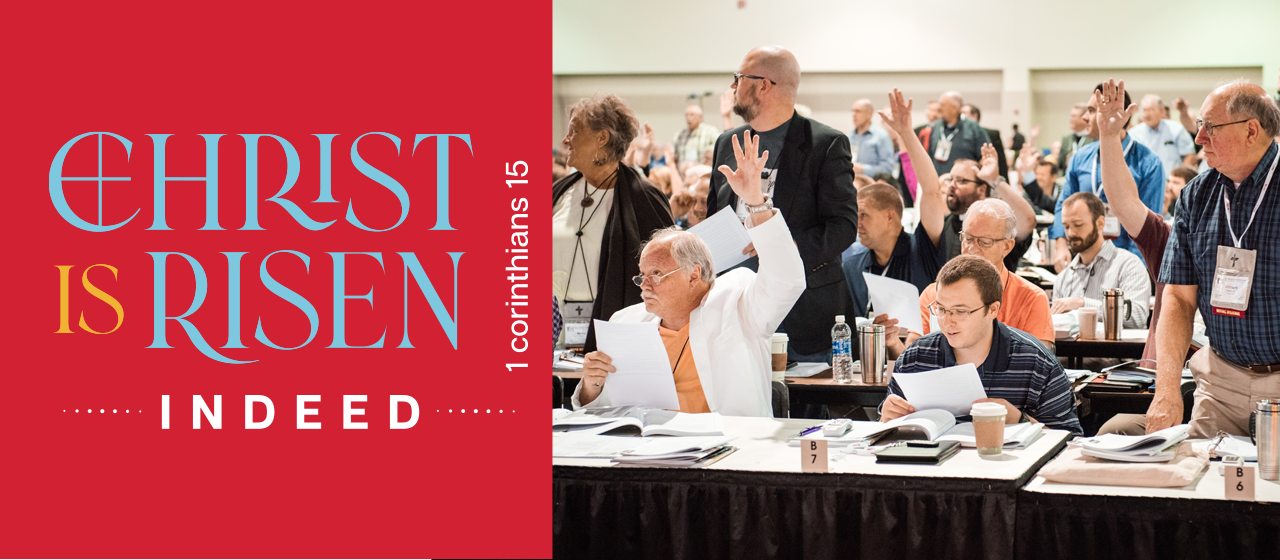
The following letter was submitted by the Rev. Stanley Lacey of St. Thomas Evangelical Lutheran Church (UAC), Magnolia, Texas to Floor Committee 5 (Theology and Church Relations) of the 2026 LCMS Convention. Rev. Lacey was born and raised in central Alabama, and grew up in the Roman Catholic Church. While studying music at the University of Alabama, he became a Lutheran after meeting his future wife, Payton, and reading the Augsburg Confession. He received his M.Div. from Concordia Theological Seminary in 2021, and served St. John’s Evangelical Lutheran Church in Clarksburg, WV for three years before accepting the call to serve at St. Thomas in Magnolia, a new church plant of the English District.
July 11, 2026
Dr. Brian S. Saunders, President
Iowa East District
1100 Blairs Ferry Road
Marion, IA 52302-3093
Dear Chairman Saunders and Members of Floor Committee #5:
I am writing to you with my own suggestions on Proposed Resolution 5-05, "To Address Open Communion and Pastoral Exceptions in Extraordinary Circumstances." I authored the Overture 5-17, submitted by St. Thomas Evangelical Lutheran Church (UAC), Magnolia, Texas, titled "To Reaffirm, Enforce, and Restore Faithful Eucharistic Practice and Synodical Discipline concerning Unionism and Open Communion."
I wrote Overture 5-17 with the desired result that our Synod President and Council of Presidents would be urged in Convention to begin expelling individual members of Synod and congregations that violate membership requirements as they relate to LCMS Constitution Article VI.2, the renunciation of unionism and syncretism in all its forms. In its current form in Today's Business, I believe that Proposed Resolution 5-05 fails to accomplish this goal.
Proposed Resolution 5-05 reaffirms the practice of closed Communion, cites the oft-abused Synodical language of "except in situations of emergency or in special cases of pastoral care," and resolves that the Synod President and Council of Presidents, "continue to be faithful in upholding the existing constitutional and bylaw provisions concerning unionism and sacramental practice and the Synod's position on closed Communion as articulated in numerous doctrinal resolutions," giving the impression that the Synod President and Council of Presidents have actually followed our Synod's existing consitutional and bylaw provisions.
Given that prominent members of Synod and some of our most visible and largest congregations openly advocate for and practice various communion practices that cannot be described as closed Communion according to Scripture and have not been publicly rebuked, given a public apology and repudiation of their heterodox teaching and practice, or been expelled from the Synod, the phrase "continue to be faithful in upholding" is false. The best, and most accurate, construction is that the Synod President and Council of Presidents are not expelling heterodox pastors and congregations for practicing open Communion in all its forms, and they should be. That being the case, I implore this floor committee to urge them to fulfill their duty to preserve the unity of the true faith and to defend against schism, sectarianism, and heresy.
One final note here: I have included the names of various figures whose false teaching is either publicly available or has been presented publicly. I am willing to share names in other situations cited in this letter so that they may respond to the claims I have made. However, since they were either private conversations or words spoken in settings where discretion is expected, such as a circuit meeting of pastors, I have left them unnamed.
Biblical Requirements for the Lord's Supper Remain Absolute Even in Emergency or Exceptional Pastoral Care Situations (Today's Business, Proposed Resolution 5-05, p. 101, Lines 8–48)
I ask that the floor committee consider language asserting the fact that even in situations of emergency or in special cases of pastoral care, a pastor still must only admit to the Lord's Supper:
Those who have been baptized.
Those who can examine themselves (1 Corinthians 11:28)
Those who believe that according to the Words of Institution in Matthew 26, Mark 14, Luke 22, and 1 Corinthians 11, "that bread and wine in the Supper are the true body and blood of Christ, and are given and received not only by the godly, but also by wicked Christians" (SA III VI 1).
Those who must not first remove a public offense that has been given through open, manifest sin (1 Corinthians 5:11). Christians under the care of a false-teaching pastor or who are joined to a heterodox congregation must remove the public offense by severring their connection with the heterodox pastor and congregation and declaring their acceptance of the true doctrine before being admitted to the Lord's Supper (Romans 16:17).
Our Lutheran fathers speak with one voice to this issue of who ought to be admitted to the Lord's Supper according to Scripture. Two prominent examples include C.F.W. Walther and Francis Pieper (C.F.W. Walther, Pastoral Theology, p. 222–232; Francis Pieper, Christian Dogmatics vol. 3, pp. 381–391).
Even in cases of urgent need, the pastor must never commune a person who plans on continuing in sin and remaining attached to a heterodox pastor and congregation, regardless of their baptized status, ability to examine themselves, or their belief in the true and substantial presence of Christ's body and blood in the Holy Supper. To commune such a one who has not confessed their sins and resolved to avoid them in the future is to disobey God's call to the minister to serve as a watchman (Ezekiel 3:17–18).
The only "situations of emergency" or "special cases of pastoral care" where someone isn't formally a communicant member of a congregation in fellowship with the Lutheran Church—Missouri Synod—that a pastor might, in good conscience, administer the Sacrament still require that all the requirements above be met. There is no emergency case concerning the Lord's Supper that would allow dispensing with these Biblical requirements.
Special situations regarding who is admitted to the Lord's Supper are addressed in Walther's Pastoral Theology:
"Anyone who cannot confess faith that the true body of Jesus Christ is actually and truly present in the Holy Supper and is therefore consumed by all communicants—both the worthy and unworthy—is incapable of discerning the body of the Lord (1 Cor. 11:29). For this reason, he should not be admitted to the Holy Supper under any circumstances. Cf. Gerhard, [De S. Coena], § 222. But even someone who confesses this cannot be admitted in accord with good order (fn. 6 - Except in the case of mortal danger, which we will address later. CFWW [See below, p. 229. DWL]) if he is not a member of our orthodox Church but instead is either a separatist, Roman Catholic, Reformed, so-called Protestant or United Protestant, Methodist, Baptist—in short, is a member of a heterodox fellowship and wishes to remain so" (Walther, Pastoral Theology, p. 225).
"The excommunicated, above all, are included among those who should be turned away from the Lord's Supper until they are reconciled with the Church again, unless they suddenly come into mortal need. Concerning this case the church order of Lower Saxony says:
'If the excommunicated person should perhaps also be afflicted by a serious, burdensome, deadly illness before reform can be seen in him, friends should join the pastor in admonishing, calling to mind, and pointing out to him with all possible diligence the divine wrath about such sins, so that he takes his sins to heart and confesses them and desires, along with reconciliation to the church which he offended, forgiveness of his sins by God through Christ. In such a case and instance, the pastor should administer Absolution to him along with the Holy Supper in the presence of a number of witnesses, with the condition that, if God helps him back out of his situation, he will not neglect public repentance and Absolution before the congregation of God. (Dedekenn, Thesaur., vol. 1, pt. 2, fol. 687)'" (Walther, Pastoral Theology, p. 229).
From these quotations above, it is clear that whether someone is exommunicated or they are a Roman Catholic on their deathbed who is also out-of-communion with the orthodox Lutheran Church, the faithful pastor must admonish them to repent, hear their confession of sins and absolve them, and, in the case of one who meets requirements #1–3 above but up to that point had been joined to a heterodox pastor and congregation must, even on the deathbed, sever their connection with these, declare their acceptance of the true doctrine, and resolve, if God preserves their life, to be joined to an orthodox Lutheran church and pastor. The Scriptures do not allow us to commune individuals on their deathbed or in any other urgent situation who might meet requirements #1–3 above but who express no resolve to remove the public offense of membership in a heterodox congregation or other great shame and vice.
There have been Lutheran dogmaticians who teach at our seminaries and have cited special cases that give the impression that requirement #4 no longer applies in such situations. For example:
On the issue of pastoral discretion, Rev. Dr. Joel Biermann states here: "I have had the conversations with people out in the narthex. You know, 'We're visiting, we'd like to take Communion.' 'What was your situation?' 'Well, we're members of such-and-such a church, and it's not LCMS.' I'd say, 'We need to talk more, and I know you would like to commune, and I'd like you to have it, and ultimately I hope we'd like to do that, but we need to talk a little more before this happens.' And I'll put them off, or I'll just tell somebody, 'No, you really don't belong at this Altar,' and see people say, 'Well, I'm just there in name only.' Well, then why are you there? I mean, you know, you've just got to deal with these kinds of things. So there are places for pastoral discretion, but like I said, these are rather rare, and just because they happen to be visiting, I don't think it rises to the level of pastoral discretion—that's just a cop-out to be lazy. Pastoral discretion is where you've got somebody who—one, the one time I did it in my ministry was where I had a guy—my congregation was dying in leukemia, her dad was a member of my congregation, her mother was Roman Catholic because she was, I don't know, Panamanian-born or something, so Roman Catholic—and I was in their home, and the daughter was on her final days, and I was giving the sacrament to the daughter and the father, and the mom was standing right there, no one else is around, and I said, 'Would you like to receive the sacrament too, with your family?' And she said, 'I would love to.' So I communed her, and I thought it was the appropriate thing to do at that time. Someone else, you can disagree with me and say, 'Ah, I shouldn't have done it.' Well, that's okay, but see, that was my pastoral discretion, and I thought that situation warranted it—the one time I did it"
(https://youtu.be/aUYMqISkfB0?si=7oUSu4LO1hAj3Soa&t=790, 13:10–14:32).
Dr. Biermann rightly points out that having a communion policy that would allow for people who belong to heterodox pastors and congregations that might also believe in the "real presence" doesn't rise to the level of an emergency or a special situation of pastoral care that might require an individual pastor to exercise responsible pastoral discretion. However, the example he provides to his students here and to viewers on YouTube suggests that in a case of mortal need, it was appropriate for him to commune a Roman Catholic, only asking if they'd like to receive the Lord's Supper with their Lutheran family. Unless details of his story were left out, there was no admonition to the Roman Catholic mother of the dying Lutheran daughter to cast aside the false doctrine of the Roman Church, no confession of sins regarding violation of Romans 16:17 by being joined to a false-teaching pastor and congregation, and no resolution and intention to sever connection with the Roman Church and join Dr. Biermann's orthodox Lutheran congregation and come under his pastoral care. Also, his example is a case in which the heterodox Christian to whom he administered the Lord's Supper wasn't in mortal need as the example from Walther above describes. He could have asked the Roman Catholic mother privately if she would like to join the Lutheran Church so that she could depart from the false teaching of the Roman Church, be joined to the orthodox Lutheran Church, and commune with her husband and dying daughter.
Regarding the way in which "pastoral discretion" is cited in our Synod, it is often the case that pastors justify the practice of open or functionally open Communion because of the size of their congregation, or to avoid coming across as inhospitable to visitors and to avoid turning away those visitors who might not understand what it means to be LCMS. Are these and Rev. Dr. Biermann's examples of exceptions truly "situations of emergency" or "special cases of pastoral care"?
True Charity and Best Construction Demand the Direct Confrontation and Correction of Manifest False Doctrine (Today's Business, Proposed Resolution 5-05, p. 102, Lines 18–25)
I ask that the floor committee consider removing this language, not because Christians aren't called to act charitably or put the best construction on things, but because the Biblical requirements for who is to be admitted to the Lord's Supper as outlined in my commentary above do not depend on a particular congregation's context and when a pastor or congregation is preaching, teaching, advocating for, or practicing open or functionally open Communion in any form, the best contruction is that they are guilty of false doctrine. This doesn't mean we assign motive to an individual's actions, but the best construction, regarding doctrine and practice, is to evaluate and judge it according to the Scriptures. If the given doctrine or practice is contrary to Scripture, then it is false, and the individual or congregation in question is guilty of intentional or unintentional sin that needs to be addressed. They either need to be corrected for acting in ignorance or rebuked for intentionally rebelling against God's Word in this matter. In both cases, a nice article on closed Communion or a convention resolution reaffirming the practice doesn't suffice.
The Synod President and Council of Presidents, as ecclesiastical supervisors, should be speaking directly with pastors and congregations that are not practicing closed Communion, and these congregations should change their practice. Yes, according to our Synod's governing documents, it is the District President's duty to do this. However, since more than one district has historically been run by pastors who either reject closed Communion outright or resort to sophistry such as "close Communion" or "caring Communion" to either tolerate, look the other way, or defend the practice of open Communion, the Synod President and the entire Council of Presidents should sit down and work this out together. Frankly, it is an outrage that district presidents can remain in office while tolerating open Communion. In our Synod, there are even candidates for the office of Vice President who openly advocate in print and online for, and practice in their congregations, open Communion in some form or another.
Any pastor who is publicly teaching and practicing open Communion in his congregation, or publicly advocating for it online or at a conference, should be dealt with publicly. Otherwise, you'll have the situation we currently find ourselves in, where most practitioners of a form of open Communion in our Synod appear to believe that this is a mere ceremony that can, and often should, be dispensed with for the sake of the Gospel in a particular context. In reality, teaching and practicing any form of open Communion is no different than teaching and practicing women's ordination. They are both rebellions against the Word of God, in an effort to be inclusive, welcoming, and hospitable by worldly standards rather than by God's standard for true hospitality.
Synodical Leadership Must Actively Enforce the Constitution by Expelling Unrepentant Practitioners of Open Communion Rather Than Merely Reaffirming Resolutions (Today's Business, Proposed Resolution 5-05, p. 102, Lines 18–20)
Our Synod's Constitution states that the Synod, "under Scripture and the Lutheran Confessions, shall—1. Conserve and promote the unity of the true faith (Eph. 4:3–6; 1 Cor. 1:10), work through its official structure toward fellowship with other Christian church bodies, and provide a united defense against schism, sectarianism (Rom. 16:17), and heresy" (LCMS Handbook 2023, p. 11). Article VI.2 concerning requirements for synodical membership requires, "Renunciation of unionism and syncretism of every description, such as:
a. Serving congregations of mixed confession, as such, by ministers of the church; b. Taking part in the services and sacramental rites of heterodox congregations or of congregations of mixed confession; c. Participating in heterodox tract and missionary activities" (LCMS Handbook 2023, p. 13). Article XIII.1–2 concerning expulsion from Synod, the Constitution states, "Members who act contrary to the confession laid down in Article II and to the conditions of membership laid down in Article VI or persist in an offensive conduct, shall, after previous futile admonition, be expelled from the Synod. 2. Expulsion shall be executed only after following such procedure as shall be set forth in the Bylaws of the Synod" (LCMS Handbook 2023, p. 18). And finally, LCMS Bylaws 2.14–2.16 outline a procedure for removing individual members, congregations, District Presidents, Synod Officers, and Synod Presidents from Synod for violating Articles II and VI of the Constitution (LCMS Handbook 2023, pp. 67–92).
Rather than taking these responsibilities and membership requirements seriously, we seem content to pass resolutions reaffirming closed Communion at each Synod Convention and to publish articles and books extolling the faithful and loving practice of closed Communion. Still, there are so many pastors and congregations that knowingly and intentionally reject the Biblical practice of closed Communion who remain members in good standing of the LCMS.
I have personally heard pastors tell me while I attended college that Biermann's description of pastoral discretion in special situations permitted them, for instance, to commune college students who belonged to ELCA congregations and had no intention of severing that membership, since there was "nowhere else they could go to receive the forgiveness of sins."
My field work pastor in seminary, as well as the pastor emeritus of my field work congregation, actively promoted open Communion to the laity in Bible class. While I served as field worker there, they openly taught the attendees of our Sunday Bible class that closed Communion was an unloving practice. While searching for their next pastor, my field work congregation's call committee made several announcements before church service to update members, where they said that they visited pastors in their congregations who were on the call list and that they'd need a new list because all of the pastors that the Indiana District President at the time sent them practiced closed Communion. When I asked my field work pastor about the disagreement with official Synod policy, he replied that things used to be "more closed" when he was younger but are "becoming more open." He also stated that if our Synod had a U.S. House of Representatives model for voting at convention, based on congregations' membership numbers, the LCMS wouldn't be in favor of closed Communion any longer. He believed the majority of LCMS pastors and laity are against the practice of closed Communion. I alerted Rev. Dr. John Pless, the field work coordinator for Concordia Theological Seminary in Fort Wayne at the time, of this situation. He quickly addressed the matter by noting that this congregation should not receive a field worker in the future while the issue remained unresolved.
As a pastor of the English District, which serves a congregation in Texas, I've had the opportunity to attend various circuit meetings and gatherings of groups such as Texas Confessional Lutherans. In certain circuit meetings, I have raised the disagreement among various groups in our Synod over Communion practice and stated, on the basis of 1 Corinthians 10–11 and Hebrews 13:17, that a pastor must practice closed Communion. I received responses from multiple pastors indicating that their congregations are too large to practice closed Communion. At one meeting of Texas Confessional Lutherans in 2025, as we studied a CTCR document on closed Communion, a retired pastor informed the group, with disappointment and regret in his voice, that "no one in the Presidium of the Texas District practices closed Communion." In a discussion at this meeting of both pastors and laity, they stated that they believed more than half of Texas District congregations do not practice closed Communion. This is not given here as evidence of guilt, but to give voice to what pastors and laypeople on the ground in my area think and feel concerning how closed Communion is or isn't practiced by the congregations in their district and even by the pastors who exercise ecclesiastical supervision in their district.
Our former Synod President, Gerald Kieschnick, who is still a rostered member of the LCMS, as far as I know, taught in favor of open Communion at the Best Practices Conference a few years ago. In this presentation, he apparently argues that the LCMS is in decline because of the practice of closed Communion. He summarizes his position in favor of open Communion, which he refers to as "sacramental hospitality," in the following video interview with Rev. Tim Ahlman of Unite Leadership Collective:
"Well, let me just say this about Sacramental Hospitality. Luther was strong on this, and so was Holy Scripture. Let a man examine himself—period. Rather than giving the pastor the authority to say, 'I'm sorry, you can't go to Communion today.' There are only rare circumstances where a person is living in open and manifest sin that the pastor should exercise that pastoral authority. Other than that, let a man examine himself. A pastor needs to explain to people what's going on in the Sacrament during the time that the Sacrament is fixin' to be celebrated. But the bottom line is it's up to the person to make that decision." To which Rev. Tim Ahlman responds, "I agree" (https://youtu.be/PjsZlf4nW68?si=Wzk5ngGxqmc0qVKy&t=3188, 53:11–54:00).
When I reached out to Unite Leadership Collective, I asked them to reconsider their position against closed Communion, citing pertinent Scripture and passages from the Lutheran Confessions. Their Director of Leadership Development, Tania Hilton, graciously responded to my message and shared the following reply from Rev. Michael Heiden:
"To the brother who shared the email and article...I am grateful he reached out directly and can appreciate his concern and heart. I also want to let him know that our primary desire is to be faithful as well (even more than being mindful of guests is our desire to faithfully administer this means of grace).. Our decision on how we conduct communion is more about following Paul's words on the Lord Supper… "Let a person examine himself" and that For anyone who eats and drinks without discerning the body eats and drinks judgment on himself" (See PDF of this email thread in the attached supporting documents).
Any honest accounting of the state of our Synod will admit that we are tolerating false doctrine regarding closed Communion in our church body. Whose responsibility is it to deal with such issues? I've heard District Presidents respond with, "If it is happening in my district, I want to know about it and will fix it." But what if it isn't in my ecclesiastical supervisor's district? Is it really my responsibility, under Bylaw 2.14, to engage as an official "accuser" against a false teacher in our Synod whom I have never met, because one of my parishioners or I has been exposed to their public false doctrine? There are obvious and well-known false teachers and heterodox congregations who hold membership in the Lutheran Church—Missouri Synod. What does that mean when one of the Synod's stated purposes is to defend against heterodoxy?
I ask that the floor committee be more explicit about the responsibilities of the President of Synod and the Council of Presidents, as ecclesiastical supervisors, under our Synod's Constitution and Bylaws. If our Constitution and Bylaws don't allow the President of Synod and the Council of Presidents to address these issues publicly and to expel heterodox pastors and congregations from our Synod when they fail to renounce unionism in all its forms in both word and deed, then these documents need to be amended.
However, in my reading of the LCMS Constitution and Bylaws, it seems apparent that the Synod President and the Council of Presidents not only have the authority but also the responsibility to expel unrepentant unionistic pastors and congregations from our Synod. Because this is not taking place, even in situations that are well-known across several districts of our Synod, I would ask the floor committee to change the language of this resolved from "continue" to something more accurate to describe the fact that up to this time, our Synod leadership has tolerated open, manifest false-teachers and heterodox congregations that mistreat pastors who seek to change their practice from open to closed Communion or who have call committees that explicitly search for pastors to call who they think won't change their open Communion practice if they accepted the call to serve as their pastor. The Synod President and Council of Presidents, as ecclesiastical supervisors, are duty-bound to promote the unity of the true faith and to provide a united defense against schism, sectarianism, and heresy. Pastors and congregations are being allowed to reject the Scriptural teaching of closed Communion in their doctrine and practice, to speak against it, and to promote forms of unionism instead.
The Scriptures and the Lutheran Confessions demand that those who are sinning publicly in this way be rebuked in the presence of all, that the rest also may fear (1 Timothy 5:20). Instead, what is happening is that there is no direct rebuke of these prominent figures, no public repentance, no expulsion. As a result, pastors and congregations who reject closed Communion are only further confirmed in their error.
Unionism, which includes open and functionally open Communion, is a lump-leavening and soul-destroying doctrine. Pastors who knowingly reject closed Communion in their teaching and practice are no different than those false prophets of Jeremiah's time of whom God says, "They make you worthless; they speak a vision of their own heart, not from the mouth of the Lord. They continually say to those who despise Me, 'The Lord has said, "You shall have peace"'; and to everyone who walks according to the dictates of his own heart, they say, 'No evil shall come upon you'" (Jeremiah 23:16–17). Those who join themselves to heterodox pastors and congregations are in spiritual danger. If they are unaware of the danger, it is the faithful pastor's duty to warn them. If they are aware and desire to remain joined to the heterodox pastor and congregation, they are guilty of unrepentant sin according to 1 Corinthians 5:11 and Romans 16:17. Administering the Lord's body and blood to a person when a pastor knows they are in one of these two situations is to be an unfaithful shepherd of Christ's flock. That pastor will have to give an account according to Hebrews 13:17 and Ezekiel 3:17–18.
The Protection of the Church Requires the Immediate Expulsion of Unrepentant False Teachers Rather Than Endless Dialogue, Alongside Support for Faithful Pastors (Today's Business, Proposed Resolution 5-05, p. 102, Lines 21–27)
Given Dr. Biermann's example of pastoral exception above, I do believe that it would be helpful for pastors and teachers in our Synod to have the CTCR address the question of extraordinary circumstances and pastoral exceptions. Pastors and congregations seeking to practice closed Communion would greatly benefit from such a resource. There are also cases in which a pastor, I've experienced this myself, where a person has been Communed who in retrospect after further investigation should not have or there's been a Sunday where I had less time to speak with a visitor than I'd like and discover that they are technically LCMS but haven't attended a church in several years and don't intend on repenting or I'm communing someone who I discover might not have received instruction when they joined their previous LCMS congregation, might still assent to the false doctrine of a sect, and I haven't had opportunity to sit down with them and talk about it yet.
These aren't issues of extraordinary circumstances and pastoral exception that absolve me or any other pastor of the duty to exercise Biblical church discipline regarding admission to the Lord's table. They are matters that need further investigation and possible correction. And every time a pastor communes someone, that ought to be open to scrutiny. Jesus has already perfectly obeyed the will of God in our place; we don't have to be afraid if we discover, or if another pastor or layperson points out to us, that we've been communing with someone we shouldn't be communing with. We repent. We confess our sins and ask for grace to avoid those sins in the future. We receive Absolution, complete forgiveness of all our sins and the perfect obedience of Christ to cover all our sins, failures, and weaknesses.
Unfortunately, the real issue behind our Synod's numerous publications and resolutions defending closed Communion is the same as at any time when false teachers and the falsely taught have sought to change the church's Biblical doctrine to something that better resonates with the current culture and spirit of the age. Those who rebel against the Word of God and want others to join them, or at least not bother them, call for "dialogue," "ongoing conversation," "further study," or ask us to "trust them to be faithful in their context." If they are just afforded time to continue these conversations without receiving church discipline, then their false-teaching might be able to leaven enough of the lump for the rest of us to see their side of things and come along with them.
The Scriptures demand that shepherds prevent the promotion and defense of false doctrine among Christ's sheep. "For there are many who are rebellious, whose words are empty, and who deceive, especially those of the circumcision party. The mouths of these people must be stopped, because they are ruining whole households by teaching what they should not teach, for the sake of dishonest gain" (Titus 1:10–11). CTCR documents and Synod resolutions do not stop the mouths of false teachers leading Christ's people astray. False teachers in our midst should be corrected sharply and directly in the presence of all. If they do not repent, they should be expelled and avoided.
There are pastors and congregations in our Synod who have practiced some form of open Communion for decades. There are districts in our Synod that are planting churches that, from the outset, practice some form of open Communion. Pastors openly admit in print, online, at conferences, and circuit meetings that they practice a form of open Communion that allows any baptized Christian who believes in the real presence, regardless of who their pastor or congregation was or currently is (1 Corinthians 5:11; Romans 16:17), with no compunction or shame. It is admitted as if the choice between closed Communion and unionism were no different than one church using an organ for worship and one using a classical guitar and flute. I submit to you all that this is how the matter is viewed because our Synod is failing to expel pastors and congregations who ought to be expelled. I do not mean giving them a chance to disaffiliate or resign quietly with nothing more than a single-sentence notification in the Reporter. According to our Synod's Constitution and Bylaws, individual members and congregations of Synod are to be expelled if they fail to renounce unionism in all its forms in their doctrine and life.
At this time, it is an incontrovertible fact that more than one pastor and more than one congregation advocate for, promote, teach, and practice some form of open Communion. It is a fact that more than one pastor and more than one congregation have done this for decades, no matter how many Synod resolutions have been passed or how many books and articles have been written. Since there are more than one pastor and one congregation for which this is the case in our Synod, making it a public offense, scandalizing all our orthodox pastors and laity, the Synod President and Council of Presidents, if they are faithful to Scripture, the Confessions, and the LCMS Constitution and Bylaws, are duty bound to expel at least one congregation and pastor from Synod membership every triennium for refusing to renounce unionism in all its forms. "Those who are sinning rebuke in the presence of all, that the rest also may fear" (1 Timothy 5:20). "For there are many who are rebellious, whose words are empty, and who deceive, especially those of the circumcision party. The mouths of these people must be stopped, because they are ruining whole households by teaching what they should not teach, for the sake of dishonest gain. One of their own prophets said, "Cretans are always liars, vicious beasts, and lazy gluttons." This testimony is true. For this reason, correct them sharply so that they may be sound in the faith" (Titus 1:10–13).
In February of 2023, President Matthew Harrison addressed what he called "disturbing ideologies" centered around certain views on race, women, homosexuality, among others. In the Lutheran Reporter online, he said,
"LCMS congregations agree to uphold our biblical standards. We are not a top-down institution. That said, I will work together with our pastors and district presidents to address this matter wherever it arises among us and reject it. We issue the cry of Jesus: 'Repent, for the kingdom of heaven is at hand' (Matt. 3:2). We are confident that the same Law and Gospel that broke the hard heart of St. Paul, himself a murderer and blasphemer, can and will do the same today. We are all called to repentance daily. 'The blood of Jesus his Son cleanses us from all sin' (1 John 1:7). Where that call to repentance is not heeded, there must be excommunication."
I agree with President Harrison that where there is no repentance in open and manifest sin, there must be excommunication. I ask that this floor committee communicate to our Synod President and the Council of Presidents that they ought to expel pastors and congregations from our Synod who fail to repent of teaching, defending, and practicing unionism through various forms of open Communion. It is the duty of the Synod President and Council of Presidents to see that this is done and that all our pastors and congregations know that our Synod is serious about preserving the unity of the true faith and providing a united defense against schism, sectarianism, and heresy. When our pastors and congregations advocate for and actually invite all self-identifying Christians to the table regardless of whether they are joined to an orthodox pastor and congregation or not, they are committing a public sin against all of us. This requires public discipline, public repentance, and, in the words of President Harrison, "where that call to repentance is not heeded, there must be excommunication."
We must all take to heart these words of warning and exhortation from our sainted President C.F.W. Walther regarding unionism. In his Theses on Communion Fellowship With Those Who Believe Differently, the final and thirteenth thesis states, "The more unionism and syncretism is the sin and corruption of our time, the more the loyalty of the orthodox Church now demands that the Lord's Supper not be misused as a means of external union without internal unity of faith." In his closing paragraph commenting on this thesis, Walther says,
"The Antichrist first succeeded in seating himself in the midst of God's temple through security and carelessness in the Church. Later on, through the security and carelessness of the Church, false unionism also crept in. Now it is up to us to light against this enemy and to disentangle ourselves from the webs and the bindings of the syncretistic spirit of the time. May the faithful and merciful God aid us and fill our hearts with a hatred for the lying spirit and an inner true love for the Word of God and the truth" (C.F.W. Walther, "Theses on Communion Fellowship With Those Who Believe Differently," in Closed Communion? [CPH, 2017], pp. 72–73).
Please present to our Synod in convention, not a pat on the back, but a solemn charge to act. It cannot be that we allow openly unrepentant pastors, teachers, and congregations to retain membership in the LCMS. We cannot tolerate ongoing dialogue when the issue at hand is clear from the Word of God. Demand that our Synod, in accordance with its own Constitution and Bylaws, stop the mouths of the false teachers by purging them from our midst. Urge them to walk alongside those who have been falsely taught, so that they might repent and be healed of the harm these false teachers have inflicted on them.
To all the members of Floor Committee #5, thank you for your service to me, my congregation, and all the pastors and laypeople who love our Lord Jesus, the Scriptures, and our Synod. The Lord Jesus bless you and yours!
Sincerely,
Stanley Lacey
Pastor, St. Thomas Evangelical Lutheran Church (UAC) of Magnolia, Texas