

Book Review: Te Laudamus
Valders, Wisconsin
The Protes’tant Conference 2025
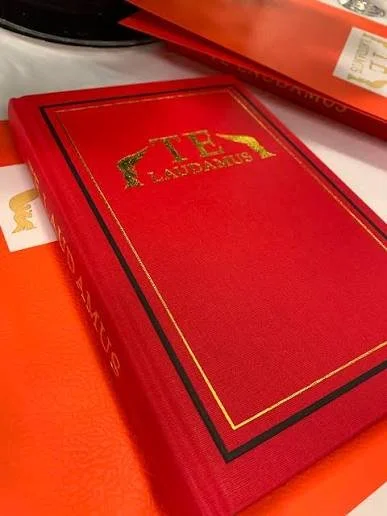
Te Laudamus: Thee We Praise
Michael J. Albrecht’s two-page Prologue to this Lutheran hymnal supplement is addressed to God, fittingly phrased as a Te Deum: “You come first. You are the Creator of the universe,” etc. Not unlike Martin Luther’s prefaces to various hymnals and subsequent hymnal introductions through the centuries, this Prologue is fitting both for the title of this hymnal (“Thee We Praise”) and indicative of what the reader will find in Te Laudamus.
Following the usual front matter, this hymnal includes all 150 Psalms pointed to the traditional Gregorian tones. Instructions for chanting the Psalms are included since many pastors, choirs, and laymen--probably raised on metrical Psalms--will need some guidance and some practice, but the rich legacy and sublimity of Gregorian chant is worth the effort. In chant the music carries the text in the beauty of simplicity, so that the text predominates as the faithful take up the prayerbook of Christ Himself. Since many Lutheran hymns are based on plainchant and the word “chorale” means chant, the rewards for learning even a few Psalm tones will bear musical fruit in congregational singing as the faithful explore our astonishingly rich musical heritage.
The hymn section follows, arranged by the church year, followed by theological topics and hymns for specific occasions. In my estimation this gathering of historic Reformation hymns, well known and long forgotten, makes Te Laudamus unique as a hymnal. In contrast to “official” hymnals of various Lutheran church bodies there is no evidence of compromise in the selection of the hymns. (How else can one account for the curious presence of praise songs by Twila Paris alongside hymns by Paul Gerhardt in many recent hymnals?) This collection reflects decades of painstaking work in selecting, translating, and typesetting over a dozen hymns by Martin Franzmann, twelve tunes by Johann Crüger, nineteen translations by Matthew Carver, nearly a dozen harmonizations by J. S. Bach, and much more. The editors made every effort to include all stanzas of a hymn whenever possible.
The role of the hymnal as a prayerbook is also facilitated by numerous collects, including several by Veit Dietrich, and beautiful works of art, with special focus on the art of the Renaissance, also Martin Luther’s Christian Questions & Answers. The result is a compendium of transcendent values viewed through a Christological lens: the truth of the Gospel, the beauty of art and music, and the goodness of the Lord who dwells among us in word and sacrament.
The Liturgy section in the back of the hymnal includes the Common Service with music by Healey Willan, a Canadian composer who was gifted with a remarkable ability to write music that is both substantive and singable. This is a tremendous gift to the church. The text of the “Page 15” Service is still familiar to many, especially devotees of The Lutheran Hymnal. As for the music, the Willan estate is notoriously uncooperative on copyright issues, leaving his liturgical music largely unknown among Lutherans. The Willan settings contained here are a long-awaited opportunity to move beyond the sentimental attachments to the music of the 1941 hymnal and breathe new musical life into The Common Service, but without the compositional trends of the 1960s that were evident in the music of Willan’s contemporaries. The liturgy section also includes Luther’s setting of the Te Deum and Willan’s challenging yet beautiful setting of the same. Matins and Vespers are also included, set to traditional chants from the Reformation. The Litany with music rounds out the Liturgy section.
How might one use this hymnal in the confessional Lutheran parish? It has been a few decades since the last round of Lutheran hymnals was published, so raising the funds for a new hymnal, adopting it as a congregation, and above all learning to use the hymnal are factors when considering the use of Te Laudamus. Pastors must take the lead by first placing it on their desk, upon their lips, and in their hearts as a prayerbook. Include the church musician in this effort, who will hopefully see this hymnal as nothing short of a treasure trove of Lutheran liturgy and hymns. The choirs (including the children) are next in the pedagogical hierarchy, keeping in mind that the best teacher of human voice is of course the human voice. A carefully ordered teaching plan from the kantor, through the choir, to the congregation will lead to a more profound “Alleluia.”
A common nugget of wisdom among pastors and church musicians is to use one hymnal per parish. Supplements have come and gone (for better and for worse) through the years, from the 1969 Worship Supplement (for worse!) to Hymnal Supplement 98 (for better, but hardly necessary after the publication of Lutheran Service Book). Te Laudamus “is designed as a companion—a hymnal intended not to replace or duplicate, but to complement . . . a congregation’s primary hymnal, providing . . . treasures not found in recently published hymnals” (p. xiii). This is fair enough, but the size and scope of this hymnal suggest that it might be used as the primary hymnal, or as the “hymnal of the day” on selected Sundays, to avoid the cumbersome task of switching between two hymnals. No companion volumes (traditional or electronic) are planned, so an electronic “blending” with another hymnal is nearly impossible. Introducing Te Laudamus beckons the pastor, the choir, and the congregation to their catechetical role in teaching psalms, hymns, and liturgy, confident that the prayer of the church teaches the church.
In his hymnal prefaces, Luther often mentions his desire for poets and musicians to write hymns and set liturgy in the common language of the people, along with the deductive conclusion that this longing was unfulfilled in his lifetime. Five centuries later, it is difficult to imagine a greater gift to Lutheran worship or a richer fulfillment of Luther’s desires than the treasures contained in Te Laudamus.
Brian Hamer
Oceanside, CA
For more information or to order, see www.telaudamus.org -ed.