

A Tale of Two Tetelestais
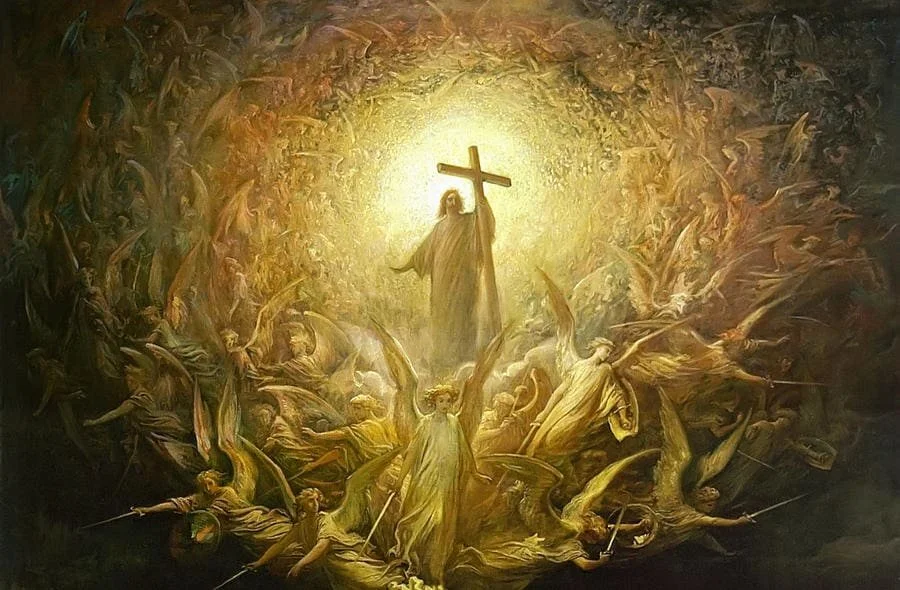
So called “Contemporary Worship” - or as it is often called today “modern worship” - employs pop songs instead of hymns. There are several problems with this. Part of it is that the sources of much of this music are writers who believe in the NAR heresy - or at very least, those who deny the Real Presence and replace the objectivity of sacraments with the subjectivity of emotions. But even with Lutheran songwriters, there are still issues. One of these issues is that tastes in pop music run the gamut from soft rock and so-called “adult contemporary,” to jazz, rock and roll, techno, rap, heavy metal, country - and a host of subgenres. So which pop music will the congregation of diverse ages subcultures and preferred musical tastes sing in their corporate worship?
Perhaps because of this “lowest common denominator” dilemma, in the practical sense, there is the undeniable reality that pop “worship music” gravitates to effeminacy, to a soft and airy sound, with no rough edges. The singers are often young, emotive women, which adds to the genre’s “Boyfriend Jesus” vibe. Unlike many of our hymns and chorales, there just isn’t a sense of manly gravitas, majesty, or the expression of the epic, powerful, and glorious. This stuff is just uninspiring. This contrast is especially clear given the combination of the robust lyrical tradition of our chorales and the fact that many of our greatest hymnwriters were themselves pastors ministering during the times of the brutal Thirty Year’s War and outbreaks of the plague. Some of our greatest hymnists officiated at thousands of funerals. These men knew the Theology of the Cross through living it. The contrast is at times stark.
This is particularly an issue in the Easter season and after Ascension.
Now, to be sure, not every hymn used in worship has to be testosterone-laced and triumphant. There is a time and place for sadness, confession, tenderness, and lament. That said, the usual CoWo praise song just comes across as whining - even when it is a time to celebrate the victory of the Lamb.
The traditional hymns of the church bypass the issue of diversity of tastes by not siding with one ephemeral style or the other. This was beautifully illustrated to me one service when I reflected upon the sight of two parishioners heartily singing the same hymn: one of whom was a 93 year old man and the other was a 3 year old girl. Pop music, by its nature, cannot do the same thing. Nor do songs without staying power become part of the long and timeless tradition and metaculture of the church universal.
The organ, in addition to being a simulation of the human voice (allowing for pitches to be easily matched, including the singing of harmonies), is known as the “king of instruments.” It is capable of a wide range of expression, from the soft and meditative, to the epic and thundering. There is indeed a time for pulling out all the stops and letting the organ confess, say, the resurrection of our Lord Jesus Christ, with chest-rattling volume and power.
So while I believe that pop music of any kind is not appropriate for worship, especially for liturgical worship that confesses the miracle of the Real Presence, there are other occasions where Christian pop music can be quite edifying. Sadly, a lot of Christian pop music apes the popular neo-Evangelical megachurch “worship” genre of wispy, breathy, soft whininess instead of an inspiring and potent expression more fitting to the occasion of the triumph of a victorious general. It is yet another example of a culture that has been tamed and gelded, a retelling of the narrative of Jesus as the exemplar of niceness rather than as the conquering Hero who redeems us militantly by His blood. It is not only to reduce Aslan to the status of a safe (oh, that word!) and tame lion, but even to the point of being a neutered and declawed housecat.
Here is an example of an Easter song that is not typical of Christian pop “worship music.” YouTube won’t allow me to embed it, so you’ll have to click the link.
I realize that it is AI. The human author of the project uses AI to bring his vision of such compositions to life. Nothing would prohibit a human band from playing and performing his songs. This particular offering is called “The Strife is Over” which pays homage to the Christian hymn “The Strife is O’er, the Battle Done” (LSB 464) a translation of Finita Iam Sunt Praelia, originally published in 1695 (though it may be much older). In addition to the title and the first line, the song, like the hymn, includes the motif of the “Alleluias,” the thematic element of Christus Victor, the descent into hell, and the resurrection itself. The song begins with our Lord’s victorious Tetelestai! (“It is finished!”) from the cross. It also picks up the line “Christ the Lord is risen today” near the conclusion - which is the title of the hymn on the opposite page in the hymnal (LSB 463), a translation of Victimae Paschali Laudes, attributed to Wipo of Burgundy (d. ca. 1050).
“The Strife is Over” represents a break from the usual genre of “praise and worship” songs that one hears in so-called “modern worship” in lieu of our traditional hymnody.
A few years ago, my wife and I took our teenage son to see his favorite band Skillet. They are Christians, and much of their music reflects their faith. They were part of a large line-up of Christian bands. They were the only ones from the hard rock genre. We endured the several warm-ups that played the usual bland CoWo fare - including a chanteuse named Kari Jobe - a Non-Denominational “worship pastor” who once headlined a Texas District event. It was painful for the entire family. But it was worth the wait. When Skillet took the stage, my son rallied like a plant after being watered for the first time in a week. Without exception, all of the earlier performers were simply insufferable, low-watt, and uninspiring. They all sounded the same, and did not artistically portray the epic nature of our Christian faith or of our triumphant King.
This following offering, recently produced by LCMS Lutherans, is very good in terms of musicianship. There is no heresy or false doctrine in the lyrics. Like the above “The Strife is Over,” it begins with our Lord’s Tetelestai! (“It is finished!”). It is intended to be a celebration of Easter. But it lacks any whiff of the epic. There is no sense of triumph. It sounds more like a lament of defeat. I realize that I bring my own biases to the table (which is part of my argument as to why pop music doesn’t belong in the worship). But there is clearly an objective lack of potency, of the triumphant confession of Christus Victor. Compare it to the above offering. To be clear, I’m not disparaging the faith, sincerity, or musicianship of anyone involved in this video. I’m expressing my opinion that the typical CoWo artistic genre is artistically incongruent with the glorious sublimity of the cross and the resurrection. This is my opinion. Others are free to disagree.
By way of another anecdote, an old friend took me to a Korean War monument. The statue portrayed an American soldier hanging his head in his rain gear. This motif annoyed my friend (a fellow ethnic Scottish Highlander). He said something to the effect that if this were a statue of a warrior in Scotland, the soldier would be holding aloft the bloody severed head of his enemy. It goes without saying that we of Highland heritage know all about defeat and lament. We have our share of songs and poems and historical memory of suffering and loss. But we also have a stubborn warrior ethos, and our folkways lionize men like my kinsman Major Gillies MacBean, who, while trapped against a wall during the Battle of Colloden, mowed down thirteen Englishmen with his broadsword before being mortally wounded by the enemy. While much of our Western tradition of strong heroes and warriors is being ground down by subversion and defeatism, the architype of the warrior and the celebration of manly courage and virtue still refuses to go quietly into the night. And this is true especially among young men - the same demographic that is surprising its elders by marching its way back into the Church Militant.
The imagery of a victorious warrior holding a severed head aloft is a fit descriptor of Christ the Victor. David, the Shepherd-King and our Lord’s royal ancestor, is a type of Christ. He not only slew Goliath the giant, but severed his head and carried it around as a trophy (1 Sam 17:51, 54). Our Lord Jesus Christ smashes the head of the serpent (Gen 3:15). Far from being wispy and effeminate, our Lord is the archetypal Warrior-King who destroys His foe, and even takes a victory lap in hell itself.
So if we are going to have Christian pop music to enjoy outside of the Divine Service - and there is no reason we shouldn’t - there should be room for the epic, the triumphal, the glorious - as befits our Christus Victor, our “Rex regum et Dominus dominantium,” the one who crushes the head of the serpent for us, who decapitates evil on our behalf, and who hurls the demons into hell.
As our forbears of long ago intoned triumphantly: “Christus vincit! Christus regnat! Christus imperat!”