

Through the Church the Song Goes On - to Follow In Their Train
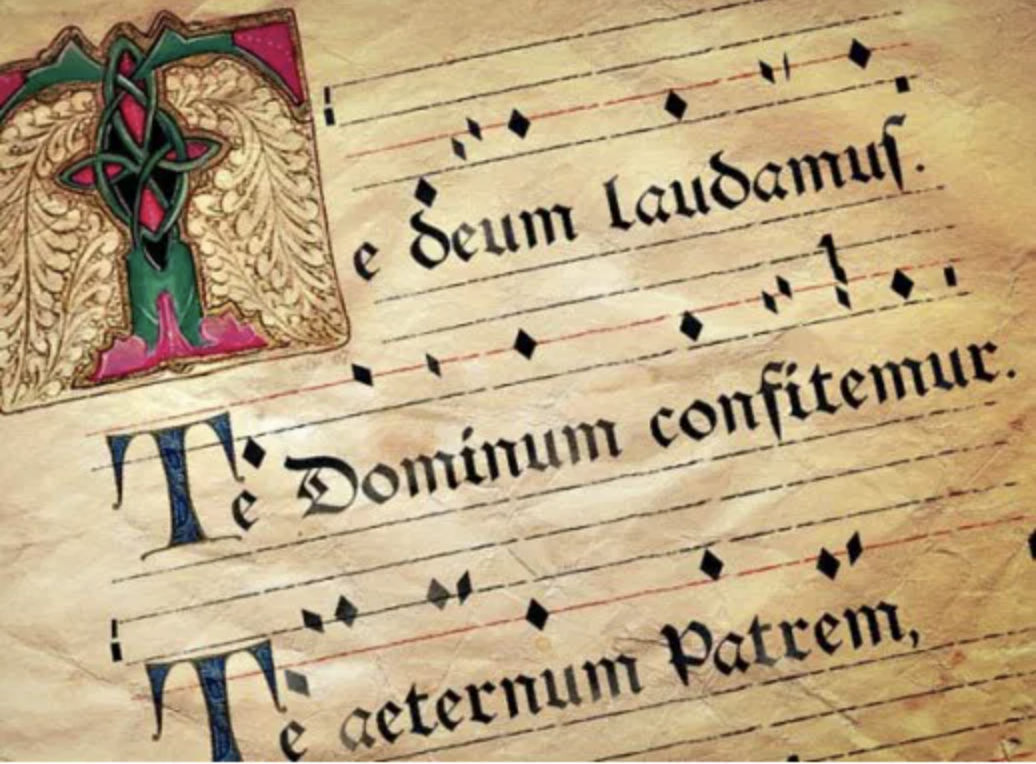
Lo, the apostles’ holy train
Join Thy sacred name to hallow;
Prophets swell the glad refrain,
And the white-robed martyrs follow,
And from morning to set of sun
Through the Church the song goes on
— LSB 940:3
As a postscript to my earlier piece about liturgical deracination, I have some reflections on the Te Deum Laudamus.
This magnificent hymn of the church, with Luther rightfully considered creedal, is part of our Lutheran and our catholic Christian identity. Perhaps as a kind of silver lining to the less-than-ideal practice of intentionally scheduling certain Sundays to deny all of the faithful the opportunity to take Holy Communion, many Lutherans in the TLH era became familiar with the Office of Matins, and with the ancient hymn often attributed to Bishop St. Ambrose of Milan (339-397), the Te Deum Laudamus, sung in English and set to a form of Anglican chant (LSB 223).
Because of the antiquity and popularity of this hymn, originally sung in Latin in Gregorian chant, it has been translated into many languages and paraphrased and set into different musical settings (e.g. LSB 939, 940, and 941). Luther’s German Te Deum - which was also translated into English, but didn’t make the LSB cut - is a beautiful antiphonal chant.
And given that the early Lutherans retained Matins and Vespers from the monastic orders for use in church and home, the Te Deum is part of our Lutheran identity. Sadly, it is yet another casualty of the CoWo deracination, one more severance from the roots of our history.
For once again, this hymn connects us to Ambrose and Augustine, to centuries of Christians who sang God’s praise having learned, and passed on, this hymn one link at a time throughout the centuries. Or as one of the Te Deum paraphrases puts it: “Through the Church the Song Goes On” (LSB 940:3).
One example of this song going on that is part of our Christian heritage involves the attempted deracination of the church during the French Revolution.
At the tail end of the reign of terror, shortly before the terror’s architect Maximilien Robespierre would meet his own end on Madame Guillotine on July 28, 1794, there were two groups of martyrs who went to the guillotine singing the Te Deum.
The Martyrs of Orange
Between July 9 and 26, 1794, 32 nuns were beheaded in a Roman theater in Orange France:
During the troubles of the French Revolution, 29 Sisters, expelled from their convents, found refuge in a house at Bollène. During their eighteen months there, they shared their life of prayer and total poverty. Arrested in April 1794 because they refused to swear the oath required by the city officials, an oath their conscience condemned, they were jailed on May 2 at Orange, in the Rectory’s prison, near the Cathedral, where 13 other Sisters were already imprisoned.
They organized themselves in a single community and consecrated the essential part of their time to prayer. Condemned to die by the Popular Commission, then commanding in the actual Chapel of Saint-Louis, they were transferred to the ancient Theater, where they awaited to climb the guillotine erected in Saint Martin’s Court. They all went up to the scaffold joyfully, singing and praying for their persecutors, who admired their courage : “These bougresses are all dying with laughter!” Ten other jailed Sisters were saved by the fall of Robespierre on July 28, and liberated in 1795.
The bodies of the Martyrs were thrown in mass graves in the field of Lapolane (at Gabet), 4 kilometers from the town, on the edge of the Aygues River, and a Chapel was built there in 1832.
One of the hymns sung by the sisters on the way to the scaffold was their beloved Te Deum Laudamus - which specifically mentions the “noble army of martyrs.”
Martyrs of Compiègne
Almost at the same time, on July 17, 1794, another group of nuns was being executed in Paris. They were also courageous, and went to their deaths not only laughing (to the awe of their executioners), but also singing hymns, including the Te Deum. While awaiting execution, they also sang Veni Creator Spiritus (LSB 499), as well as the offices of Vespers (LSB 229) and Compline (LSB 253).
As the sixteen sisters mounted the scaffold one after another, they chanted Psalm 116 (which is also in our LSB hymnal), each one singing until the blade dropped, and the next picked up where the previous sister left off.
Obviously, these sisters are not from our Lutheran tradition, and nobody is denying the differences that we have with Rome that inhibits communion with them. But that said, these women were martyrs because of their confession of our Lord Jesus Christ. They were strengthened by knowing these ancient Psalms and canticles that rooted them into the church’s ongoing story: “through the church the song goes on.” How impoverished are those in our synod who have gotten rid of the hymnal and its treasures. One can only wonder what they would sing were martyrdom be foisted upon us in our day.
Do We Follow In Their Train?
Another hymn in our hymnal that non-liturgical and non-hymnal congregations have cut themselves off from is "The Son of God Goes Forth to War” (LSB 661) from the “Church Militant” section. I suspect that even many of our liturgical churches don’t sing this inspiring hymn that connects us to the martyrs. For the same theme is in there: our collective memory and praise of “the noble army of martyrs” as we sing in the Te Deum. Movie aficionados may recognize the hymn (though sung to a different tune) from the 1975 Sean Connery film (based on the Rudyard Kipling novella) “The Man Who Would Be King.” This text, written by Anglican Bishop Reginald Heber (1783-1826) - the favorite hymn of General George S. Patton, sung at his funeral - certainly seems inspired by the Te Deum Laudamus as well. We do well to sing this hymn and remember the cost of discipleship, including the Christian heroines who sang the Te Deum as they made their way to the scaffold at the bloody end of the Reign of Terror. May we never forget our history through the decoupling of the train and self-deracination. And where we have been severed from our past, let us seek to restore that which was taken from us.
A glorious band, the chosen few,
On whom the Spirit came,
Twelve valiant saints — their hope they knew
And mocked the cross and flame.
They met the tyrant’s brandished steel,
The lion’s gory mane;
They bowed their necks their death to feel —
Who follows in their train?
A noble army, men and boys,
The matron and the maid,
Around the Savior’s throne rejoice,
In robes of light arrayed.
They climbed the steep ascent of heav’n
Through peril, toil, and pain.
O God, to us may grace be giv’n
To follow in their train. (LSB 661:3-4)
Postscript
Just a few days after publishing this, the LCMS-based Center for Worship Leadership (The Songwriter Initiative) made my point by taking the inspiring, ancient, rousing, militant Te Deum and subjected it to this stylistic interpretation. Can anyone imagine the sisters mounting the scaffold for decapitation singing it like this? Is this genre capable of the militant, inspiring, majestic, and epic? Must every song sound like this?