
A Tale of Two Worship Videos
Liturgical worship developed organically in response to the miracle of our Lord’s Presence with us in Word and Sacrament. It is no accident that every ancient pre-Reformation church tradition was, and is, liturgical. Lutherans - especially as confessed in the Book of Concord and in the historic practice of our churches - followed in continuity, since we are a continuum from the church of the apostles “in doctrine and in ceremonies” (AC Conclusion 5) retaining the liturgical order of the western Mass (AC 24:1, Ap 24:1). Along with the church that came before us, we too confess the Real Presence, and this sacramental credendi is matched by and supported by our liturgical orandi.
Likewise, the worship practices of the radical reformation are also organic, resulting from a denial of the Real Presence. Incarnational elements of worship, such as images and statues, were purged. Ceremonies that confess the Real Presence - like bowing, kneeling, the sign of the cross at certain moments, bells, even candles placed on the altar - were excised. Continuity with the past was purposefully severed. Reverence during the consecration of the elements was relaxed in harmony with their confession that this is merely a symbolic, natural ritual, rather than the miraculous manifestation of the supernatural Divine Presence.
Today, the difference between the liturgical worship of historic Christianity and the modern worship of contemporary Evangelicals (so-called) is stark. The former maintain the continuum of litugical identity, even within a diversity of specific traditions. The latter also have a unifying principle of casualness and entertainment, also within a diversity of specific traditions. But it is undeniable that there are two distinct streams within modern Christianity. And their respective orandies reflect their respective credendies.
But Lutherans have gone schizophrenic: trying to pound the square peg of “modern worship” orandi into the round hole of confessional Lutheran credendi.
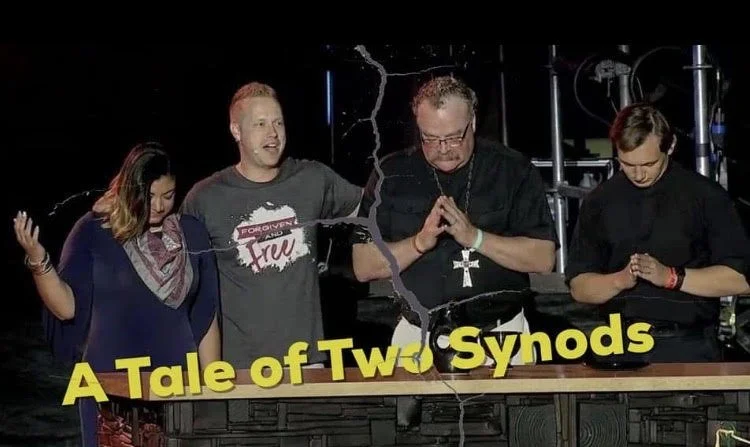
And the results are predictable: confusion, offense, and disunity. Advocates of “modern worship” say that the problem is with the unloving, inflexible liturgicals who won’t just yield and accept them. Their strategy is to wear down the liturgicals through the velvet glove of endless “conversation” combined with their iron fist of leveraging their money and potential synodical power by trying to change the calculus of voting (giving themselves extra votes while seeking to disenfranchise normal-sized churches), as well as seeking to end the liturgical bent of the synod’s leadership through elections and resolutions.
We can see the two divergent approaches in these two videos.
In this first offering, Fr. David Kind, pastor of University Lutheran Chapel in Minneapolis (a liturgical congregation that the “missional” faction temporarily succeeded in literally bulldozing), gives a presentation that explains the maxim “lex orandi, lex credendi,” and why it matters in authentic Lutheran worship. Pastor Kind isn’t merely talking, but we see images of worship as he celebrates and officiates in his parish. We see the lexes in harmony with one another, complementing and feeding into each other - teaching the people “what they need to know about Christ” (AC 24:3).
In the second, we see a different approach: the latest in the quest for the historical eating the cake of Evangelical (so-called) style while retaining the cake of Lutheran substance. Fr. Steve Zank and Mr. Kip Fox are rostered faculty members of Concordia - Irvine. In this video, they use a synod resolution as a roadmap to explain their attempt at a via media between what they consider to be two extremes. They are part of the Center for Worship Leadership, and they provide alternative liturgies and soft-rock worship music that reflect their approach.
They are trying, yet again, to walk that Lueckean tightrope between Evangelical (so-called) style (orandi) and Lutheran substance (credendi).
In the current Gottesdienst print journal, Fr. Eckardt wrote a piece called “Reflections of a Recovering Praise Band Leader.” In this autobiographical article (confession?), we learn that Fritz was a piano player in a praise band at a church called Calvary Chapel (a Calvary Chapel, not the Calvary Chapel). As he was becoming Lutheran, his contemporary worship began to reflect his shifting theology. In his own words:
I crafted an entire “liturgy” for the whole congregation at Calvary to sing. I called it “The Rock Mass.” My conservative nature kept me from writing lyrics out of sheer cloth; instead I stuck to the words of the traditional liturgy I had recently learned at Calvary, which offered both “contemporary” and “traditional” forms of worship, and in those days “traditional” still meant using The Lutheran Hymnal. But that was so dry and dull, compared with the flair of the contemporary style I had learned to love. So I came up with the bright idea of setting those words to my kind of music. All the parts were there: Kyrie, Gloria, Creed, Offertory, Sanctus, Agnus Dei, and Nunc Dimittis. But the music was rock and roll. I presented it to the church council, and they were thrilled. Soon the Rock Mass was a favorite form of liturgy at Calvary Chapel. The kids were rocking out, having fun, grooving with the beat, and singing the very words of the liturgy. One could even say that Evangelical style and Lutheran substance were fully on display in the Rock Mass. And it was so much fun; I couldn’t wait for Sunday mornings to come, so we could perform it again. Worship was thrilling.
If you want to read the whole piece, you can download the current Gottesdienst here.
There aren’t any extant videos of Fr. Eckardt’s Rock Mass, but if you’re interested in a heavy metal attempt, there is a Finnish Lutheran priest who tours the country with his band. Of course this is the official Finnish “church” that “ordains” women, and this is the country that prosecutes and convicts faithful Christians for their biblical confession - so keep that in mind.
Here is an excerpt from a service:
And while the magic cargo-cult word “context” is often used to say that as long as the words (credendi) are orthodox, the style (orandi) doesn’t matter, I do think that here in the real world, none of our LCMS contextualizers will be using this arrangement of a hymn (arranged and performed by a Christian band) that has passed doctrinal review:
The bottom line is that we have to decide the role, if any, entertainment plays in Christian, and more specifically, authentic Lutheran, worship. Speaking of authentic Lutheran worship videos, Gottesdienst has some of our own that you can watch here. And for a mix of Divine Services and talks about Lutheran worship, you can check out this search for “Divine Service” at Flaneur Record.