

Who are the Real Nominalists? Is it Baked into Wittenberg or Rome?
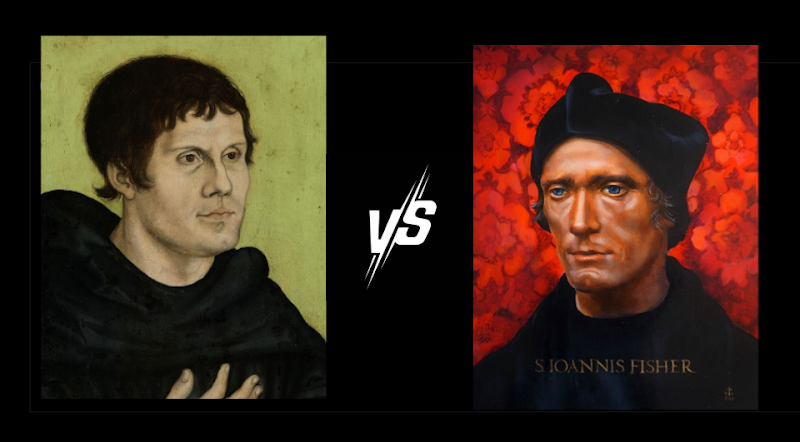
By Nathan Rinne
Review and comments on the article, “Bishop John Fisher’s Response to Martin Luther”
“I am not aware of modern Catholic theologians who have attacked [John] Fisher in the way the ‘Nominalists’ have been subject to vilification. Presumably, it is Fisher’s now canonized status that protects him, in spite of the vulnerability of his statements.”
– Thomas P. Scheck
“The Scottish humanist Florentius Volusenus later told the story of a conversation at Rochester, probably around 1530, in the course of which Fisher admitted to him that he wondered what divine providence meant by making some Lutherans such fruitful commentators on Scripture despite their being heretics.”
– Richard Rex
Introduction
In these last days, as the influence of Christendom wanes and fades in the Western world, we often might breathe a sigh of relief when a relative, for example, chooses to marry any Christian, including a Roman Catholic.
I fully understand this sentiment. And yet, I nevertheless would still be quite concerned about such marriages.
When we were first married many years ago now, my lovely wife taught junior high science at a Roman Catholic school. Growing up, one of her favorite relatives was her great aunt, a devout Roman Catholic woman who also, interestingly, loved the good Lutheran hymns from The Lutheran Hymnal, “TLH”. Besides the fact that she is quite special herself, I am certain that my wife's affection for her very devout great aunt played a role in her getting that teaching job – perhaps in addition to the fact that the priest at that parish had many conservative confessional Lutheran friends!
One day while at that school, my wife heard a chapel service in which a guest preacher gave a sermon that did not mention Christ once but did tell all the students – through the use of a very memorable story – that one must "do what one can” to be saved. In her science class during the next hour, my wife shared the message of God's free grace in Jesus Christ in a very heartfelt way to students who heard her with interest. In any case, who was that seemingly renegade priest and what had just happened?! This, after all, was not the Roman Catholic Church that she had grown to respect in her life!
Up until a couple weeks ago, I had often wondered where in the world that priest came from as well! In the past 25 years or so, when I have taken the time to listen to programs like Catholic Answers or the typical Relevant Radio fare, I simply do not recall coming across people who taught like that priest.[1]
A Fascinating Yet Apparently Neglected Opponent
The mystery was recently solved for me after my wife, who still pays some attention to Roman Catholic happenings, informed me about the heroic life of Bishop John Fisher, of whom this article is about.
This will take some explaining. To start off, many contemporary intellectual Roman Catholics see Lutheranism as an unhappy result of a short-lived school of medieval thought called Nominalism. No doubt, in modern Catholicism, Nominalism is viewed as a definitional enemy of Orthodox Catholicism, which is largely based on the thought of Saint Thomas Aquinas.
Both this current piece, and the Franciscan Studies journal article it reviews and builds upon, Thomas P. Scheck's 2013 Franciscan Studies “Bishop John Fisher’s Response to Martin Luther,” challenges this common narrative in their own ways.
Both articles show that in the Middle Ages Nominalism was truly a respected and accepted ontological and theological school within Roman circles, prior to Protestant circles existing. Moreover, both those for and against the Reformation made use of the tradition. Indeed, there can be no doubt that Scheck – who is a former Associate Professor of Theology and Classics at the very conservative Ave Maria University – has produced a piece that will be of some major interest to many serious Lutherans!
Let's begin by way of some very interesting biographical background regarding Bishop John Fisher. In 1935, he, along with Sir Thomas More, was made a saint in the Roman Catholic church. The reason that this happened concurrently has to do with the fact that both men stood up to King Henry the VIII in his efforts to dispose of his current wife in favor of another. Aware of the fact that Martin Luther had faltered in allowing Philip of Hesse to take another wife, Fisher’s heroic stand had spoken to my wife, who had also learned about his writing against Luther.
After forty-one of Martin Luther's views were condemned by a Papal Bull in 1520, the reformer responded to it, and then, a short time later in early 1523, John Fisher took the time to counter each of Luther's responses in his “Confutation of Luther’s Assertion”. That work is still today only available in Latin and not in English, even as Scheck has apparently adequately summed up the work, as well as offered a recent translation of key parts of it.
What is particularly interesting about Fisher vis a vis many of Luther’s other opponents is that he was universally revered as a Franciscan man of great piety. In his Dec. 2025 First Things article about Fisher, “Make Me A Lutheran”, Richard Rex shares a number of quotes that help us to form a better picture of the man:
“Fisher’s Confutation was widely read in its time, running to about 20 editions by 1600, many of them published in the 1520s, and it left its mark on the Catholic response to what would come to be called ‘the Reformation.’ It was often cited or invoked at the Council of Trent in the middle of the century, its reputation enhanced by its author’s status as one of the first Catholic martyrs of the English Reformation….”
When it came to his opposition to Luther, with Luther’s, Rex says, “relentless and egotistical insistence on absolute assent to whatever he happened to decide was the plain meaning of Scripture” (“scriptural interpretation can never be the plain and simple thing that Luther said”!), he emphasizes Fisher’s duties and responsibilities as a bishop:
“Fisher wrote against Luther because it was his duty to do so. Everything Fisher published (as well as most of the things he wrote that remained unprinted) was the fulfillment of some very definite duty…. his sermon at the burning of Luther’s books in 1521 was presumably delivered at the command of Henry VIII or Cardinal Wolsey, or both, since they had planned the entire occasion. Fisher made clear that his Confutation of Luther’s Assertion, like all his efforts in polemical theology, was written in pursuance of his duty as a bishop to defend the souls entrusted to his care from the snares of heresy. If Erasmus’s identity was essentially authorial, Fisher’s was above all pastoral.”
Deeply concerned, he fought Luther for no other reason than the sheer duty to counter heretics:
“The progress of Lutheran and other heretical doctrines at Fisher’s beloved alma mater caused him increasing grief over the next ten years. In February 1526 he preached another sermon at Paul’s Cross, this time at the first public recantation of the newfangled dissidents in England. Most of those disavowing heretical beliefs on that occasion were German merchants from the ‘Steelyard’ (the Hanseatic trading station in London), whom Thomas More had found in possession of Lutheran books during a spot search. But with them was Dr. Robert Barnes, who had preached a sermon modeled on one of Luther’s at the little church of St. Edward’s, just off the market square in Cambridge, on Christmas Eve 1525. This airing of Lutheran ideas by a member of the Cambridge Divinity Faculty must have seemed to Fisher an almost personal betrayal. Publishing his sermon soon afterward, he explained: ‘My duty is after my poor power to resist these heretics, the which cease not to subvert the church of Christ.’”
Rex also says that “Fisher had never been a courtier, and he was an austere, somewhat forbidding figure, of whom it was once said, ‘not only of his equals, but even of his superiors, he was both honoured and feared.’”’ So Fisher had the respect of many of his contemporaries, including Erasmus, and what is of particular interest to us is that, again, his views appear to have been a major factor in the deliberations and final statements of the Council of Trent (Scheck: “especially [with regard to] the ecclesiastical tolerance of the [non-Augustinian] scholastic concept of meritum de congruo”)!
It is therefore intriguing that Fisher’s respectful and scholarly response to Luther was never directly responded to. Scheck quotes Erasmus at the end of his article saying to Martin Luther: “[Bishop John Fisher] is tried and true, a man of learning, dignity, and a holiness not often to be encountered; and he challenges you time after time and you do not come forth to struggle with him.”
Rome Should Celebrate the Nominalist Fisher!
Ready to do a deep dive into scholastic and reformation theology? Things will be getting a little bit harder going at this point, but I hope you might still choose to stay with me!
Rex does not associate Fisher with the Nominalist scholastics and the “via moderna” vis a vis the “via antiqua”[2], but Scheck does, and convincingly so. I am at a loss to express how significant I think that this work from Scheck on John Fisher is. Here is a taste of the main thrust of his paper:
“My thesis is that Bishop John Fisher seems to have made a productive contribution to Catholic dogma in the sixteenth century, and that his learning and Episcopal authority may even have been a factor in the Catholic Church’s tolerance of the theories concerning the working of divine grace espoused by certain streams of scholastic theology. This claim makes a difference because some modern Catholic theologians, as I shall exemplify below, have attempted to vindicate Luther to some extent, in the name of doing ecumenical theology, by accusing pre-Reformation Catholicism of doctrinal decadence. These moderns have by and large left Fisher out of the discussion and have refrained from making him the target of their accusations. I suspect that the reason for this is that his canonization in 1935 has formed a protective shield around him. And yet Fisher strongly supports the very doctrines that have been vehemently assailed as being ‘Pelagian’ and ‘Semi-Pelagian.’ Consequently, either the moderns should add St. John Fisher’s name to their catalogue of ‘decadent late-medieval Catholic theologians,’ or they should cease making accusations against the congruous merit doctrine that the Church, to my knowledge, has never censured.”
So even as he speaks about the “problematic philosophical positions of Nominalism”[3], Scheck says that the sainted Bishop Fisher was a Nominalist in the later scholastic fashion and that he certainly helped get the idea of "congruous merit” accepted in the Council of Trent. And that basically Roman Catholics need to be honest about and proud of this fact!
To repeat for emphasis, Scheck’s article is largely about how Fisher – along with, significantly, the scholastics who came before him – affirmed the doctrine of congruous merit, a topic that, interestingly enough, is not mentioned in the new Roman Catholic Catechism. So what is this apparently valid and even critical yet apparently somewhat neglected doctrine? It is “that the human being in his natural state, or the baptized Christian in the state of mortal sin, can, even without the assistance of supernatural grace, become worthy of, or merit, God’s reward, in some sense” (italics mine).
As one does what lies within, the thing merited would not be eternal life or salvation right away, but rather one becoming worthy of God's grace in some sense, grace which the sinner is then able to meritoriously cooperate with in their progress towards their salvation and the overall process of salvation (477).
This congruous merit or “merit of congruity” is “God’s loving promise to reward human effort”, and it is a mercy, not something based on the strict justice God obligates himself to fulfill. That kind of merit, called “condign merit”, is something Scheck says that all Scholastics rejected (in the sense “that man apart from a supernatural infusion of grace can obligate God to reward”).
The significance of all of this should not be lost on serious Lutherans and other Bible-believing Protestants who exult in the doctrine of justification by grace through faith. Over and against 20th century Thomist objections about the “decadent influence of a Nominalism” that supposedly was most responsible for causing the Reformation disaster, all of this from Scheck, given that it is accurate, itself essentially validates the traditional Lutheran critique and the necessary reformation of the church.
Again, the case is only further strengthened when we read from Scheck that “the positions that John Fisher will adopt and defend against Luther’s assertions will eventually become the official doctrine of the Catholic Church.”
Truths, Long Hidden, Coming to Light?!
Evidently, even many well informed and educated contemporary (yet traditionally-minded) Roman Catholics who are mostly familiar with the content of the new catechism simply do not know what they are missing!
And Scheck’s article makes or establishes a number of claims that this Lutheran as well, somewhat familiar with the teachings of the Catholic church, found to be quite illuminating. Items from his article – in addition to things found in other sources that help us to better understand what he writes – follow:
”To my knowledge the term ‘Semi-Pelagian’ was first coined in a Christian creedal statement in the Lutheran Formula of Concord (1577/80).”
That very term was later used by Thomist or Dominican theologians against the Jesuit Luis de Molina, who had attempted to create a synthesis between the doctrine of election and free-will (see more on this specifically in a recent blog post that I did on the topic).
Even as some Roman Catholics like Harry J. McSorley follow Heiko Oberman and say men like Erasmus and Gabriel Biel were “Neo-semi-Pelagians”, Scheck vigorously denies this.
The Nominalists are certainly not Pelagians, for they “have no separation of divine grace from human free will.” “The Pelagian claim is that the sinner can earn grace without divine aid; in other words, that the sinner’s actions are sufficient for grace” (Cross).
So, according to Scheck, these are not Pelagians because the “human activity which counts as disposition towards justification must be regarded as presupposing the context of grace.”[4]
For instance, Bonaventure says that the gratia gratis data (gratuitously given grace) “is always at hand to rouse it [free will], and with its aid the will can exert itself to the full.” This would go hand-in-hand with “actual grace”, a theological term that originated only after the Council of Trent (495, 496).
Here, evidently, the merit of Christ, the merit accomplished by Christ, would also be said to be in the background, assumed. Even if in practice, explicit mention of, or gesturing toward, Christ and his work need not necessarily always accompany grace.
Again, no scholastic theologian was really a Pelagian because there is no “inner connection” between nature and grace. In other words, doing the right things does not, strictly speaking (i.e., according to strict justice), earn grace as a necessary reward that God obligates himself to fulfill.
So, perhaps, strictly speaking — very technically speaking — it might appear that no one “deserves mercy”, or grace. At the same time, Scheck nevertheless quotes Fisher talking about how the sinner “can do many good works with the help of [] grace” whereby he can “earn pardon” (499)!
Thomists these days might say God’s gift of redemption/eternal life can only be received or accepted in faith via an act of freewill – but not earned (Malloy) ; also, Pope Benedict in fact went so far to say we can't merit heaven![5]
Still, again, Trent remains. And “perhaps [Fisher’s] Episcopal authority contributed to the tolerance of these scholastic concepts which seem to owe very little to Augustine’s late anti-Pelagian theology.”
Fisher also used a quote from a man who was thought to be Augustine, the late 5th century church historian Gennadius of Marseilles, to support “freedom of the human will and… synergism or human collaboration in the process of salvation”, meaning initial justification or regeneration. Men like Lombard, Bonaventure, Scotus, Aquinas, and John Eck also used this same quote, and also attributed it to Augustine.
The Roman Catholic apologist Dave Armstrong says that Pelagianism is basically “salvation by works” and semi-Pelagianism means “[being] saved partially by our own self-generated works” (italics mine), whereas, in truth, the very choosing to seek God “is always caused by God”.[6]
Given what we have learned about “gratuitously given grace” or “the context of grace” above, Armstrong's sentiment is understandable. That said, when congruous merit essentially admits to self-generated works or works done by nature, the label “semi-Pelagianism” seems apt.
Again, congruous merit is “that the human being in his natural state, or the baptized Christian in the state of mortal sin, can, even without the assistance of supernatural grace, become worthy of, or merit, God’s reward, in some sense” (italics mine).
”[The Thomist Francis] Clark remarks that if Pelagianism is defined to mean the free cooperation of the human will with grace, then not only Biel’s theology, but all Catholic theology is Pelagian.”
So all parties in Rome will agree – following the teachings of the Council of Trent itself – that it is really possible for even unregenerate men – even if only on account of the graces that God bestows – to love God, truly keep and obey his commandments.
Still, ”Monti says that although this was often presented in a way that suggested that by ‘doing what lies within one’s power,’ a person could put God under obligation to reward him or her, the theologians of the early Franciscan School at Paris refined the meaning of this maxim, stressing that sinful human beings can in no way force God to act” (italics mine).
Regardless of that last comment, Luther's comments in Section 3 of the 1537 Smalcald Articles, official confessional documents of the Lutheran church, nevertheless still seem highly relevant here:
“It was impossible that [Rome] should teach correctly concerning repentance, since they did not [rightly] know the real sins [the real sin]. For, as has been shown above, they do not believe aright concerning original sin, but say that the natural powers of man have remained [entirely] unimpaired and incorrupt; that reason can teach aright, and the will can in accordance therewith do aright [perform those things which are taught]; that God certainly bestows His grace when a man does as much as is in him, according to his free will.”
So, to review, Scheck points out that “some of the so-called ‘Nominalist’ doctrines that have been accused of being Pelagian or semi-Pelagian are ones shared by classical scholastics such as Scotus, Aquinas and Bonaventure. Moreover these views are defended as orthodox by Fisher.” All of these men and more, for example, taught the merit of congruity, and not only as something for those in a state of grace. In particular Fisher, as a Nominalist, developed the notion of the “merit of congruity” in the same Pelagian/"semi-Pelagian” direction as others. He had a massive influence on the Council of Trent, where the Augustinian currents in the church were arguably suppressed[7], and therefore much of Rome appears to be in denial today about what it truly was and is. They seem to no longer remember, for example, the claim of John Eck in 1530 that “the monks try to pattern their lives more closely after the Gospel in order to merit eternal life” (Roman Confutation to the Augsburg Confession).
Accompanying All of This is Confusion about Luther
At this point, taking into consideration what we have learned from Scheck, we should also address his misunderstandings and misrepresentations of Martin Luther.
First of all, Scheck raises some reasonable questions and concerns about Luther’s exegesis of 1 Tim. 2:4, as well as his condemned comments about “absolute necessity” and sinful man's [non-existent] free will.[8] That said, at the same time, he goes on to wrongly attribute inconsistency to Luther simply because Luther also teaches that the new creature in Christ has freedom when his will is united to God's by faith.
This could have been avoided by addressing the wider context of the incredibly well-known debate that followed between Luther and Erasmus just a couple years later — not to mention by noting that the Lutheran Confessions, which are binding on true Lutheran pastors, extol and recommend Luther’s Bondage of the Will even as they also address and answer other important questions about the true scriptural teaching regarding predestination.
Second, it seems that Scheck misleads the reader in his paper in other ways as well, inadvertently if not significantly so. He says that Luther “stands in tension with the scholastics” and likely exaggerates the views of others when in his early Commentary on the Psalms (1515), he says that “God gives his grace ‘without fail’ to the man who does what is in him.”[9] Rather than citing Cross who says of Scotus that “the scholastic doctrine did not place God under any such obligation”, Scheck would do well to first of all recognize that Luther was mainly interacting with, and, at that time supporting, the very prominent and more contemporary Franciscan Gabriel Biel.
And was Luther interpreting Biel here fairly? (481-482). Here, it is helpful to look at Scheck favorably quoting Clark on Biel:
“He did not allege that such naturally good actions had in themselves any salutary power or merit which could establish a claim in justice, either to eternal life or to the granting of the grace of conversion. What he did hold, and it is something essentially different, is that God, from pure liberality and not from any obligation in justice, chooses to bestow grace on those who by their natural powers ‘do what in them lies’” (italics mine).
In the entire 1515 Luther quote Scheck provides, Luther indeed talks about how God made himself our debtor. Nevertheless though, rather than insisting that Luther means that God was obligated to reward men according to their works, the context of the quote makes clear that when Luther says that “God gives his grace without fail” he is expressing the way God comforts his people out of the mercy he has promised and attaches to these “do-your-best-works”. As was so often the case during his career, Luther’s first instinct, knowing his own struggles, was to be pastoral, and so he uses debt in a more metaphorical sense here to strongly make his point, attempting to bring the struggling Christian comfort.
Also, it is important to recall from earlier in the paper that Scheck also says that for all the scholastics the merit of congruity is “God’s loving promise to reward human effort”. So God promises to give grace, and Luther was not only rightly addressing men like Biel, but Scotus. For when it came to the matter of congruous merit there was no appreciable difference between the men!
Third, can Reformation theology be dismissed as Martin Luther's aberrant “scrupulosity”, OCD, or other psychological issues?[10] Even though Scheck does not make this exact claim, this belief is almost ubiquitous among contemporary Roman Catholic apologists (I think that these are the only plausible things they can cling to, given Luther's integrity), and so it is more than likely that it is in the background of his thinking (and see the footnote above).
When one takes into consideration both the above and the fact that even the apparently more tenacious Augustinians in Rome today say one might be freely committed to Christ, even have a divine faith, but also not have a true or living faith (Malloy), this accusation against Lutherans seems to be more coping than truth. It would appear that any person who is being particularly honest about both what the Bible and the Roman Catholic Church teach might have thoughts and feelings like those Luther had, even today. Even today, many of the particularly devout fear the fires of purgatory, for instance (see Patrick Madrid show, Jan.6, hr 1).
Finally, It is also interesting that Fisher's response to Luther does not mention that what he is doing – saying that fear of God's punishment instead of love for God is salutary and readies one for grace – no Scholastic theologians at that time were addressing, a fact Scheck makes clear without drawing attention to it![11] Of course, Martin Luther was talking about this kind of thing all the time, but not in the context of free will and human works, but in the context of God's working repentance in man.
So what does this all mean?
Just as prior to the Reformation very few theologians were actually talking about faith in a biblical and practical way, there were also no contemporary theologians of prominence during Luther's time that were talking about how it was good, right, and salutary that a person would tremble and be fearful of God’s punishment because of their lack of faith and righteousness!
Blessed Clarity, that we Might Know Who Has God’s Approval!
Why didn't Luther or Melanchthon respond to Fisher, who they considered a Pelagian? Luther, after all, famously did battle with the more popular Erasmus. Scheck indirectly answers the question when he says that “there is a profound congruence between Erasmus’s and Fisher’s assessments of Luther’s errors and between Erasmus’s and Fisher’s theological positions generally…[From Fisher] Erasmus found supporting arguments for his own Catholic position.”[12]
It is to be expected that Roman Catholics will find errors with Lutherans. And vice versa. So, for our own part, we must say that this is definitely some seriously wrong stuff that Rome still tolerates today (albeit not so openly and loudly)! So what Martin Luther wrote in his Large Catechism, explaining the Third Article of the Apostles Creed, comes to mind, as he displays the decisive clarity that we need:
“For where He does not cause it to be preached and made alive in the heart, so that it is understood, [God’s word] is lost, as was the case under the Papacy, where faith was entirely put under the bench, and no one recognized Christ as his Lord or the Holy Ghost as his Sanctifier, that is, no one believed that Christ is our Lord in the sense that He has acquired this treasure for us, without our works and merit, and made us acceptable to the Father. What, then, was lacking?
This, that the Holy Ghost was not there to reveal it and cause it to be preached; but men and evil spirits were there, who taught us to obtain grace and be saved by our works.
Therefore it is not a Christian Church either; for where Christ is not preached, there is no Holy Ghost who creates, calls, and gathers the Christian Church, without which no one can come to Christ the Lord.”
When then-Pope Benedict XVI said in Nov. 2008, that “Luther’s expression sola fide is true if faith is not opposed to charity, to love”, serious Lutherans took real notice. But unless Augustinian emphases arise strongly in Rome again, here we will certainly never be dealing with the simple “differences of expression, emphasis, and insight” that men like Christopher Malloy suggest exist.
And so here things stand with Thomas P. Scheck, in spite of the good and honest work that he has done! After all, he seems at pains to emphasize that Rome “stresses the responsibility of the human being to respond to God’s general offer of grace by taking up the offer and manifesting one’s seriousness by getting on the path to conversion.” After all, he asks, would not “an all-good God…. surely recognize [one’s] best efforts as providing an appropriate basis for the divine self-gift of justifying grace”?
I can only conclude that a “Great Divorce” on God’s part that would actually be justice… wholly justified… against all the vain works of man, does not seem to occur to many today, even among those who even most vigorously claim Jesus Christ as their own….
So, we can see more clearly now, can we not? This was indeed the “good word” early 16th century Rome had for those fighting despair of God’s grace! And as we see from that 1515 quote from Luther mentioned above, this is evidently somewhat similar to what Luther himself taught at that time! Again, Pope Benedict – quite familiar with Luther's writings – was not jesting when he said that Luther at this time was indeed being a good Roman Catholic!
Evidently until he wasn't, as that was not sufficient. So, then as now, serious students of Scripture, especially recalling Luther’s and Erasmus’s Bondage of the Will debate, will respond by saying that as “pastoral” as all of this seeks to be on Rome’s part, it in the end amounts to only idle, futile, and even harmful speculation.
So, for example, when the popular Roman Catholic apologist Patrick Madrid, somewhat understandably, tells his caller that God will provide even those who have not heard the gospel a chance to repent, to cooperate, he is asserting things he has no business asserting (The Patrick Madrid Show: January 28, 2026, Hour 2, Relevant Radio, 1:00 minute mark). No. As much as one may desire that all men be saved.
Against those who emphasize free will, we will side with those who say such are tampering with the mystery of God’s predestinating grace here – not fully respecting it and in fact trying to rationalize (“rational lies”) it! For man is by nature a child of wrath (Eph. 2:3)! And as the prophet Jeremiah said, “The heart is deceitful above all things. Who can understand it?” (17:9).
Yes, by God's goodness, some men are certainly looking for salvation from their sin, death, and the devil and need grace, need that word: They need to hear the gospel, hear of the free forgiveness, life, and salvation found in Jesus Christ!
At the same time, Christ calls all to repent, and no man is really interested in grace until he truly sees and feels his need. And, even once that need is felt, all of fallen man’s subsequent moral efforts to obtain grace will end up eventually expecting God to find one worthy of adoption as sons (see CCC 1266, 1999, 2000, and 2010; Compendium of the Catechism 263 and 423), reciprocating in response to one's own goodness.
Alternatively, they will move towards accusing God of being evil and unjust in this or that fashion! Or, perhaps, simply just unreasonable and “improper” when it comes to the business of governing both heaven and earth! This, to be sure, does not lead to peace with God.
Concluding Thoughts
The opinio legis, or “opinion of the law”, is the belief, held in common by sinful man[13], that being good merits not only blessing but salvation, blessing in the life to come.
In other words, all our good outweighs all our evil and hence we merit his favor, or more piously, His mercy. The worthy obtain mercy! Might one be forgiven – particularly in light of Lumen Gentium which gives hope to even “good” atheists – for concluding that Roman Catholic theology has simply been systematizing and formalizing the opinio legis into its theology for a long time?
Commenting on one of Luther’s favorite passages, Jesus’s statement that “your faith has saved you” (Luke 7:50), John Fisher wrote in a 1526 sermon:
“Our Saviour saith, not only Fides, but Fides tua. Thy faith (a truth it is) is the gift of God. But it is not made my faith, nor thy faith, nor his faith, as I said before, but by our assent. …But our assent is plainly our work. Wherefore at the least one work of ours joineth with faith to our justifying.”
Alternatively, for Luther, all of this was an existential matter of the utmost importance – something that Fisher seemed to realize in his own concern that fear and terror of God be thought to be salutary. In his 1537 Antinomian Disputations, Luther in fact went so far to speak of how where “this poor and damned nature seizes Christ the Propitiator and Mediator by faith, there sin itself, which is still in the flesh, not only is not condemned, not considered as sin, but is also forgiven for Christ’s sake and is like nothing.”[14] One might look at a statement like this from Luther and say that God has created this cooperation that pursues the good (which is in fact true), but at the same time, in a debate like this one even putting the focus there is kind of beside the point, and in fact rather misses it.
In sum, the person who would live by law will not actually follow God's law – even if they are inclined to think they do – and even the amazingly good news of the gift of God’s grace becomes something to basically be contained and regulated. Essentially, something to just be “baked into” the framework of our doing good things for God that we might merit His salvation!
The problem of basically using one's neighbor as a means to secure temporal and eternal blessings for oneself is not the only problem. Scheck appears to be willing to face up to and admit what few men today in Rome will, though by way of contrast, he at least – given his rhetorical questions! – evidently does not see the following viewpoint as a problem at all: If God were not to compensate us in some way, He would actually, in some sense, be committing an offense by violating that which is “fitting”. He would, in some sense, be unfairly discriminating against us!
No. And this is exactly the reason there is the need for real conversion, for the turn from darkness to light in Christ. For knowledge of the real law, the real judgment, and the real grace, that is the promise of Christ. If one doubts that this kind of clarity is actually true of Luther's teaching, they need only look at the final section in his Large Catechism, the conclusion to the Ten Commandments.
As the church fathers and Augustine taught, freedom is simply “the ability to choose what we want.” But as Woody Allen says: “The heart wants what it wants”. Our fallen will, wanting what it wants, is precisely the problem! So of course God is the one, in our Savior Jesus Christ, who makes us want to trust in him and love him. For he is the Good One who died for us and was raised from the dead to save our soul! If God’s grace and our “freedom” with its “meritorious works” are combined, our justification before God is always uncertain, for it always, in part, lies with us.[15]
But that is out of our hands. The Bible says that through the blood of Christ and his righteousness we can indeed rest in peace before him – unless our love of sin simply causes us to shut him out.
To this author, it seems inevitable that Luther must become a saint in the Roman Catholic church if it is to remain a true church. At the very least, pray for a revival of biblical teaching in Rome, a recovery not just of any scholastic, but the great St. Augustine himself!
FIN
[1] As such, I confess that I have at times admonished Christians not to assume that every Roman Catholic that they meet is trying to earn their salvation by works, but that their Church these days also emphasizes the mercy of God in Christ crucified. There are, for example, Roman Catholics who are still partial to Augustine. Still.
[2] “To a scholar such as Fisher, who had imbibed at Cambridge the theological traditions of the via antiqua—the ‘old way’ of Thomas Aquinas and Duns Scotus—Luther’s cavalier dismissal of most of the sacraments, together with his via moderna (‘new way’) emphasis on the sheer will—one might almost say the sheer willfulness—of God, was always likely to be rebarbative. On the subject of scholastic theology, by the way, Scheck advances in this book, as he has done elsewhere, a case for seeing Fisher as a Scotist. It remains my own view that Fisher was more an eclectic than a disciple of any specific figure, but that nonetheless he had a particular predilection for Thomas Aquinas, whom he more than once acclaimed as ‘the flower of theologians.’ Yet whatever might be thought of his precise theological affiliation, his theological center of gravity lay firmly within the ‘realism’ of the High Middle Ages rather than the ‘Nominalism’ of the Later Middle Ages.”
[3] “Without wishing to deny that Ockham’s teaching may pose serious philosophical problems from the Thomistic and other perspectives, I wish only to indicate that he seems to have been a victim of unfair vilification in some modern circles. Certainly John Fisher, the subject of this article, admired Ockham and praised him highly, which should at the least give pause to Ockham’s more immoderate modern accusers” (italics mine).
A key quote from Ockham would be the following: “For no act [elicited] by natural [causes] or by any created cause whatever can be meritorious. Rather [merit comes only] from the grace of God voluntarily and freely accepting [some act].” (Ockham, Sent. Lib. 1, D. 17.2)
[4] Scheck knows Pelagius well, as he is the author of Thomas P. Scheck, “Pelagius’s Interpretation of Romans,” in A Companion to St. Paul in the Middle Ages, ed. Steven R. Cartwright (Leiden: Brill, 2013), 79-113.
[5] “Finally, Benedict underscores ‘the insignificance of our actions and of our deeds to achieve salvation’ (Nov. 26). Elsewhere, he states, ‘We cannot—to use the classical expression—”merit” Heaven through our works’ (Spe Salvi, 35). If we turn to Trent, we hear,
‘If anyone says that the good works of the justified man are gifts of God in such a way that they are not also the good merits of the justified himself, or that the justified person, by the good works he performs through the grace of God and the merit of Jesus Christ (whose living member he is), does not truly merit an increase in grace, eternal life, the attainment of eternal life itself (if he dies in grace), and even an increase in glory, let him be anathema.’ (Trent, VI, canon 32)
It is of first importance to stress the continuity of the faith. As Paul VI indicated and as Pope Benedict XVI indicates, the Second Vatican Council, as all post-conciliar teaching, must be read according to a hermeneutic of continuity. That hermeneutic demands as its bedrock a solid knowledge of Tradition and as its lifeblood a suppleness grounded in attention to the real, to what the rule of faith tells us.”
Later Malloy insists: "This Redemption is radical. Such a gift can only be received; it cannot be earned, though its acceptance through faith is an act of freewill."
[6] Armstrong sees no contradiction in saying this and also talking about how our free will, with grace, chooses God: one “choose[s] in the same way they choose to sin or not sin at any given moment.”
In the New Advent dictionary available for free online it says this about semi-Pelagianism:
“Thus, from being half friendly, the Massilians developed into determined opponents of Augustine. Testimony as to this change of feeling is supplied by two non-partisan laymen, Prosper of Aquitaine and a certain Hilarius, both of whom in their enthusiasm for the newly-blossoming monastic life voluntarily shared in the daily duties of the monks. In two distinct writings (St. Augustine, Epp. ccxxv-xxvi in P.L., XXXIII, 1002-12) they gave Augustine a strictly matter-of-fact report of the theological views of the Massilians. They sketched in the main the following picture, which we complete from other sources:
-In distinguishing between the beginning of faith (initium fidei) and the increase of faith (augmentum fidei), one may refer the former to the power of the free will, while the faith itself and its increase is absolutely dependent upon God;
-the gratuity of grace is to be maintained against Pelagius in so far as every strictly natural merit is excluded; this, however, does not prevent nature and its works from having a certain claim to grace;
-as regards final perseverance in particular, it must not be regarded as a special gift of grace, since the justified man may of his own strength persevere to the end;
….the[se] three…. propositions contain the whole essence of Semipelagianism.”
[7] Regarding Augustine’s views on original sin and concupiscence, note what Jesse Couenhoven, writing in a Roman Catholic publication (Journal of Augustinian Studies) from a Roman Catholic institution (Villanova), says:
“In his (396) essay To Simplician Augustine defines sin as ‘perversity and lack of order, that is, a turning away from the Creator who is more excellent, and a turning to the creatures which are inferior to him’ (I.2.18). Later in his life, he gives a corresponding definition of virtue as ‘rightly ordered love’ (Civ.Dei XV.22) and writes that ‘it must be a sin to desire what the law of God forbids’ (Civ.Dei XIV.10.). These statements fit perfectly with Augustine’s claim in The Perfection of Human Righteousness: ‘But there is sin either where there is not the love that ought to exist or where it is less than it ought to be, whether or not this can be avoided by the will’ (6.15). This states a principle from which Augustine never deviates—indeed, it is central to his thinking….Carnal concupiscence is desire for things forbidden, and thus, the desire for sin (C.Jul.imp. IV.69). Put otherwise, it is the law of sin (Pecc.Mer. II.4.4), or “disobedience coming from ourselves and against ourselves” (nupt.et conc. II.9.22), and as such the sin that is the penalty of sin mentioned above. Thus, carnal concupiscence is disordered desire…
[Augustine] mention[s] that some claim that the sin that resides in our flesh is not really sin, but only leads to sin insofar as one consents to it. To speak that way, he notes, is to think of concupiscence as sin in an unusual and ill-defined sense (Perf.Just. 21.44; cp. Rist 1994, 136). “Such persons draw these subtle distinctions,” he writes – not admiringly – but he goes on to grant the point for the sake of argument; he then suggests that people sin because they naturally consent to the desires of “this same sin . . . evil concupiscence” (ibid.). One might contend that his willingness to direct his argument away from the mere presence of carnal concupiscence to consent to it indicates that Augustine has begun to consider carnal concupiscence not sin, but temptation, a penalty of the fall. Yet he obstinately calls it sin, even while pressing his argument that all sin on his subtle opponent’s own ground, by arguing that we naturally and inevitably consent to evil desire” (italics mine)
[8] Even as God at times chooses to give men over to their sin, Luther certainly did not believe that God is the moral cause of unbelievers sinning and going to hell – even as some took Luther's words about absolute necessity this way, even after the clarifications he made in the Bondage of the Will and later as well, particularly in his Genesis commentary See the Solid Declaration, Article 2, Formula of Concord, 44:
“Even so Dr. Luther wrote of this matter also in his book De Servo Arbitrio, i. e., Of the Captive Will of Man, in opposition to Erasmus, and elucidated and supported this position well and thoroughly, and afterward he repeated and explained it in his glorious exposition of the book of Genesis, especially of Gen. 26. There likewise his meaning and understanding of some other peculiar disputations introduced incidentally by Erasmus, as of absolute necessity, etc., have been secured by him in the best and most careful way against all misunderstanding and perversion; to which we also hereby appeal and refer others.”
Lutherans will maintain that their understanding of predestination, which is focused on grace and not on the faith of the believer, is in line with that of Saint Augustine who said, “Predestination is the foreknowledge and preparedness on God’s part to bestow the favors by which all those are saved who are to be saved.”
Robert Kolb, in his 2005 book, Bound Choice, Election, and Wittenberg Theological Method makes matters more clear in his introductory chapter: “This study presumes that [Martin Luther and Philip Melanchthon] and their disciples struggled to make clear that God, as the creator of all that is and the moving agent of all that happens, exercises total responsibility for everything in his creation, while at the same time they insisted that God has given every human being responsibility for obedience in his or her own sphere of life” (10).
The same year Luther defended his view of absolute necessity in 1521 his colleague Philip Melanchthon said in the first edition of his Loci Communes—highly praised by Luther—that “since everything that comes about happens necessarily according to divine predestination, our will has no freedom.” (Philipp Melanchthon, Commonplaces: Loci Communes 1521, Translated by Christian Preus, [St. Louis, Miss: Concordia Publishing House, 2014]), 29.
In a footnote in his recent English translation of Melanchton’s 1521 Loci, Christian Preus states (on page 31):
"John Eck (1486-1543) was a German Scholastic theologian who championed the cause of Rome against Luther and Melanchthon. In his work Chrysopassus (1514), he had condemned Valla’s position on the bondage of the will and insinuated that Valla was not competent to write on such a topic. Erasmus, in his Diatribe on Free Will (1524), also dismisses Valla: 'Larurentius Valla’s authority does not hold much weight among theologians' (AS 4:24)."
Therefore, whatever Valla’s influence, not every theologian of the time was captive to his ideas. For an argument that Luther and Melanchthon had basically gotten caught up in Valla’s wake, see Kraal’s 2015 article “Valla-Style Determinism and the Intellectual Background of Luther’s De servo arbitrio,” (Harvard Theological Review. 108, no. 3: 402-422). Kraal argues that some of the most important features in Luther’s arguments for absolute necessity find their real genesis in Valla’s De libero arbitrio of 1439.
The author recommends this work with a grain of salt, as it seems Kraal makes a glaring error in stating that Melanchthon states, “boldly and triumphantly, that ‘Valla…refuted the position of the Schools on free will’” (416). As best as I can tell, this is not at all what Melanchthon says in his text.
[9] The full quote from Luther is this: "He does not say ‘as we have merited,’ but ‘as Thou hast sworn.’ Hence the fact that God made Himself our debtor is because of the promise of Him who is merciful, not because of the worth of meritorious human nature. He required nothing but preparation, that we might be capable of this gift, as if a prince or king of the earth would promise his robber or murderer one hundred florins, prepared only to wait for him at the determined time and place. Here it is clear that that king would be a debtor out of his free promise and mercy without the robber’s merit, nor would the king deny what he had promised, because of demerit. So also the spiritual advent is by grace and will be by glory, because it is not on the basis of our merits but of the pure promise of a merciful God. Thus he promised for the spiritual advent: ‘Ask, and you will receive, seek, and you will find, knock and it shall be opened to you. For everyone who asks, receives, etc.’ (Matt 7:7-8). Hence the teachers correctly say that to a man who does what is in him God gives grace without fail, and though he could not prepare himself for grace on the basis of worth (de condigno), because the grace is beyond compare, yet he may well prepare himself on the basis of fitness (de congruo) because of this promise of God and the covenant of his mercy." (LW 11, 396 (WA 4, 262, italics mine).
[10] Or self-righteous authoritarian tendencies? Scheck: “One of his favorite texts, according to Rex, became ‘Omnis homo mendax’ (‘Every man is a liar’ Ps 115:11), a maxim he applied rigorously to all human authors and authorities except himself.”
[11] “According to Heynck, Fisher goes beyond both Duns Scotus and Gabriel Biel in his positive assessment of the remorse that arises from fear. Whereas they (Scotus and Biel) did not want to recognize it as authentic and true, a predication that applied only to contrition, not attrition, Fisher is more positive and stresses that a detestation of sin that arises from the motive of fear of punishment is a true and sincere remorse. On the other hand, Heynck concludes that it is legitimate to characterize Fisher’s doctrine of remorse as ‘Scotist.’” (497, italics mine)
[12] The free will, he said in this famous debate, is “the ability of the human will according to which man is able either to turn himself to what leads to eternal salvation, or to turn away from it.” More: “They say that man cannot will anything good without special grace,… cannot complete anything without… the constant help of divine grace. This opinion seems to be pretty probable, because it leaves to man a striving and an effort, and yet does not admit that he is to ascribe even the least to his own powers.”
[13] See the 20th century Lutheran dogmatician Francis Pieper on the only two kinds of religion: https://podcasts.apple.com/si/podcast/the-essence-of-christianity-franz-pieper/id1852167931?i=1000746045685
[14] Sonntag edition, 2008, Lutheran Press. 3rd disputation.
[15] In a debate with the online Roman Catholic apologist and Molinist Dave Armstrong, one JS stated:
“The solution of St. Thomas and St. Augustine halts at this [Rom. 11:33] mystery and respects it fully as there is no attempt to tamper with it. And this ‘halting’ of the intellect before the brightness of this mystery is no less of a ‘cop out’ than St. Paul’s admission of the ‘incomprehensibility’ of the wisdom and knowledge of God. While Molinism is not heretical, it does not fully respect the mystery; it seeks to penetrate and ‘rationalize’ it via middle knowledge and foreseen merits, so that it appears more respectable and ‘humane.’ I candidly disagree with this approach, and find it to be vain” (italics mine).
All this said, the position of the Thomist also may well lead to despair. In his debate with Dave Armstrong, JS went on to put matters this way:
“If God granted efficacious grace (specifically that of final perseverance) to everyone, then everyone would be saved, since efficacious grace moves man’s will to perform meritorious works and fulfill the commandments. Yet not everyone is saved. Therefore, not everyone is given these graces. Why does God give some men the grace of final perseverance? We don’t always know, other than the fact that God loves them more so as to impart those graces. Why does God allow final impenitence? Essentially, as a punishment for previous demerits. Why does God allow a just man to fall into sin? Essentially, for a greater good for that person and for the whole of God’s plan, which is not completely realized in this life (italics mine).
More: “As the Council of Trent admonished, we ought to entrust ourselves to the providence of God, to the sacraments, and to perseverance in good works, since the sovereignty of God is absolute (not conditioned) and He will show mercy on whomever he wishes to show mercy.”
No one can be absolutely certain of his or her salvation (except via private revelation) in this life; so we must hope for that which we do not as yet possess, and remain obedient to the will of God. Yet who will call God to account for why some fall away and others persevere? We must also remember the distinction between the primary cause of obedience, which is God’s grace working through us and with us, and the secondary cause of grace, which is our free will manifesting God’s grace through cooperation” (italics mine).
It is easy to see how the focus here is on one's own works, and not the freely given grace of Jesus Christ which gives certainty of eternal life upon its delivery. Therefore, Rome's position regarding Jews, Muslims, Hindus, and even outright “atheists of goodwill” today comes as no surprise.