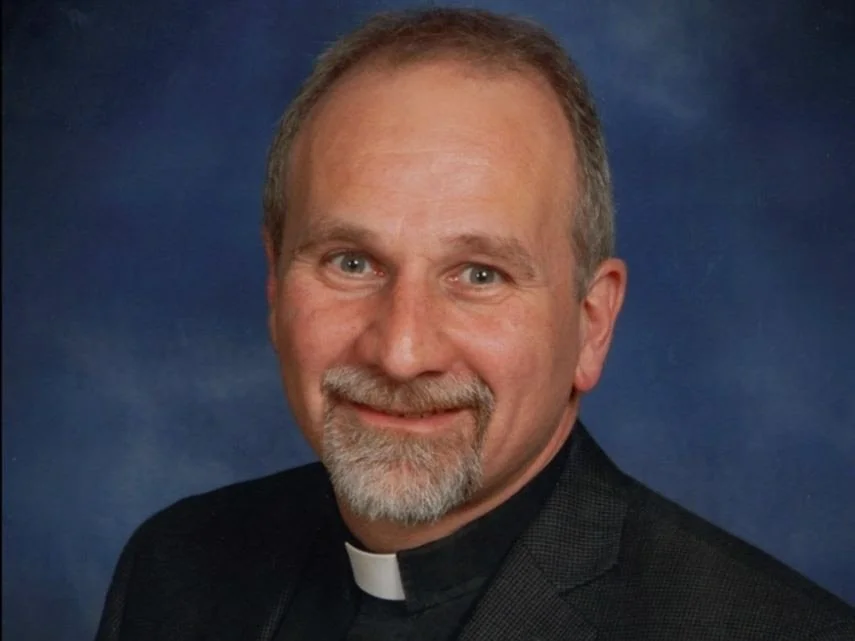

'You will shine like the splendour of the firmament, like the stars forever and ever' (cf Dn 12:3): In piam memoriam Revd Warren W. Hamp (1963-2026)
Exile from the great Dominion that is my earthly homeland and from the Synod that is my ecclesial zu Hause weighs especially heavily on my heart today, Saturday 7 March, as I cannot attend in person the funeral of a beloved pastor of Lutheran Church—Canada who was briefly my student and then became a good friend for going on four decades. I first met Warren (known to friends and family as Woody) Hamp around1987, when he brought his wife and infant daughter over to Lewiston NY to check out for himself the liturgical antics of a young pastor who had become controversial for his espousal of unheard-of perspectives on the Lord’s Supper. And then I recall his taking an elective with me at CLTS in the spring of 1988, just around the time when LCC became an autonomous jurisdiction distinct from the Missouri Synod. President Howard Kramer made a point of attending most of the class, saying how interested he was in the topic of liturgy (No, Howard, be honest, you weren’t!), but really wanting to know if I could handle a class. He must have thought I could, otherwise my career would have taken another turn.
Along with his classmate Tom Winger, Woody was at the halfway point of his vicarage when I began teaching at the seminary as one of its called professors, so that I made the deeper acquaintance of these two Ontarians when they returned for their final year, taking three quarters of their core courses in historical theology with me before their certification in the spring of 1990. Tom still recalls my describing the ecclesiology of the Missouri Synod as molecular Febronianism. A glance at the Call Service photo of the graduates of that year, one of whom had been my field worker at Escarpment, Lewiston, and who with his wife is godparent to our daughter Margaret, yields the sobering reflection that Tom Winger is the only one who now remains in fulltime ministry.
As a newcomer to North America, it took me some years to clue in to the cultural differences between those who live north and south of what is still boasted of as the longest unguarded border in the world. At that time around one-third of the St Catharines student body was comprised of men from the US, and when at length I spotted the differences between seminarians who dressed and mainly sounded so similar to each other, I remarked in class how ‘You Canadian and American gentlemen are really very different from one another.’ A unanimous chorus of dissent emerged from the desks in front of me: ‘No, we’re basically the same.’ Since we were in the midst of a dogmatics class, I was able to play a trick on the unsuspecting class, making a point as loudly and forcefully as possible, slamming my hand hard on the lectern and kicking the desk with gusto. No sooner were the words out of my mouth but the Americans were vigorously responding while Canadian heads ducked most deferentially. ‘See, you made my point.’ Whereupon laughter ensued. Those who make brash and crass remarks about wanting to make Canada the 51st State of the Union should reflect that the inscrutable God of Battles knew what He was doing when He did not permit the adolescent United States to extend its dominion over the whole of North America. I recall a poem by Robert Frost that included the sage line, ‘Fences make good neighbours.’
As the years rolled on, I discovered how quintessentially Canadian in general and Ontarian in particular Woody was, instinctively loyal to the Crown, unaffectedly speaking with the distinctive accent of the Niagara Peninsula as spoken in his hometown of Hamilton. When he opened his mouth, Woody didn’t sound all that different from the blue-collar workers among whom he grew up, but if you listened closely, you noticed that his grammar and syntax were in perfect order and, if you heard him preach, you swiftly realised that this man who did not set himself above his hearers was a deep thinker capable of reaching the academic heights had he ever set his mind to do so. An ageing adjunct professor who taught at the seminary during Woody’s time used to remark that he was every bit as bright and clever as the gentleman who went on to become its president for the best part of the last twenty years.
I was hugely impressed by a paper Woody wrote for me in the modern church history class on Schleiermacher. Yes, this luminary of the young university of Berlin was hugely heterodox and as wrong as it is possible to be in his premises and conclusions, but instead of rehashing the usual critiques Woody calmly and skilfully explained how and why, given his background and formation, he said what he did. The paper was quite masterful. In those days I was a co-editor of Lutheran Theological Review, in which I made a point of publishing essays by recent graduates: with a steady supply of his MDiv and STM essays, Tom Winger kept the journal going for a while, perhaps to his own detriment, as on the basis of original Luther research he said things that some brethren at that time did not want to hear. When I indicated to Woody my desire to include his Schleiermacher essay in an upcoming issue, he claimed not to be able to locate this piece of work which, along with most instances of unpublished writing at that time, was available only in hard copy. I suspect, though, that Woody’s modesty prevented his student paper from seeing the printed light of day.
During his few years serving in the Niagara Peninsula and then sporadically over his three decades in Kitchener an hour and a half of busy highway away, Woody came to the seminary from time to time in the capacity of a guest instructor and then adjunct professor, teaching some systematics and then majoring in preaching and other aspects of practical theology. At those times he would preach in chapel once a semester, and I recall Jon Grothe remarking that he had never heard Woody preach a middling or indifferent sermon. No, Woody penetrated the depths of his text and connected what was going on there with his hearers; he was usually a spellbinding preacher. I hope someone scours the files of his computer for the many homilies he preached over more than three decades; the published result would be a treat for mind and soul, a devotional feast of great intellectual depth.
At one juncture Woody was shortlisted for the dogmatics chair at St Catharines, and the then senior professor regretted that the call was not extended to him. But Woody was putting down deep roots at Faith, Kitchener, and his wife, Annette, herself a Michigander whom he had met at Ann Arbor, maintained that she would only leave Kitchener feet first. Woody had the gifts to serve as bishop at synodical or district level or as a college or seminary professor, but his self-effacing character never sought but rather shunned the limelight.
But, as Bjarne Teigen once observed to me in another context, the cream always rises to the top, so it came as no surprise that, as the present century entered its second decade, Woody served three consecutive terms as chairman of LCC’s Commission on Theology and Church Relations, a body very different from its US counterpart, with no fancy office and zero permanent staff. The Canadian CTCR chairman does most of the donkey work of the Commission. Colleagues in St Louis have told me how much they appreciated Woody’s contribution at the international level, not least when he delivered a stellar paper on hermeneutics in Adelaide in what has turned out to be a vain attempt to steer LCC’s Australian sister synod from the disastrous course it has taken over the last several years. Noting how Woody played a similar role for him to that played by the future Benedict XVI for John Paul II, Robert Bugbee playfully told LCC’s 2017 convention how he had taken to calling him Hampzinger. When I rejoined the CTCR for Woody’s last triennium as chairman, I was hugely impressed at his leadership of our meetings at which his mental firepower was equalled by his pastoral and fraternal tact and kindness. Woody played a helpful role in at least one session of our dialogue with the Anglican Church of North America, and he made a deep impression on the Roman Catholic side of the table at the dialogue LCC continues to conduct in lowkey but fruitful fashion with the Canadian Council of Catholic Bishops.
A little over four years ago, Woody suffered the tragic loss of his wife Annette, following a hard battle with cancer. And then over the last six months his and Annette’s five children have undergone the bitter experience of losing a second parent to that disease. A brother in Ontario has kept me posted on Woody’s declining health, and I have been not in the least surprised to receive reports of how he has ministered to his visitors, nurses, and brother pastors. One nephew who took his fiancee to see his uncle said Woody gave them more than they gave him. Happily, as Woody looked forward to joining the saints and angels before the Throne and desired to receive the Blessed Sacrament as often as possible, the pastors of the Kitchener Circuit and the surrounding area took turns in communing him daily; I am sad not to have been able to take part in that rota. When one well-known brother bade him farewell on the Wednesday before his death, Woody parted from him with, ‘I’ll see you at the altar.’
While I rejoice at Woody’s blessed consummation and am led to contemplate the text that Erlangen Professor von Zezschwitz took for his memorial sermon for Wilhelm Loehe, Daniel 12:3, my heart grieves and my tears flow for a dear and beloved brother taken from his children, his nonagenarian mother, and his four siblings—his oldest brother still serves a parish in the Niagara Peninsula—,and I lament that a prince has fallen in Israel. Rest in peace, beloved brother Woody, delight in the liturgy on the other side of the altar and rise in glory. My love goes out to the sorrowing brethren in Canada today