
Football Stadium Teleology
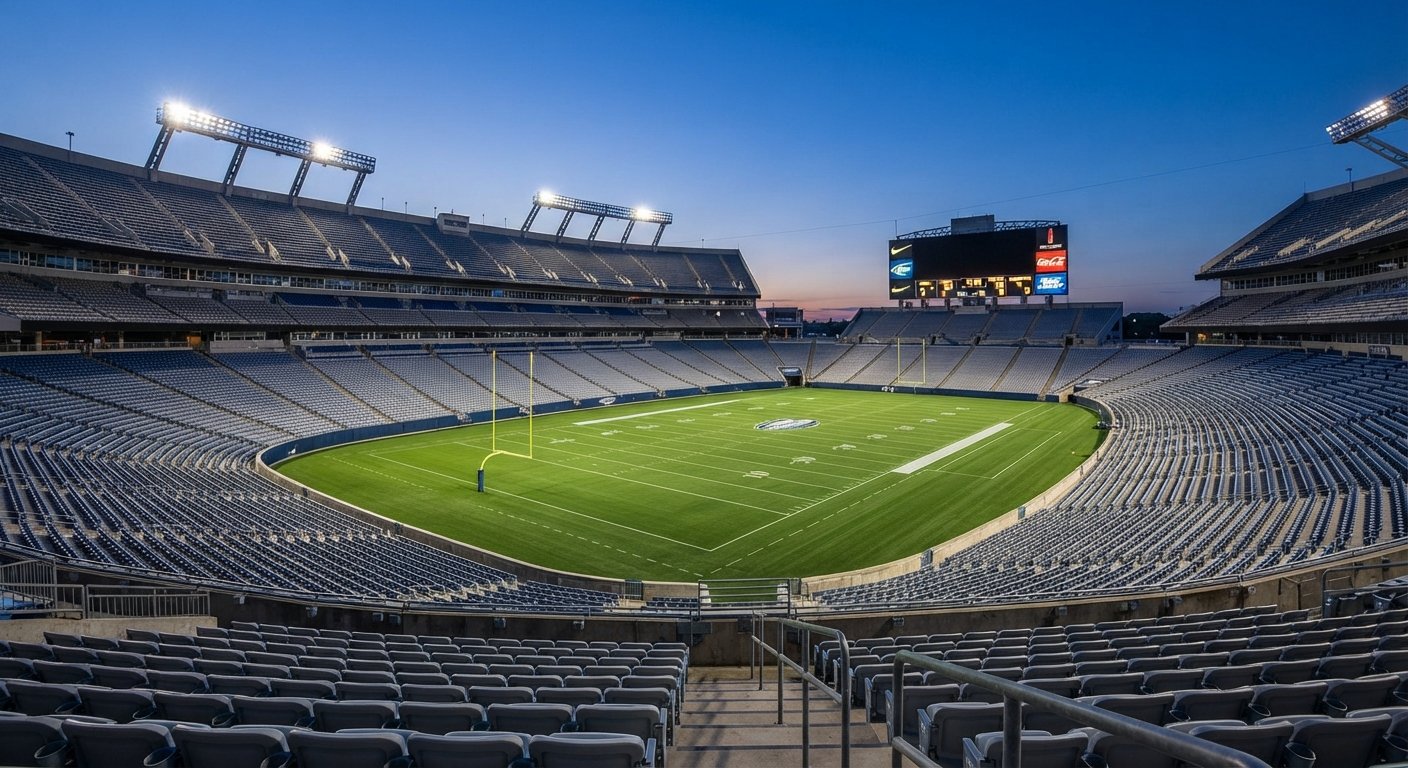
Why do football stadiums basically look the same? There are certainly differences in size, whether or not they have a dome, and the external aesthetics of the building. They are individually known by different names. But that said, you can drive by a football stadium - whether at the local high school campus, the university, or in a big city that has an NFL presence - and you will know that this is a stadium - not a shopping mall, not a state capitol, not a house, not a court building, business center, or hotel. It is not a church. It may at times be used for other purposes, but it was designed specifically to be a football stadium.
So why do they look the way they do? It’s a matter of teleology, of purpose.
The purpose of a football stadium is to be a physical space where the sport is played. The rules of the game determine the size and shape of the playing field, and the number of players. In addition to the field, there must be room on the sidelines for players, coaches, trainers, and medical personnel; enough space between the goalposts and the spectators (and a way to prevent field goal and point-after attempts from being potential lawsuits), as well as space for locker-rooms, offices for executives, restrooms, and booths for announcers. And since there are spectators, the stadium needs seats - whether hundreds, thousands, or tens of thousands - designed in such a way as for all to be able to see the playing field. The design is driven by the primary (field) and secondary (seating) purposes of the structure.
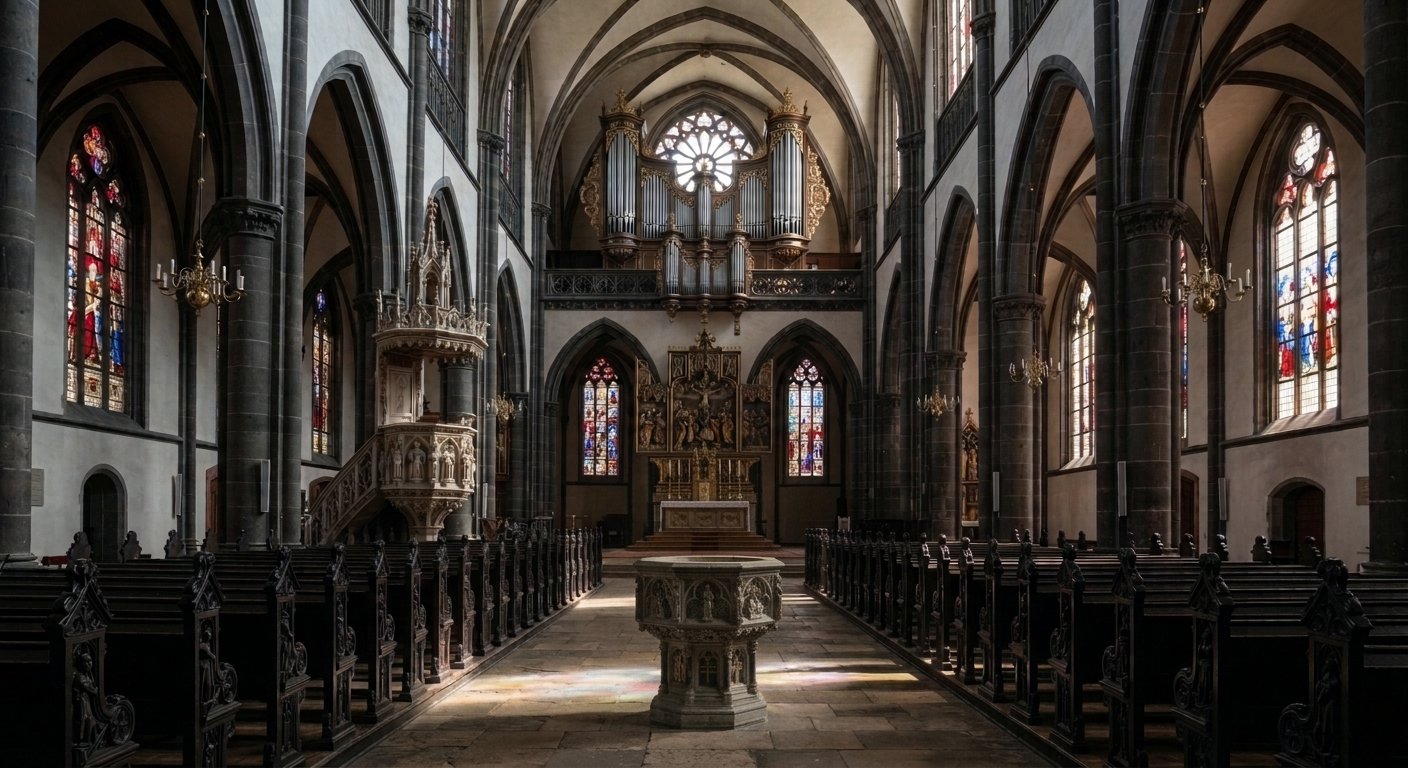
Religious buildings are often easily identifiable. You can still tell right away when you see a mosque or a synagogue or a Buddhist temple. Until fairly recently, you could easily identify a Christian church. In times past, churches often had spires or steeples (to hold the bells). There may well be external symbols on the building, like crosses. As for the inside, for sacramental churches, they need a central table (altar) for the consecration of the Lord’s Supper - usually marked and set apart by an altar cross or crucifix. They need a place to celebrate Holy Baptism (font). They need a place for the preacher to proclaim (pulpit). They need a place for people to kneel and receive the Holy Eucharist (communion rail). There needs to be seating for the faithful, an aisle to move around, and a place for an organ and choir - which are usually in a balcony in the back so as not to become the center of attention, as if the music were a concert or show.
This is why churches look the way they do. There is a lot of variety within this paradigm. But again, the teleology drives the design - in this case, not a sport but the incarnational and sacramental way God comes to us when we assemble by His invitation.
But the more recent expressions of Christianity are not sacramental, and far less incarnational. The radical Reformation gave us the Anabaptists. In time, the Anglican communion would splinter into groups that rejected sacramental theology. The religious scene of the U.S. is dominated by this kind of non-sacramental Baptist and non-denominational theology. That said, until recently, Baptist churches still looked like churches, as there was still a sense of reverence and sacred set-apartness regarding the delivery of the Word. Baptist churches featured a pulpit from which the Word was proclaimed. There were still pews for the faithful, a place for the choir, and an organist. There were places for hymnals. When Baptism and the Lord’s Supper were celebrated - albeit with the Baptist theological understanding that they are symbolic ordinances and not supernatural sacraments - appropriate furniture was employed. Church was not about entertainment and comfort, but about receiving the Word of God unto salvation and sanctification. There are still Baptist and non-denominational churches like this today, but most have changed.
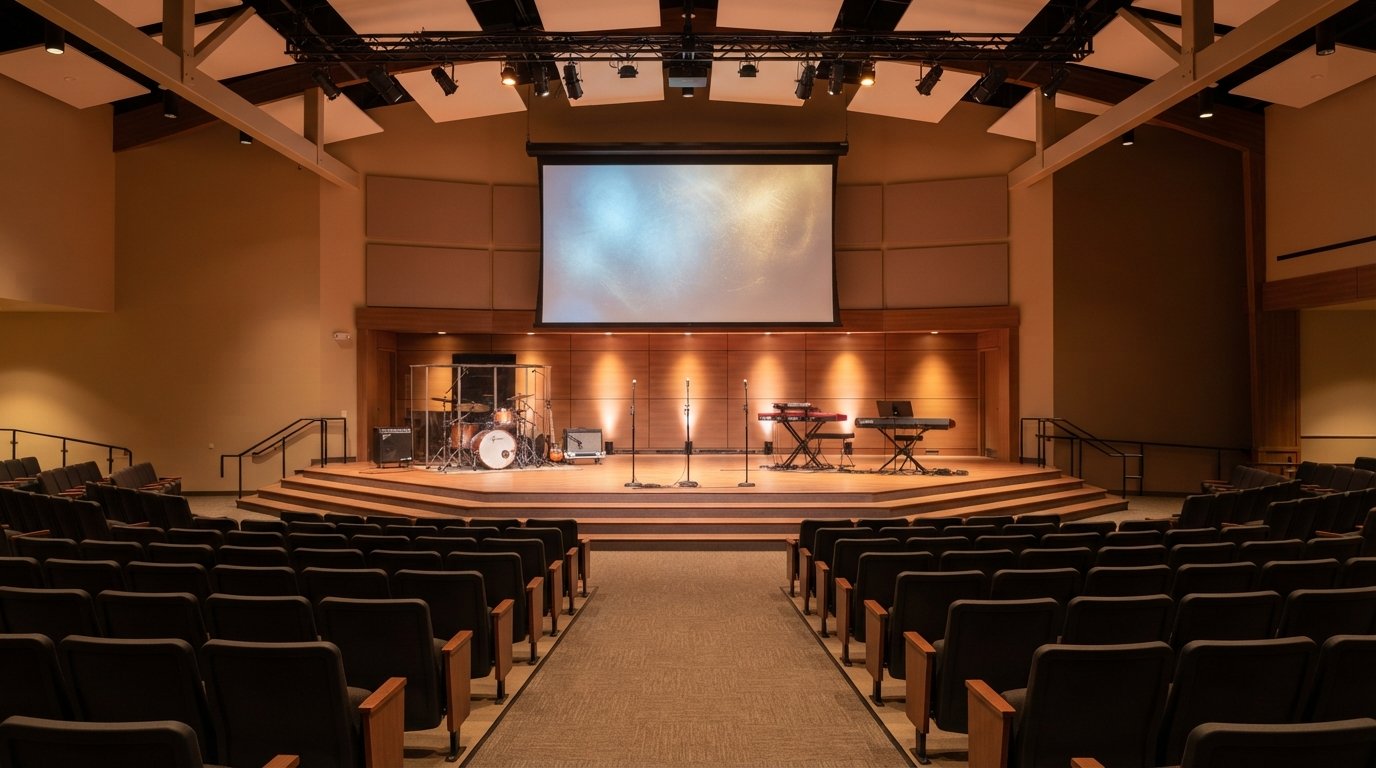
Just as the design of the football stadium begins with the playing field, most modern non-denominational churches begin with the modern foundation: the band. The band: singer, guitar player, bass player, keyboard player, perhaps others - needs a place to play. And that place is a stage. The stage requires a mixing board, microphones, speakers, wires, and spotlights. The performance becomes central. Since non-denominational churches do not have a sacramental theology, altar and font can be pushed aside or even dispensed with. And to keep the stage flexible for various kinds of performances, a permanent pulpit is increasingly replaced by a removable music stand, or perhaps nothing at all - changing the sermon into a kind of perambulatory pep-talk. Screens are increasingly part of the experience: song lyrics, still pictures, and even video.
And since the service is largely spectatorship to a performance, theater seating is preferable to traditional pews. Sitting for long periods of time (as opposed to liturgical participatory standing and kneeling) calls for more attention to ergonomics and comfort. Just as stadium and theater seating have become increasingly designed around the entertainment and comfort experience, so too with church seating. They may well include cup-holders for coffee and other beverages.
Again, the teleology drives the design.
So why would sacramental Lutherans adopt the non-sacramental design? Why would some even renovate their sanctuaries to look like non-denominational worship spaces?
The early pioneers of the Lutheran church growth movement put it bluntly: market competition for numbers. And it actually works in many cases! Again, the teleology drives the design. If you give people entertainment, they will come. Rock music, dancing girls, skits, comedy, tear-jerking testimonials, a variety-show format, and a theater- or stadium-like experience will indeed pack the house. And the house will have to grow larger and larger. And for the church growth practitioners, this often becomes the focus of their writings, the measure of their success: bigger attendance, more seats, larger budgets and staffs, expanded physical spaces - all measured not by confessional faithfulness, but by quantifiable census-taking. This inevitably becomes the teleology, rather than an incarnational, sacramental encounter with the Most Holy Trinity, communion with our Lord Jesus Christ by virtue of a sacramental miracle, and the justifying work of the Holy Spirit working sacramentally according to the Spirit-inspired Word rather than through entertainment, emotional manipulation, and music that takes the place of sacraments.
We are told that we can be also be numerically and financially successful by getting rid of altar, font, pulpit, liturgy and vestments, hymns and the stewardship of the mysteries. We are told that the way to reach the masses is not by Masses, but by non-denominational worship style. And they claim that we can do so without sacrificing our incarnational and sacramental theological substance and teleology. But this is like claiming that playing a football game in a basketball stadium, a national park, or a strip mall would have no effect on the sport and the way that it is experienced by players and spectators. For the teleology determines not only the appearance, but the entire experience.
And unlike sports, our faith is not of human origin, nor is it about play and entertainment. The church is the physical location where the faithful gather to receive the Gospel proclaimed and the sacraments administered. A permanent pulpit sends the message that the Word is more important than a concert. The Word is objective and “remains forever,” even when instruments and pop music styles come and go, when fickle emotions run the gamut from exuberance to boredom. The font is a visual reminder that our sins have been washed away in that same name: the name of the Most Holy Trinity, as the invocation with which we begin our liturgy, and upon whose name we bless ourselves with the sign of the holy cross as a reminder of the teleological connection between cross and font, between Calvary and the Jordan, between our discipleship and how we have been made disciples - is the name that is the teleological foundation of who we are. The altar with a crucifix on it serves as a reminder that “we preach Christ crucified” and that His Word miraculously unites ordinary bread and wine with His extraordinary flesh-and-blood Presence.
The unseen organ and choir in traditional churches remind us that the Divine Service is neither show nor concert, that the beauty of music is a confession of the beauty of our Lord and of our salvation rather than a celebration of the music itself. The greatest Lutheran composer of all time, Johann Sebastian Bach, reminded himself, and us, of this reality when he signed every piece of church music that he composed with the monogram SDG: “Soli Deo gloria” - to God alone be the glory.
Even before computers and power equipment, our ancestors built magnificent cathedrals and churches. And their building projects took many generations lifetimes - even centuries. For the teleology of these edifices was eternity, not ephemeral personal entertainment or comfort. In the west, the churches themselves often took the shape of the cross, and this was not by accident. The church building is itself a confession that outlives and outlasts the earthly lives of their builders and attendees. And even unbelievers who pass by such Christian churches know what they are and what they are not. Church buildings are Christian holy places where our Lord Jesus Christ is present and continues to interact with us; they are not mosques, synagogues, temples, stadiums, schools, libraries, business parks, strip malls, or concert halls.
For this is the teleology of the church - both the people and the building, just as Bach confessed: to glorify God by receiving Him in Word and Sacrament. Everything else flows from this foundational, teleological confession of faith - everything, including our liturgy, our hymnody, our preaching, our church buildings, and even our very lives. We are confessors and servants of Jesus. There are times and places for sports and entertainment. But there are also times and places for worship, for receiving the evangelical, incarnational, sacramental, and cruciform gifts offered to us by our merciful God - all by grace and through faith. And as shown by the example of the golden calf, when worship becomes play, God judges His people.
Our worship is about our resurrectional conquest of death by Christ’s atoning sacrifice, and our reception of this free gift through faith. It’s not about cheering a touchdown or bobbing our heads to a guitar riff. It’s not about the cupholder in the theater-style stadium seat, but rather the cup that is the New Testament in His blood, . It is rather about Him who “sits at the right hand of God, the Father Almighty” and the Good News that in Him, we have everlasting life. Whether the church grows or shrinks does not depend upon our providing an entertainment experience. It depends upon the mysterious work of the Holy Spirit who blows where He wishes, and the narrow gate that few find. And what people find in passing through the narrow gate that is the holy church is something far greater than a rock band and a comfy seat with a cupholder.
Entertainment withers and fades like the grass and the flowers, “but the Word of the Lord remains forever.”