

Consecration of an Acolyte
I’ve often heard the service of the acolyte being downplayed as “just lighting candles.” If that’s the case, why have them at all? And since we now have electricity, why have candles at all? For anyone in the congregation can flip the switch. Such denigration of acolyte service is unfortunate and ill-advised.
The reality is that the office of acolyte is a minor order of the clergy. The oldest reference to this office dates to 251 AD. In times past - and it is still nominally true in some confessions of Christendom - serving as a pastor means going through a training process that includes serving in all of the minor orders - culminating in that of subdeacon (also called “reader”), on the way to the major orders of deacon, priest, and possibly bishop.
In the LCMS, we don’t have this traditional path to the ministry. However, we still do something similar albeit informally. A seminarian will function as a subdeacon: vesting and reading the Old Testament and Epistle lessons in the Divine Service. As a vicar, he will function as a deacon: vesting and perhaps reading the Gospel lesson and preaching under the oversight of a pastor (“vicarage bishop”). In my own case, I was consecrated as a deacon when I was installed as a vicar. A seasoned pastor may be elected to oversee other pastors and congregations (“District President” in LCMS parlance), but he will still be referred to as a pastor, being an ordained man in the service of the church. This reflects the same methodology - though perhaps different terminology - used by the church for more nearly two millennia.
That said, in the history of the church - ancient and modern - a pastor will likely never be advanced to bishop or president; a deacon may never be advanced to pastor; a subdeacon may never be advanced to deacon; an acolyte may never be advanced beyond this role in the church. But in the history of the church, many young men who served as acolytes have gone on to serve in the Office of the Holy Ministry. Their service as members of the minor clergy introduces them to serving with the pastor and his assistants in the chancel, with vestments, with prayer, with the privilege to be in the proximity of the body and blood of Christ, and with the humbling responsibility of churchly service. Acolytes may also serve as crucifers or thurifers - and act as assistants to the pastor and other servers, and participate in processions. They model reverence and piety for the congregation - especially for youth and for children. Acolyte duty is a way to draw a young man into the orbit of ministry, whether he ends up pursing the Office or not.
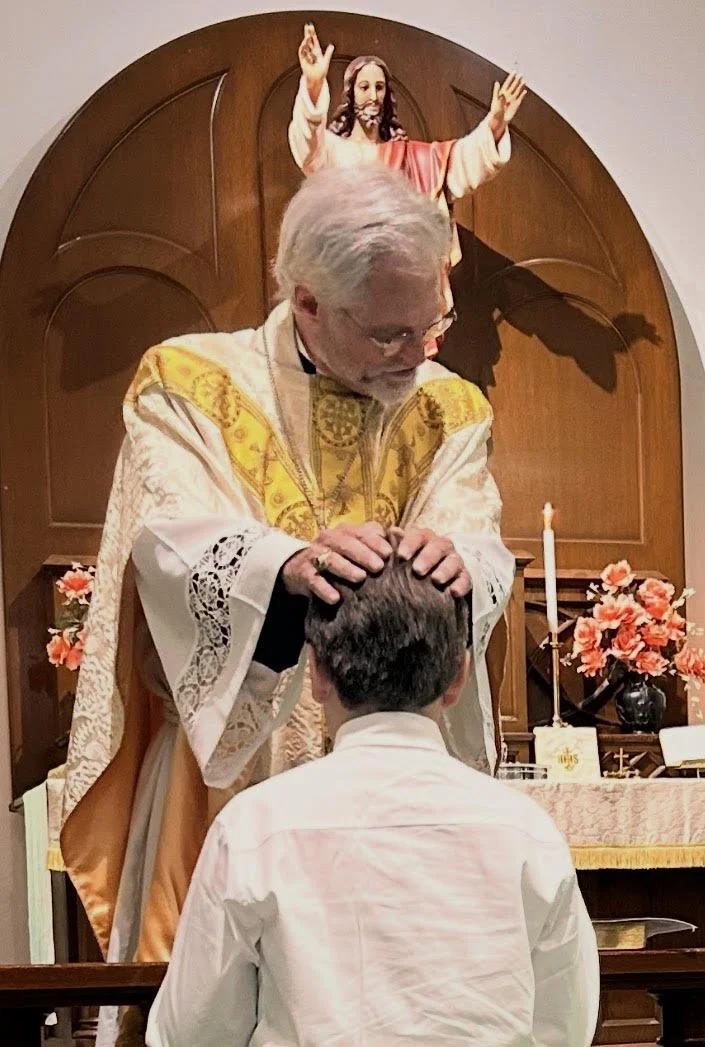
On All Saints Day, I consecrated and installed my eleven-year old parishioner Jon-Paul as an acolyte. His service will begin next Sunday. JP is a smart and pious young man from a solid and faithful family. His dad serves in the military. His mom was a high school student of mine 22 years ago (and All Saints Day is her birthday). JP knows the Bible, the Catechism, and the liturgy. He is a communicant, and is eager to serve the church. He even wore a tie, black pants, and black Oxfords (and finding dress shoes for young men is no small task these days). I prefer my black loafers, but I told JP that I would wear my own Oxfords in solidarity with him when he puts on cassock, cincture, and surplice for service for the first time.
Instead of just suddenly putting him in vestments and having him serve, I made a point to consecrate him to this office during the All Saints’ Day Mass, and to install him into service for our congregation. I modified a prayer used by my dear brother and classmate Latif Gaba, who oversees the Acolyte Corps in his congregation.
The idea of the Acolyte Corps seems to be spreading in liturgical congregations, and I think this is a salutary development. Hopefully, other young men will join JP in service in the chancel of my congregation, Salem Lutheran Church in Gretna, Louisiana. And also, perhaps some of our young men who today serve as acolytes in Lutheran churches all over the country and world will tomorrow consider becoming subdeacons, deacons, and pastors - if God so wills it.
Here is the prayer that I used (thank you, Latif).
Holy Lord, Father Almighty, eternal God, You have sent the light of Your glory into this world through Jesus Christ, Your Son, our Lord, and His apostles, and have willed that, in order to blot out the ancient debt of our death, our Lord Jesus Christ should be fastened to the most glorious standard of the Cross, and that blood and water should flow from His side, for the salvation of the human race. Vouchsafe to + bless this Your servant for his service as acolyte, that he may faithfully serve at Your holy altar, and attend to the lighting of Your Church. Enkindle, O Lord, his mind and heart with the love of Your grace, so that, alight with the splendor of Your countenance, he may faithfully serve You and Your holy Church. Through the same Christ our Lord. Amen.
For the consecration, I simply laid hands on the head of the candidate and said:
“[Name] I consecrate and install you as acolyte, in the name of the Father and of the + Son and of the Holy Spirit. Amen.”