

The Liturgy of Concord: Confessionalism Requires “Liturgicalism”
By David Miller
One Lord, One Faith, One Liturgy
There is something wonderfully appropriate about the name Book of Concord. Concord means harmony, agreement, and unity. Yet the unity envisioned by the Lutheran reformers was never merely institutional or organizational. Christian concord is created by a common confession of the truth. We are united because we confess the same faith, and we confess the same faith because we have been given the same Word of God.
The Church does not create the truth by agreeing upon it. Rather, the truth creates the Church’s agreement. Our unity is not something we manufacture; it is something we receive through the Gospel and confess together.
Consequently, the Lutheran pastor’s relationship to the Book of Concord cannot be casual. It is not a collection of historical documents to which we appeal when convenient. It is the Church’s public confession of the biblical faith, a confession to which we bind ourselves because it faithfully expresses the doctrine of Holy Scripture.
This commitment has significant implications for Lutheran worship. Can a church claim to be confessionally Lutheran while deliberately abandoning the liturgical inheritance that the Confessions defend? Can a pastor promise to teach according to the Book of Concord while treating its insistence upon retaining the Mass, preserving ceremonies for instruction, and teaching the congregation through its singing as merely quaint observations about sixteenth-century Christianity?
The question is not whether every congregation must look identical. Lutheranism has never required that. The question is whether Christian liberty gives us permission to discard the very forms through which the reformers intended the Gospel to be proclaimed, taught, confessed, and received.
A genuinely confessional Lutheran church should therefore be a liturgical church. Not because every rubric is divinely mandated, nor because outward ceremonies earn God’s favor, but because the Church is gathered around the Word and Sacraments, and because its inherited forms of worship are servants of the Gospel. To abandon this inheritance carelessly is to misunderstand the confession we have promised to uphold.
Quia or Quatenus: Confession or Concession?
Two Latin expressions help explain the nature of confessional subscription: quia and quatenus.
Quia means "because." A quia subscriber accepts the Lutheran Confessions because they faithfully explain the teachings of Holy Scripture. Their authority rests not upon ecclesiastical decree but upon their faithful agreement with God's Word.
Quatenus means "insofar as" or "to the extent that." A quatenus approach accepts the Confessions insofar as they agree with Scripture, while reserving the right to determine independently which portions remain acceptable or applicable.
The distinction concerns where the burden of theological judgment rests. The quia subscriber submits his theological judgments to the Church's confession, seeking to understand Scripture faithfully through the doctrine confessed therein. The quatenus subscriber risks making his own contemporary judgment the final court of appeal.
This distinction is important to the identity of The Lutheran Church—Missouri Synod. Article II of the LCMS Constitution identifies the Scriptures as the inspired and inerrant Word of God and receives the Symbolical Books of the Evangelical Lutheran Church, contained in the Book of Concord of 1580, as a true and unadulterated statement and exposition of God's Word. Article VI requires its ordained and commissioned ministers to subscribe to these confessions.
The ELCA also affirms the Lutheran Confessions as foundational documents, although its approach to confessional authority and dissent differs from the LCMS's unconditional subscription.
The historical controversies surrounding the Missouri Synod in the early 1970s, the formation of the Association of Evangelical Lutheran Churches, and ultimately the establishment of the ELCA in 1988 illustrate the significance of disagreements concerning biblical authority and confessional commitment. Later ecumenical agreements further demonstrated differences concerning the extent of doctrinal agreement necessary for church fellowship.
The point is not to rehearse these controversies for their own sake. It is to recognize what is at stake. A confession that can be selectively accepted is no longer functioning as a common confession in the fullest sense.
And this brings us directly to worship. If we subscribe quia, we cannot treat the Confessions as authoritative when they support our preferred doctrines and merely historical when they challenge our preferred practices. We cannot affirm the doctrine of the Sacrament while ignoring their insistence upon its regular administration. Nor can we celebrate the importance of Christian instruction while disregarding their defense of ceremonies and congregational singing as instruments of that instruction. We cannot claim the inheritance while casually disposing of the furniture in the house.
We should be content with nothing less than being genuine Lutherans: Christians determined to preserve the Lutheran confession in its integrity.
Reformed, Not Replaced: The Mass
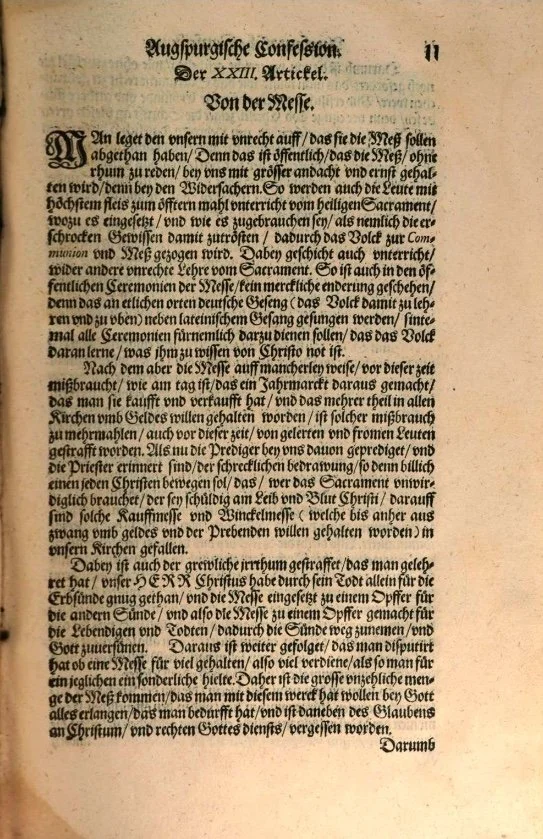
Augsburg Confession Article XXIV speaks unmistakably about Lutheran worship:
"Our churches are falsely accused of abolishing the Mass. The Mass is held among us and celebrated with the highest reverence. Nearly all the usual ceremonies are also preserved, except that the parts sung in Latin are interspersed here and there with German hymns.” (Augsburg Confession XXIV.1–2).
Notice what the confessors do not say. They do not announce that the medieval liturgical inheritance has become irrelevant or that a new form of Christian gathering has replaced it. They say that the Mass is retained. Indeed, they explain that nearly all customary ceremonies are preserved, with certain portions formerly sung in Latin now sung in German so that the people might learn.
The Apology of the Augsburg Confession makes the same commitment:
"We do not abolish the Mass, but religiously keep and defend it" (Apology XXIV.1).
Melanchthon describes the ordinary practice of evangelical congregations: Masses celebrated every Lord's Day and festival, Scripture lessons, prayers, vestments, and the administration of the Sacrament to those who desire it.
The reformers were not attempting to make worship novel. They were attempting to make worship evangelical. They removed abuses that obscured the Gospel while retaining ceremonies that served its proclamation. The Lutheran Reformation was not a revolution against liturgy. It was a reformation of the liturgy according to the Gospel.
The Mass: God's Giving, Not Man's Doing
The central disagreement between the reformers and their opponents concerned what the Mass actually accomplished.
The reformers rejected the notion that the Mass, performed as a priestly work, could merit forgiveness for the living and the dead apart from faith in Christ. They objected particularly to its commercialization through private Masses offered for stipends. Christ's sacrifice upon the cross is sufficient. Nothing can be added to it.
Hebrews 10:14 declares that by one offering Christ has perfected forever those who are being sanctified. The Mass does not repeat Calvary or supplement Calvary. Rather, it distributes the benefits of Christ's saving work to sinners who need them.
The Augsburg Confession explains that the Mass was instituted so that the faith of those receiving the Sacrament might remember the benefits received through Christ and find comfort for troubled consciences. Here we discover the heart of Lutheran liturgical theology. The Mass is Gospel. It is Christ's testament, His gift, His promise, and His provision for the anxious conscience. The Church does not gather to impress God with its religious accomplishments. It gathers because God has promised to meet His people with His gifts.
Every generation produces sinners who need forgiveness. Every age produces troubled consciences, fearful hearts, and people who need something outside themselves. Christ gives precisely that. The Gospel remains good news, and the liturgy that proclaims and delivers that Gospel is never obsolete.
The Mass: Presence Produces Reverence
Why did the reformers insist that the Mass be celebrated with the highest reverence? Because Christ is truly present to give His body and blood to His people. Lutheran reverence is not theatrical solemnity or anxiety about performing religious ceremonies correctly. It is faith responding to a divine promise. The pastor administers Christ's gifts according to His institution. The congregation receives what Christ says is given and shed for the forgiveness of sins.
The Apology describes the pastoral purpose of the Sacrament:
"The Mass is to be used for administering the Sacrament to those that need consolation” (Augsburg Confession XXIV.33).
Melanchthon also invokes Ambrose:
"Because I always sin, I am always bound to take the medicine."
What a beautiful description of the Christian life! We have not graduated from the need for forgiveness. We remain sinners who continually need the medicine of immortality. The Lord's Supper is not a graduation ceremony for spiritually accomplished Christians. It is Christ's gift to those who need Him.
Reverence therefore begins with recognizing that God is keeping His promise. Where Christ's presence is confessed, where His Word is proclaimed, and where His body and blood are distributed according to His institution, there is every reason for awe, thanksgiving, and joy.
The Mass: Five Ordinaries, One Confession
The historic Western Mass contains five principal fixed elements known as the Ordinary: 1.) the Kyrie; 2.) the Gloria in Excelsis; 3.) the Creed; 4.) the Sanctus; 5.) the Agnus Dei. These elements belong to the historic Western liturgical inheritance substantially preserved by the Lutheran reformers. Although the Confessions do not establish an immutable five-part Ordinary, their retention beautifully reflects the Confessions' commitment to preserving ceremonies that teach the faith. Each element has a profound theological purpose.
The Kyrie: Lord, Have Mercy: The Kyrie places the sinner's confession upon the lips of the congregation. We have sinned and cannot stand before God's holiness on the basis of our own righteousness. We need mercy. We approach God as beggars, and Christ answers beggars with gifts. The healings of long ago enter our present time by healing sinful hearts by the means of grace.
The Gloria in Excelsis: Glory to God in the Highest: The Gloria takes us to Bethlehem. The angels announce the birth of the Savior and the peace that comes through the incarnation of the Son of God. The mercy for which we have prayed is not an uncertain possibility. God has acted. The Savior has come. He is here according to His Word and will share with us His incarnate flesh and blood.
The Credo: I Believe in One God: The Creed is the congregation's public confession of the faith. It confesses the Father, Son, and Holy Spirit; the incarnation, crucifixion, resurrection, and ascension of Christ; and the one holy Christian and apostolic Church. The Creed protects the congregation against false teaching and gives the people a common confession of the faith once delivered to the saints. All of this prepares our hearts and readies sinners to encounter Christ in Holy Communion.
The Sanctus: Holy, Holy, Holy: Drawing upon Isaiah's vision of the heavenly throne room and the triumphal acclamation of Christ's entry into Jerusalem, the Sanctus joins the congregation to the song of heaven. "Hosanna in the highest. Blessed is He that cometh in the name of the Lord." The congregation confesses that Christ comes to His people. It does not manufacture an encounter with God. It receives the One who has promised to come through His Word and Sacrament.
The Agnus Dei: O Christ, Thou Lamb of God: Drawing from John the Baptist's proclamation in John 1:29, the Agnus Dei directs the congregation to Christ, the Lamb who takes away the sin of the world. The Eucharist is not an opportunity to demonstrate spiritual accomplishment. It is the gift of the Lamb who was slain for us.
The five elements therefore lead the congregation through a theological journey: 1.) Kyrie: We are sinners who need mercy; 2.) Gloria: God has sent His Son to bring peace; 3.) Credo: We confess the saving work of the Triune God; 4.) Sanctus: The holy Lord comes to His people; 5.) Agnus Dei: Christ takes away our sin. This is no arbitrary collection of religious texts. It is the Gospel confessed through the congregation's own singing. The liturgy teaches the people who God is, who Christ is, what He has accomplished, and why the Church gathers around His altar. And it teaches these things Sunday after Sunday. The liturgy catechizes.
The Mass: God Puts His Word in Our Mouths
Here we arrive at one of the most important reasons for retaining the historic Lutheran liturgy. The liturgy is not merely a historical collection of ceremonies that happens to contain biblical references. Its extraordinary value is that it is saturated with the actual Word of God.
Consider the Divine Service. The congregation confesses Scripture through the Kyrie, Gloria, Creed, Sanctus, and Agnus Dei. It hears the appointed readings. It prays biblical language. It sings psalms, canticles, and hymns drawn from the Scriptures. It hears the words of Christ in the proclamation of the Gospel and at the administration of the Sacrament. The liturgy is, from beginning to end, a continuous encounter with God's Word.
I have heard newcomers to Lutheranism remark with amazement at the number of Scripture references printed throughout the Lutheran Service Book. They discover that the hymnal identifies the biblical sources for the various portions of the Divine Service, prayers, canticles, and hymns. That is intentional. The Church is not simply providing religious language for people to express their feelings. It is placing God's own Word upon their lips.
This is particularly important when we remember what Scripture teaches about faith.
Romans 10:17 declares:
"So then faith cometh by hearing, and hearing by the word of God."
Faith is not something we manufacture through emotional intensity, personal determination, or the atmosphere of a worship gathering. We are saved by grace through faith, and faith itself is created and sustained by the Holy Spirit through the Word. The Word is the instrument through which the Spirit works faith in the heart.
This means that worship must be concerned above all with delivering that Word. When the liturgy and Lutheran hymnody disappear, the Word of God can disappear from congregational singing as well. And when the Word disappears, so does the very instrument through which faith is created and sustained.
This is not a minor aesthetic concern. It is a theological and pastoral concern of the highest importance. Hebrews 4:12 describes the Word of God as living and active. The Word is not merely information about God. It is God's own living address to sinners. Through it, the Holy Spirit convicts, comforts, creates faith, and directs the hearer to Christ.
The remarkable thing about the historic Lutheran liturgy is that it continually places this living and active Word before the congregation. The people are not left to invent their own religious language. They are given God's language. They confess what He has revealed, pray what He has taught them to pray, and sing what He has promised and accomplished.
This is profoundly Lutheran. We are saved by grace through faith. Faith receives Christ and His benefits. But faith comes through hearing the Word of God. Therefore, a worship service intended to be genuinely faith-giving must be rich in the Word of God. The liturgy does not replace the preaching of the Gospel. It surrounds the proclamation with God's Word, reinforces it through congregational confession, and continually places the promises of Christ into the ears and mouths of His people.
The Church should never be embarrassed by this abundance of Scripture. It should rejoice in it.
The Mass: Lessons from the Liturgy
The Lutheran Confessions explicitly identify instruction as one of the purposes of ceremonies.
Augsburg Confession XXIV declares:
"For ceremonies are needed for this reason alone, that the uneducated be taught ."
The Apology expands upon this:
"Ceremonies should be celebrated to teach people Scripture, that those admonished by the Word may conceive faith and godly fear, and may also pray. (This is the intent of ceremonies)."
This is the reformers' understanding of liturgical practice. Ceremonies teach Scripture. They admonish the congregation through the Word. They call forth faith and reverence, provide comfort, and teach the people to pray. The reformers recognized that the Church needed to teach. Their response was not to abandon the inherited liturgy but to translate, explain, reform, and retain it.
Luther's German Mass of 1526 demonstrates this commitment. He sought to make worship intelligible to German-speaking Christians while retaining its essential evangelical character. He also emphasized the importance of suitable German hymns that would teach and confess the Christian faith.
Luther understood something every pastor should remember: people remember what they sing. A theological proposition may be heard once and forgotten. A well-crafted hymn can lodge itself in the memory and accompany a Christian throughout an entire lifetime.
Consider several examples: "Dear Christians, One and All, Rejoice" teaches justification and the work of Christ. "A Mighty Fortress Is Our God" teaches the theology of the cross and Christ's victory over sin, death, and the devil. "Salvation unto Us Has Come" teaches the relationship between Law, Gospel, justification, and good works. "O Lord, We Praise Thee" and "Soul, Adorn Yourself with Gladness" teach the evangelical understanding of the Lord's Supper.
These are not merely expressions of religious enthusiasm. They are theology put to music. They teach the congregation to speak accurately about God, recognize its condition as sinful, confess the saving work of Christ, and receive the Sacraments as gifts rather than human achievements. They also give the congregation a common theological vocabulary. A congregation that sings the same doctrinally rich hymns year after year develops a shared theological memory. Its members learn to recognize biblical truths and doctrinal errors because they have been formed by the same confession.
This is particularly important in our own time. Christians have access to more religious information than ever before, but access to information is not the same as theological formation. Our people hear competing explanations of Scripture from Lutheran, Reformed, Baptist, Pentecostal, Roman Catholic, and non-denominational sources. Some are faithful; others are confused or misleading. The question is not whether our people are hearing theology. They are. The question is whether they are being equipped to distinguish sound doctrine from error. The congregation needs to sing the faith. It needs to hear, memorize, confess, and internalize the doctrines of Christianity. The hymnbook is a theological library that the congregation carries in its heart.
This brings us to a significant pastoral concern. Much of contemporary worship music has shifted the emphasis of congregational singing away from the objective proclamation of God's saving work and toward subjective expressions of personal religious experience.
Consider several widely sung examples.
"Goodness of God" (Bethel Music): The song repeatedly emphasizes God's goodness, faithfulness, and personal care. These are certainly biblical themes. Yet its emphasis is predominantly the singer's personal experience of God's goodness. It offers relatively little explicit proclamation of humanity's sin, Christ's atoning death, justification, or the forgiveness of sins.
"Graves Into Gardens" (Elevation Worship): The song emphasizes God's power to transform circumstances and bring new possibilities. Although transformation and God's power are biblical themes, the song's repeated emphasis on personal transformation can leave the congregation with a generalized message of divine intervention rather than a clear confession of Christ crucified for sinners.
"Oceans (Where Feet May Fail)" (Hillsong UNITED): This song emphasizes trust, vulnerability, and following God into the unknown. These themes can certainly be connected to Scripture. Nevertheless, its emphasis is primarily upon the believer's personal journey, trust, and experience. The objective saving work of Christ and the specific promises of the Gospel receive little attention.
"Reckless Love" (Cory Asbury): This song attempts to communicate the extraordinary extent of God's love in pursuing sinners. Its central theme can be pastorally meaningful, but its use of the word "reckless" introduces an unnecessary theological ambiguity. God's love is extraordinary and undeserved, but it is never reckless in the sense of being careless or without wisdom.
These examples illustrate a broader concern. Many contemporary worship songs contain biblical phrases and genuine expressions of Christian devotion, yet provide little sustained theological instruction. They frequently emphasize what God is doing in my life, how I feel about Him, how I respond to Him, and how He is helping me overcome my circumstances.
But where is the sustained proclamation of Christ's incarnation, substitutionary atonement, resurrection, justification, forgiveness, Baptism, and the Lord's Supper? Where is the confession of sin and the declaration of absolution? Where is the objective promise that Christ has died for sinners and gives His gifts to the unworthy? Where is the doctrinal substance that teaches the congregation what Christianity actually confesses?
The problem is not that Christians should never sing about their experiences or express their love for God. The problem arises when subjective religious expression becomes the dominant content of congregational worship. A congregation can sing for an entire service and still receive remarkably little substantive instruction in the Christian faith through its singing. This is especially concerning when such music replaces hymns that explicitly proclaim the Gospel.
Compare the theological richness of "Salvation unto Us Has Come" with a song whose principal refrain simply repeats that God is good. The latter statement is true, but the former teaches the congregation why salvation is necessary, what Christ has accomplished, how justification is received, and why good works follow faith. These are not equivalent forms of theological instruction. A congregation needs more than songs that make it feel devoted. It needs songs that teach it to believe, confess, and understand the faith.
And there is an even more fundamental concern: when the Word of God is displaced from congregational singing, the Church diminishes one of the principal means through which the Holy Spirit creates and sustains faith. Romans 10:17 does not say that faith comes through the atmosphere of worship, the emotional intensity of music, or the sincerity of the worshiper. Faith comes by hearing the Word of God. This is why Lutheran hymnody matters so much. It is not merely an inheritance of beautiful music. It is an inheritance of the Word.
The Formula for Discord Not Concord: Misusing Adiaphora
Someone will inevitably object: "Isn't the liturgy adiaphora? Doesn't the Formula of Concord teach that congregations are free to change their ceremonies?" Indeed, it does. Formula of Concord, Solid Declaration X.1, describes ceremonies as matters neither commanded nor forbidden by God's Word, introduced for good order, propriety, and Christian discipline.
It also declares:
"The community of God in every place and every time has, according to its circumstances, the good right, power, and authority to change and decrease or increase ceremonies . They should do this thoughtfully and without giving offense, in an orderly and appropriate way, whenever it is considered most profitable, most beneficial, and best for good order, Christian discipline, and the Church's edification” (Formula of Concord, Solid Declaration X.9).
Lutheranism recognizes freedom concerning external ceremonies. No pastor should turn every historical custom into a divine commandment.
But the Formula does not teach that everything permissible is equally beneficial. It warns that practices proposed under the appearance of adiaphora but contrary to God's Word are not genuinely adiaphora (SD X.5). It also insists that ceremonies should serve the Church's edification. Freedom is exercised for the good of the Church. It is not a license for thoughtless innovation or the abandonment of useful practices.
A congregation may or may not incorporate the cope into its vestment repertoire, make use of the First or Third Setting of the Divine Service, incorporate blue or rose into its liturgical color pallet, or other external arrangements. But the fact that it is free to omit the Creed does not mean that omitting the Creed is equally beneficial for teaching the faith. Likewise, a congregation may replace a historic hymn, but that does not mean every replacement provides the same biblical and doctrinal instruction. Freedom is not the same thing as wisdom.
The Formula also recognizes that outward practices can become matters of confession when they communicate theological agreement or compromise. Ministers must sometimes confess the truth not only in words but also "in works and with deeds" (SD X.10).
We must therefore resist two errors. The first is turning human ceremonies into divine commandments and binding consciences where God has not bound them. The second is using Christian liberty as an excuse for despising the very ceremonies that have served the Church so well. The first is legalism. The second is ingratitude. Neither is worthy of a confessionally Lutheran Church.
The Liturgy: Timeless Like Its Lord
The Confessions were written in the sixteenth century, but they do not confess a temporary Christianity. They confess the biblical faith, and biblical truth does not expire. The Augsburg Confession defends the Mass because Christ instituted the Sacrament for the consolation of sinners. The Apology defends ceremonies because the Church is perpetually called to teach Scripture. The Formula of Concord commends ceremonies because congregations in every time and place need good order, instruction, and edification.
These are enduring truths. If the Church's mission is to teach the faith, why would that mission become less important as access to information increases? If the Sacrament is Christ's gift to anxious consciences, why would those consciences become less anxious in the twenty-first century? If faith comes through hearing the Word of God, why would the liturgy that continually places that Word before the congregation become obsolete?
Indeed, the opposite is true. The more confused the religious environment becomes, the more important it is for the Church to be clear about what it believes. The more voices our people hear, the more important it becomes that they regularly confess the faith together. The Church should not be embarrassed by its inheritance. It should be grateful for it.
The Liturgy of Concord
The historic liturgy also contributes to the unity of the congregation. The pastor and people speak the same words. They confess the same Creed, sing the same Kyrie, hear the same Scripture readings, pray the same prayers, and receive the same Sacrament. The liturgy is not the private property of the pastor or the personal expression of the worship leader. It belongs to the Church. A pastor may come and go. A music director may retire. A generation may pass away. But the Church continues to confess the same faith. The congregation does not have to reinvent its identity whenever its leadership changes. It receives a common inheritance and passes it along.
This is particularly important in an age when congregational identity can become dependent upon the personality of a particular pastor or the preferences of a particular generation. The liturgy reminds us that we are not the first Christians, nor will we be the last. We belong to the one Church of Christ, joined to believers who have confessed the same faith across centuries and continents. The historic liturgy gives visible and audible expression to that continuity.
Paradise Lost: Losing the Liturgy Loses the Gospel
It would be irresponsible to suggest that every congregation with a less liturgical worship style is doctrinally unsound. Nor should we pretend that beautiful vestments and elaborate ceremonies guarantee faithfulness to the Gospel. Outward appearance is no substitute for doctrine. Nevertheless, we should not ignore the pastoral consequences that can accompany the systematic abandonment of the liturgical inheritance. When the historic patterns of worship are displaced, what replaces them?
Sometimes the answer is a thoughtful alternative deeply rooted in Scripture and Lutheran doctrine. But sometimes worship becomes organized primarily around congregational preferences and personal religious experience. The focus shifts from what Christ gives to what the congregation experiences. The Lord's Supper may become an occasional addition rather than the ordinary culmination of the congregation's gathering. Congregational singing may become less concerned with confessing doctrine and more concerned with expressing generalized religious affection. The pastor may increasingly be regarded as a personality responsible for producing an engaging weekly experience. And the people may gradually lose the common theological vocabulary that the historic liturgy once provided.
But there is a deeper danger. When the liturgy and Lutheran hymnody disappear, the Word of God can become increasingly absent from the congregation's corporate confession. This is not simply a loss of tradition. It is a loss of the very instrument through which the Holy Spirit creates and sustains faith. If faith comes by hearing the Word of God, then the Church must take seriously what it places before the ears of its people.
A service filled with generalized expressions of devotion may produce an emotional response, but emotional response is not the same thing as faith. Faith rests upon the promises of God in Christ. The Church does not need to manufacture religious experiences. It needs to deliver the Gospel. The Lutheran reformers criticized the late medieval Church because the Gospel had become obscured by practices that no longer served their proper purpose. Their answer was not to abandon the Mass but to restore its evangelical purpose, teach the people, and preserve the historic forms that served the proclamation of Christ.
It would be a tragedy if Lutheran congregations, in their enthusiasm to escape an allegedly outdated liturgical inheritance, gradually abandoned the very theological protections the reformers sought to preserve. The answer to abuses of the liturgy is not the abandonment of the liturgy. The answer is to restore its evangelical purpose.
The Evangelical Tradition: Being Faithful Stewards of Our Inheritance
There is a particular kind of poverty that comes from being surrounded by riches and failing to recognize their value. Imagine a family that inherits a magnificent library containing generations of wisdom. Yet the children, convinced that the books are old-fashioned, begin replacing them with whatever happens to be popular. Eventually the library is empty.
Something similar can happen in the Church. We have inherited a liturgical tradition that has served generations of Christians. We have inherited hymns that teach the faith with extraordinary theological precision. We have inherited prayers formed by Scripture, a Church Year that directs us through the life of Christ, and a pattern of worship that moves from confession to absolution, from Word to Sacrament, and from the gifts of Christ to lives of thanksgiving.
Why would we be eager to dispose of such riches? Times have changed, certainly. Languages, musical styles, cultures, and congregations have changed. But sinners have not changed. They still need forgiveness. Christ has not changed. He is still the Savior of sinners. His Gospel has not changed. It remains the power of God unto salvation. His Sacraments have not changed. They remain His gifts to His Church. And faith still comes through hearing the Word of God. This is why the Church should preserve, teach, and faithfully employ its liturgical inheritance.
This is not an argument against development. Luther himself translated and revised liturgical texts. Lutheran churches have produced new hymns, new musical settings, and new orders of service. The tradition is not a museum exhibit. But development is not repudiation.
A living tradition can grow without forgetting its roots. New hymns can be composed without neglecting the old ones. New musical arrangements can be employed without abandoning doctrinally rich congregational singing. The question is whether we are developing the inheritance or discarding it. We ought to be faithful beneficiaries of what we have received.
Walking Together = Worshiping Together
The Lutheran Church has been given an extraordinary inheritance. We have the Scriptures, the Ecumenical Creeds, the Lutheran Confessions, the Small Catechism, the historic liturgy, the rich corpus of Lutheran hymnody, the Church Year, and the lectionary. These are not obstacles to the Church's mission. They are gifts that serve it.
The Book of Concord teaches us that the Mass is retained and celebrated with reverence, that ceremonies are preserved for the instruction of the people, that congregational singing teaches the faith, and that Holy Communion is offered to those who desire its consolation. The Formula of Concord teaches us that Christian liberty must be exercised thoughtfully, for the sake of edification and good order, and never in a manner that compromises the confession of the Gospel. And Scripture teaches us something essential to the entire discussion:
"So then faith cometh by hearing, and hearing by the word of God” (Romans 10:17).
This is perhaps the most important reason to treasure the Lutheran liturgy. We are saved by grace through faith. Faith is the instrument through which we receive Christ and His saving benefits. But faith does not arise from within ourselves. It is created and sustained by the Holy Spirit through the Word of God.
The liturgy continually places that Word before us. The Kyrie teaches us to cry for mercy. The Gloria proclaims the incarnation of our Savior. The Creed gives us the confession of the Christian faith. The Sanctus joins our voices to the worship of heaven. The Agnus Dei directs us to the Lamb who takes away the sin of the world. The Scripture readings proclaim God's promises. The prayers teach us to pray according to His Word. The hymns put the doctrines of the faith into our mouths and hearts. The sermon proclaims Christ crucified and risen. The Sacrament delivers the forgiveness Christ has promised. What could be more Lutheran?
We should therefore resist the temptation to despise our inheritance. We should not confuse Christian liberty with theological carelessness. We should not replace the riches of Scripture-saturated liturgy and doctrinally substantial hymnody with worship that offers little more than generalized expressions of religious affection.
Let us retain the Mass, celebrate it reverently, offer the Sacrament regularly, and teach our people through the rich liturgical and musical tradition entrusted to us.
Let us be genuine Lutherans. Let us be gnesio-Lutherans in our determination to confess the faith faithfully, not by making human ceremonies divine commandments, but by refusing to treat the Church's evangelical inheritance as disposable.
And above all, let us remember why we gather. We gather because Christ has died for us. We gather because Christ has risen for us. We gather because Christ has promised to be with us. We gather because He gives us His Word and Sacraments. We gather because faith comes through hearing that Word, and because the Holy Spirit continually works through it to create and sustain faith in the hearts of sinners.
The liturgy is not merely something the Church does. It is one of the great ways in which God serves His Church with His living and active Word. That is the remarkable gift of Lutheran worship: Sunday after Sunday, generation after generation, the people of God are given the very words and promises of God. Let us not exchange that gift for something less. Let us be neither ashamed of the liturgy nor indifferent to the hymnody of our fathers. Let us be a Church that sings the Word, hears the Word, confesses the Word, and receives the Word.
That is the concord we confess. That is the inheritance we treasure. That is the liturgy we retain. And that is the faith we shall pass on.