

The Lutheran Breviary App — Available for Advent
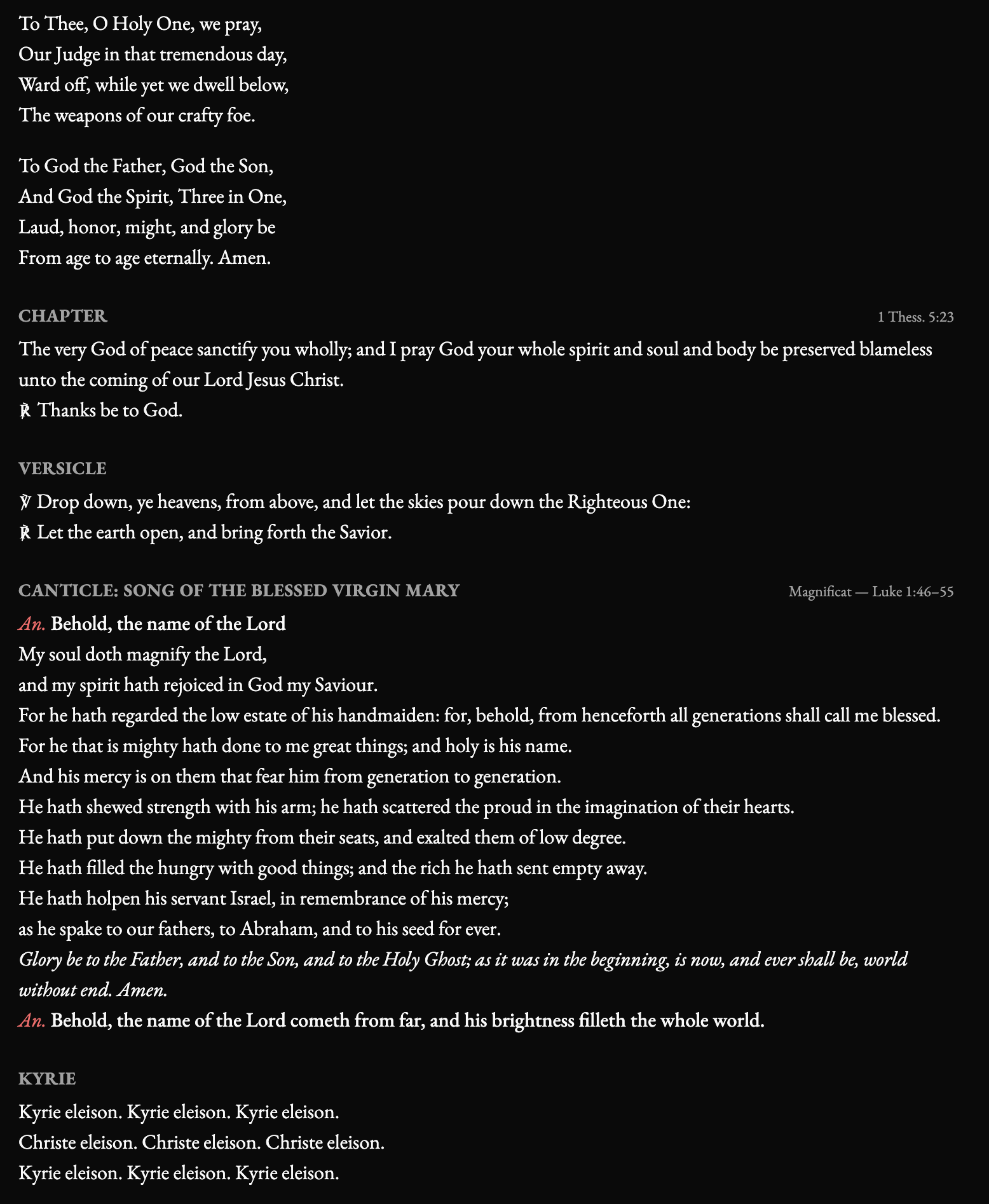
A portion of First Vespers of the First Sunday in Advent from The Lutheran Missal app.
The Lutheran Missal app has previously been featured here on the blog, but I would like to draw your attention to it in anticipation of Advent, beginning this evening.
The Lutheran Missal app (note: currently only the Android app and web app, more on iOS later) now features nearly all of the office propers for the first weeks in Advent, so that you can pray the divine office with your fathers in the faith both before and after the Reformation. The only current omissions in the Advent propers are those of the fourth week (coming soon), and the patristic readings as appointed for Matins on Sundays and Ember Days, as these require more attention with regard to their translation, in contrast with Biblical texts which can be readily made available according to the Authorized (King James) Version.
In contrast to the once or twice a week worship to which we are largely accustomed, and in addition to the mass propers for Sundays, Wednesdays, Fridays, and Ember Days, every day in Advent has distinct readings and antiphons in the daily office, all of which serve to direct our attention to the Christ who has come in the flesh, who comes to us in Word in Sacrament even now, and who will come again on the last day.
The Matins lectionary during Advent is drawn from the prophet Isaiah, who speaks to both to the people of God awaiting the approach of their Savior in the flesh, as well as the people of God today who await His coming in glory to judge both the quick and the dead. This lectionary can be found in two forms in the app, with the briefer and more numerous readings of the medieval breviary (also found in some post-Reformation uses) displayed as they appear in the 1514 Magdeburg breviary, or in the longer and less numerous readings of the 1613 Magdeburg Cantica Sacra, which adapted this existing medieval lectionary to twice daily chapter-length readings (though it really was four times a day, as each chapter was read in both German and Latin at successive offices). The user has the option to toggle between lectionaries by going to Settings > Office > Lectionary. The Magdeburg 1613 readings are selected by default.
While The Lutheran Breviary will require a great deal more research, with at least a few dozen sources eventually being cataloged and incorporated, these texts are provided to help serve as a beginning for all those who would like a fuller observance of the office than what is currently available in The Lutheran Hymnal, Lutheran Service Book, or the Brotherhood Prayer Book, and obviates the need to look to either Anglican or Roman works. These two sources, Magdeburg 1514 and Magdeburg 1613, serve as a good beginning point because they describe the use of the same cathedral one century apart, display a great deal of continuity, and allow for cross-referencing between the two texts when one of them is unclear.
One thing that will be unfamiliar to many users in the traditional form of Matins is the interplay between the Invitatory and the Venite. Matins in the Common Service, as found in The Lutheran Hymnal (1941), provides the Sunday Invitatory alone in the body of the service (“Oh, come, let us worship the Lord: For He is our Maker”), with the reasonable expectation that this is the day on which it will primarily be used. But each day of the week has its own proper invitatory (e.g.: the Invitatory for Wednesdays is “In Thy hand, O Lord: Are the deep places of the earth.”), as do many feasts and seasons throughout the year. Advent alone has more than half a dozen invitatories, with one for each Sunday and several more besides. While some seasonal invitatories are found in The Lutheran Hymnal, even if in a corrupted form (the Common Service either deliberately or accidentally conflates the Advent invitatories Ecce venit Rex and Regem venturum into one), my experience has been that even these have seen extremely limited use, likely due in no small part to the lack of accompanying music. As yet another aside, it is, perhaps, worth considering that the quest for novelty and variety that exploded in the latter part of the twentieth century owed at least some of its origin to the neglect of the appointed propers in both mass and office that provided the variety within constancy that characterizes mass and office.
In addition to the multiplicity of proper texts of the Invitatory found in the traditional form of the office, the way in which they were said or sung differs significantly from current usage. Rather than being a versicle and response that are simply said before and after the Venite, the Invitatory, either in full or in part, is most properly also said between verses of the Venite, and twice at its beginning, in part so that the choir or congregation can repeat it in full. See, for example, the Venite with the appointed invitatory for the First Sunday in Advent, with the invitatory text in bold.
℣ Behold, the King cometh:
℟ Let us go forth to meet our Savior.
Behold, the King cometh: let us go forth to meet our Savior.
O come, let us sing unto the LORD: let us make a joyful noise to the rock of our salvation.
Let us come before his presence with thanksgiving, and make a joyful noise unto him with psalms.
℣ Behold, the King cometh:
℟ Let us go forth to meet our Savior.
For the LORD is a great God, and a great King above all gods. In his hand are the deep places of the earth: the strength of the hills is his also.
℟ Let us go forth to meet our Savior.
The sea is his, and he made it: and his hands formed the dry land.
O come, let us worship and bow down: let us kneel before the LORD our maker.
For he is our God; and we are the people of his pasture, and the sheep of his hand.
℣ Behold, the King cometh:
℟ Let us go forth to meet our Savior.
To day if ye will hear his voice,
Harden not your heart, as in the provocation, and as in the day of temptation in the wilderness:
When your fathers tempted me, proved me, and saw my work.
℟ Let us go forth to meet our Savior.
Forty years long was I grieved with this generation, and said, It is a people that do err in their heart, and they have not known my ways:
Unto whom I sware in my wrath that they should not enter into my rest.
℣ Behold, the King cometh:
℟ Let us go forth to meet our Savior.
Glory be to the Father, and to the Son, and to the Holy Ghost,
As it was in the beginning, is now, and ever shall be, world without end. Amen.
℟ Let us go forth to meet our Savior.
℣ Behold, the King cometh:
℟ Let us go forth to meet our Savior.
The effect of the invitatory being sung in the midst of the Venite is that the tone is changed, in the same way that an antiphon might change the tone of a psalm. Rather than being only focused on God the Son as He revealed Himself to Moses and the people of God in the wilderness — as in the language of the psalm itself — the invitatory reminds us unmistakably that the same God whose hands formed the dry land, the one “by whom all things were made,” is also the one who is the coming King whose advent we await. But it isn’t only waiting, it is, in the language of Matthew 25 (and of the Last Sunday after Trinity), an exhortation to us: “go ye out to meet him.” The juxtaposition of “Behold the King cometh: let us go forth to meet our Savior. Today if ye will hear his voice, harden not your heart….” is a reminder to us that even as the people of God in the wilderness so often hardened their hearts against the words of God given by Moses, so also we are prone to turning aside and closing our ears and hearts to the words of God given in Holy Scripture, or by those whom He has sent. In contrast, as the Venite continues on, after remembering the hardness of heart of the Israelites, we pray again, “Let us go forth to meet our Savior,” even as they would not.
That is, of course, only one of several invitatories for the season of Advent alone, and time and repetition will doubtless help to draw much more to light in all those who pray these words.
The psalm antiphons for Sunday Matins in Advent are drawn from Romans 13: “Know that now it is high time to awake out of sleep: for now is our salvation nearer than when we believed. The night is far spent, the day is at hand,” and the responsories at Matins are, as always, astonishingly rich. See, for example, the famous first responsory on the First Sunday in Advent, Aspiciens a longe:
℟ I look from afar, and behold I see the Power of God coming, and a cloud covering all the land: Go ye to meet him and say: Tell us if thou art he, who art to reign over the people of Israel.
℣ Both low and high, rich and poor, together.
Go ye to meet him and say: Tell us if thou art he, who art to reign over the people of Israel.
℣ O Shepherd of Israel, thou that leadest Joseph like a flock;
Tell us if thou art he, who art to reign over the people of Israel.
℣ Stir up Thy strength, O Lord, and come and save us.
Who art to reign over the people of Israel.
Glory be to the Father, and to the Son, and to the Holy Ghost.
℟ I look from afar, and behold I see the Power of God coming, and a cloud covering all the land: Go ye to meet him and say: Tell us if thou art he,Who art to reign over the people of Israel.
This responsory repeats the same text several times over in progressively shorter renderings: “Go ye to meet him and say: Tell us if thou art he, who art to reign over the people of Israel,” with the speaker changing each time and the meaning still perfectly clear. The seventh responsory (Ecce virgo), a more typical example, draws together two familiar texts (Isaiah 7 and 9, Psalm 24) in an unexpected way:
℟ Behold, a virgin shall conceive, and bear a son, and shall call his name Wonderful,
The mighty God.
℣ Lift up your heads, O ye gates; and be ye lift up, ye everlasting doors; and He shall come in.
The mighty God.
The words of the psalmist in Psalm 24 now refer not to the Savior’s triumph, but to His conception, and the same words elsewhere in the office will be used to describe the harrowing of hell on Holy Saturday and later the Ascension.
This is only the tiniest fragment of what is now available for the first time to English-speaking Lutherans, first digitally, and eventually in print. The multiplicity of the proper texts of the daily office are the fruit of centuries and centuries of the word of Christ dwelling richly in His people, fruit that we are happy to make available to the church once again.
NOTE: While we have Android and iOS applications, the web app will always have the most recent data that incorporates the most recent additions or corrections. The iOS app store review, in particular, causes some delay between the submission of changes on our end and the availability of those changes on the smartphone app. The Advent texts, in particular, are not yet available on iOS, but are available on the web application.