

Different Spirits: The Kyrie & Contemporary Worship
[Note: We are happy to announce that Fr. Matthew Richard is now a Gottesdienst blogger. We like the way he thinks… and writes. He has served as pastor of St. Paul’s Lutheran Church in Minot, North Dakota since 2018. He is the author of Will the Real Jesus Please Stand Up? and Will the Real Church Please Stand Up? - both published by CPH. — Ed.]
Well over a decade ago, after joining the Lutheran Church—Missouri Synod from another synod, I was installed as pastor of my first LCMS congregation. At the time, my first congregation did not use a hymnal. Instead, the service was printed in a booklet.
After several weeks of leading the service from the booklet, something caught my attention. Certain parts of the historic liturgy were missing. For example, the Kyrie was nowhere to be found. I remember being perplexed: “Why remove such a short and pious part of the Divine Service?” And so, the following Sunday, I simply put it back into the booklet.
But something unexpected happened. The Kyrie felt out of place. I had inserted it exactly where it
belonged in the historic liturgy, yet something still felt off. Why didn't it fit?
Holy Begging vs. Expressive Individualism?
To answer this question, we must first understand the Kyrie itself. The word Kyrie means “Lord,” and liturgically it echoes the cry of blind Bartimaeus in Mark 10:47: “Jesus, Son of David, have mercy on me!” In other words, the Kyrie is the desperate cry of a helpless beggar before a merciful King. And so, it is no accident that the Kyrie comes near the very beginning of the ancient liturgy. In other words, the Kyrie is the Church's first cry before the Lord, as the pastor first approaches the altar. One could say that it establishes the posture of holy begging for the entire Divine Service: we come as beggars, crying out for mercy, “Lord, Have Mercy!”
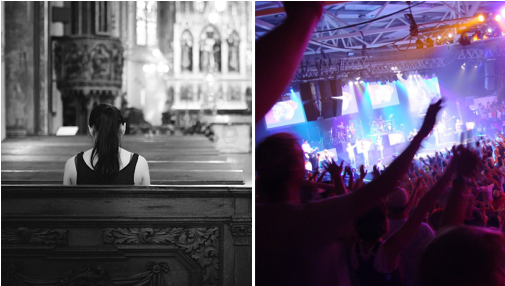
So, why didn’t the Kyrie fit? Simply put, under the previous pastor, the congregation had gradually moved toward a more contemporary style of worship. But this shift involved more than musical preferences or casual customs. The emphasis of worship had moved from receiving Christ's gifts to expressing one's devotion and praise to God. And so, when I reintroduced the Kyrie, its posture of holy begging stood in sharp contrast to this new emphasis.
We are often told that the difference between historic liturgy and contemporary worship is merely a matter of style and instrumentation. While these differences certainly exist, something much deeper and more substantial is at stake. When contemporary worship is shaped by the worshiper's expressive individualism, it loses the posture of holy begging. The contrast could not be greater: expressive individualism seeks to give voice to one’s devotion and thanksgiving through worship, whereas holy begging cries out for mercy. One comes with something to offer; the other comes empty-handed to receive. Simply stated, a beggar comes before the Lord not to express himself, but to plead for mercy.
Holy Reverence
But we must not overlook another aspect of the Kyrie. The Kyrie also establishes a posture of holy reverence that permeates the entire Divine Service and even the entire Christian life. Indeed, the historic liturgy is marked by these two dispositions: holy begging and holy reverence. We beg because we have nothing; we revere because Christ gives us everything.
And so, if holy begging is the Church standing before King Jesus with empty hands, holy reverence is the Church receiving His good gifts with awe and thanksgiving. We beg because we are sinners in need of mercy. We revere because the merciful King Himself comes to serve us. To paraphrase Dr. John Kleinig, “Reverence has to do with good things received.” In other words, Holy reverence is not something we express to the Lord, but something the Lord calls forth in us through His gracious gifts. The Lord’s giving creates our reverence.
Worship as Reverent Beggars?
In my previous denomination, we designed worship sets to elevate the congregation in expressive praise and worship: “Please stand and lift up your hands and voices unto God.” Songs were carefully arranged to build momentum, stir emotions, and intensify the worship experience. The goal was to get the congregation to sing louder, raise their hands higher, and express greater passion for God. The more energy, emotion, and enthusiasm, the more successful the worship set was considered.
This approach stands in sharp contrast to holy begging and holy reverence. And having experienced and personally led this kind of worship in my former denomination, I began to recognize a similar emphasis in my first LCMS congregation. Suddenly, I understood why the Kyrie had felt so out of place. The difference was not merely one of style, but of posture. Whereas the contemporary worship approach I once led sought to elevate worshipers into a heightened expression of praise, the Kyrie humbles them before Christ in reverence, so they receive His gifts with thanksgiving.
But doesn't Scripture also call us to praise God with praise and thanksgiving? Certainly! Yet Scripture also teaches us something essential about our posture before the Lord in worship.
Consider the Greek word προσκυνέω (proskuneō), commonly translated as “worship” in the New Testament. The word conveys bowing down, kneeling, falling on one’s face, paying homage, and humbling oneself before someone of greater authority—like a king. For example, upon finding the Christ Child, the wise men fell down and worshiped (proskuneō) (Matthew 2:11). Or, consider the who approached Jesus to be clean, he knelt before Jesus (proskuneō) (Matthew 8:2). And who can forget the Canaanite woman who, desperate for her daughter’s healing, lowered herself and knelt before Jesus (proskuneō), crying out, “Lord, help me” (Matthew 15:25)? All of these individuals worshiped Jesus, not by attempting to elevate themselves into a greater worship expression. They came low – as beggars – before the King. The wise men fell down, the leper knelt, the Canaanite woman bowed and begged. Their worship was not centered upon expressing themselves, but upon humbling themselves before Christ. This is the spirit of the Kyrie. This is holy begging. This is holy reverence.
Contemporary Worship – a different spirit from the Liturgy
The difference between contemporary worship shaped around the worshippers’ expressive individualism and the historic liturgy is not merely a matter of musical instruments, song selections, or ceremonial customs. It is a difference in disposition – it is a difference in posture. Does the worshiper come before God to express something, or does the worshipper come before God as a beggar to receive something? Is worship about expressing the self, or about the gifts of Christ given to sinners?
And so, the lesson I learned from my first congregation went far beyond recognizing a missing piece of the liturgy. The Kyrie could not simply be inserted into a service as though it were another song or prayer. Its spirit must permeate the entire Divine Service, for the historic liturgy is more than an arrangement of words, prayers, and ceremonies. Likewise, the differences between the liturgy and contemporary worship go far beyond musical styles, instruments, or pastoral vestments. At the heart of these differences is a contrast in posture: one seeks to express the self before God through worship, while the other stands before the merciful King - empty.
We beg because we have nothing. We revere because Christ gives us everything.
Lord, have mercy. Amen.