

The Lutheran Sources of the Common Service (Part 3)
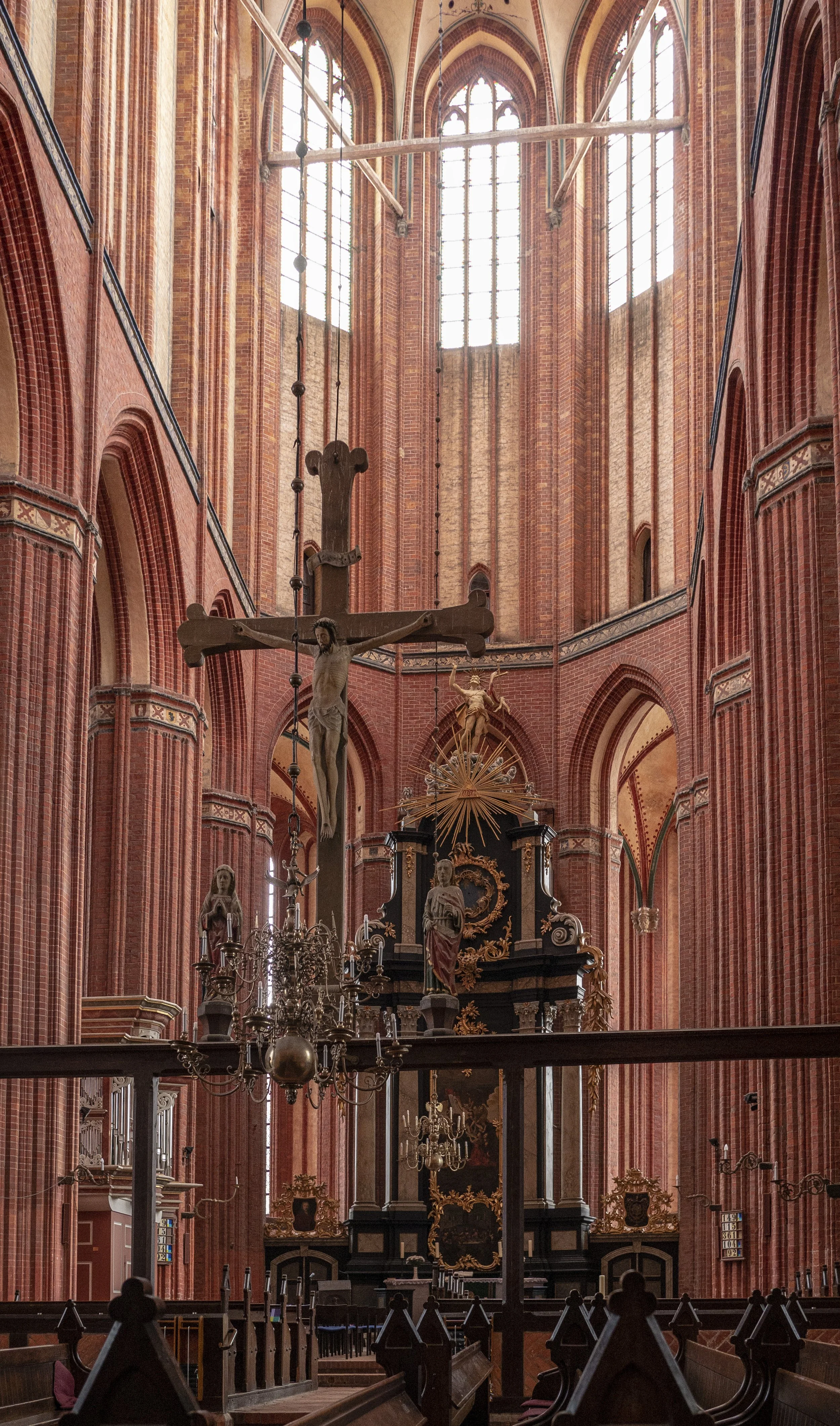
Nikolaikirche, Wismar, Mecklenburg-Vorpommern. Photo: chrisaliv, CC BY-SA 4.0, via Wikimedia Commons
The following article, “The Lutheran Sources of the Common Service”, by Edward T. Horn, is taken from Lutheran Quarterly, Vol. 21, No. 2, pp. 239–268 (April 1891). This is the third installment. The first can be found here, and the second here. Typographical errors have generally been corrected.
This article presents the historical data and liturgical criteria and framework that lie behind the Common Service of 1888, the full text of which can be found here, at the beginning of the United Synod of the South’s Book of Worship (1888). Slight variations in the text exist between the published editions by the three church bodies that commissioned the Common Service, but that of the United Synod of the South is the text authorized by the committee and could be considered the typical edition.
While many today frequently refer to the Common Service most particularly as the Order of Holy Communion found in The Lutheran Hymnal (1941), it is much broader, and also includes a liturgical calendar, lectionary (both temporal and sanctoral), daily office lectionary, Vespers, Matins, introits and collects, daily office propers such as invitatories, antiphons, responsories, and versicles, collects, general prayers, and a selection of psalms.
While reading, one might well be critical of Horn’s (and the committee’s) assertions and assumptions from time to time, but the elucidation of these principles provides us with necessary background for understanding how the Common Service came about.
IV.
We now come to the parts of the Service, and will notice as we meet them certain minor additions which (upon good Lutheran authority) were made in the final arrangement of the Service. Such are the collection, the Pax, the Words of Dismissal, the Nunc dimittis, and the Benedicamus.
Those familiar with the Orders will recognize the propriety of allowing instead of the Introit a Psalm or Hymn. This accords with Lutheran usage, and needs no further note. It will be remarked, however, that while the Church-Book prescribed the omission of the Gloria Patri in Lent, the Common Service has not such a direction. The Roman Missal does indeed omit it from Judica Sunday until Easter, and so does the Bamberg Missal, on which so many of our Orders were based; but Lossius gives it for Palm Sunday and has no Service for Holy Week; Spangenberg, Edward VI. and the Nürnberg Officium Sacrum retain the Gloria Patri. Therefore the Common Service retains it.
The Introits are given in full in Lossius,* [*Psalmodia, hoc est, Cantica sacra veteris ecclesiae selecta etc., per Lucam Lossium cum praefatione Philippi Melanthonis. Viteb. Rhau 1561.] Nürnberg Officium Sacrum, and in Spangenberg† [†Kirchengesaenge Deutsch auf die Sonntage u. fürnemliche Feste, durchs ganza Jar, etc., 1545 — These books were in the hands of the Sub-Committee.] whenever a full Service is given; and the Bamberg Missal gives those in use before the Reformation, to which our Orders refer. The Biblical sources of the Introits are given in Jacobs: Lutheran Movement in England, p. 294. Wherever the Introits as given vary from the texts of the Church Book (e. g. Second, Fourth, Seventh and Twentieth Sundays after Trinity) the change is in obedience to the originals. An alternative Introit for Easter is given suggested by Schoeberlein III. 148 and Loehe. The 27th after Trinity is based on the Bamberg Missal and Lossius. For the Annunciation, instead of that given, Bamberg, Lossius and Spangenberg gives the Introit for the 4th Sunday in Advent; while N'b'g. Off. Sac. gives the Introit for the 1st Sunday in Advent. For the Visitation, N'b'g. has the Introit for the 4th in Advent, Lossius has the Gaudeamus, and Spangenberg has Ps. 106:4, 5, 1. The Introit for Evangelists, etc., is the Roman for St. Paul's day. Lossius, Sp. and N'b'g. have Ps. 139:17, 1, 2, but our English version does not agree with the Latin. The Introits are “marked" or "pointed" according to the latest English authority. The arrangement of the Sundays after Trinity (differing from the Roman, after Pentecost) accords with the Bamberg use, which the Reformers kept.
The Kyrie needs no further remark.
Nor does the Gloria in excelsis. The rubrical permission to use another Canticle or Hymn except on occasions when a full Service is desirable, accords with Lutheran usage. Many of our sources prescribe the versification of the Gloria in excelsis (by Nic. Decius, 1531) Allein Gott in der Höh' sei Ehr; some having both the Latin and the German hymn, though the Gloria was in German prose with notes as early as the Strassburg Kirchenampt 1525, and in Döber's Spitalmesse 1525 as given in Schlüter 1531. In the latter the Minister said, “Glory be to God on high," and the choir answered, “Peace on earth, etc.;" and this is the way in which it usually appears.
For the general purport and the origin of the Salutation, see my Liturgics, p. 62. Though no mention of it appears in the outline of many Orders, I do not think it was meant to be omitted, except, perhaps, in such a case as Pommern 1534, which says, “Let us pray,—without turning to the people." For instance in Richter's resumè of Mecklenburg 1552 while the Salutation is omitted from the outline of the full Service for the city, it is expressly given for the village- and country churches. Music is provided for it in old Cantionales, and it is prescribed in BN. 1533, B. 1540, Prussia 1544, Ritzebüttel 1544; Waldeck 1556, Edward VI. 1549.
The invaluable notes on the Collects of Dr. B. M. Schmucker doubtless are treasured in the Library of the Seminary at Philadelphia; and my notes are too incomplete to be of service.
As to the Epistle: It is hardly necessary to bring proof that while some of our Orders preferred the lectio continua, it became Lutheran usage to retain the traditional Epistles and Gospels. (F. M. 1523 omits them, advising the choice of better; Prussia 1525 omits on ordinary Sundays; Riga 1530, BN. 1533, Meckl. 1540, Pfalz-Neuberg 1543 omit, but the old use was afterwards restored.—The German Mass 1526, Prussia 1544, (except at Königsberg), Liefland 1570, Württemberg 1553, Cologne 1543, Saxon 1539, Nordlingen 1539, Brandenburg 1540, Brunswick 1528, Hamburg 1539, Lubeck 1531, Pommern 1535, Schl. Holstein 1542, Meckl. 1552, Calenberg-Göttingen 1542, Br. Wolffenbüttel 1543, Hadeln 1544, Hildesheim 1544, Br. Luneberg 1619, 1643, 1647, Coburg 1626, Meckl. 1650, Halle 1660, Reuss 1776, Prussia 1822, retain them.) The rubrical permission of other Lessons from Holy Scripture and the prescription of the Epistle and Gospel for the day, therefore have good authority. It should be added that Epistles and Gospels have been supplied to the days of Holy Week from the Comes Theotinchi, except the Epistle for Good Friday, which has good Lutheran authority.
For the Hallelujah see Liturgics pp. 61, 82, 108, 109. The rubrical permission of a Sentence, Psalm or Hymn after it may be justified by the multifold practice of our Church, which I must beg the reader patiently to consider.
1. Prescribe a Psalm. Meckl. 1552. Pom. 1535 a Psalm, or Latin Alleluia or Gradual.
2. A German Song, such as Nun bitten wir den heiligen Geist: G. M. 1526, Vis. Artt. 1533; Ritzebüttel 1544.
3. Psalm or Sequence: Bremen 1534; on Festivals, Pom. 1535; Sequence or Spiritual song, Meissen Vis. Artt. 1539, Saxon 1539.
4. Hallelujah and Sequence or Psalm. Nordh. 1539, Hamb. 1539, B. 1540, Cal. Gött. 1542, Pom. 1542, Osnabrück 1543, Cologne 1543. Wit. 1533: "After the Epistle the children shall sing an usual Alleluia in Latin, at times also a Gradual, and then a German Song from Holy Scripture, which may be sung only to save time. On Christmas and until Purification the Sequence Grates nunc omnes shall be sung, the first verse three times and the last once, and, between its verses, verses of Gelobet seistu Jesu Christ, so that they both be sung through together.—On Easter and until Ascension in the same manner Victimae paschali and Christ lag in Todespanden.—On Pentecost Veni Sancte Spiritus and Nun bitten wir den heiligen Geist.—On the Nativity of John Baptist, Psallite regi nostro. The Sequence, Laus tibi Christe may be sung once or twice in the year on a Sunday. But the Sequence de Sancta Trinitate as often as it is wished." Prussia 1544 has Hallelujah arranged to the melody to which the German Psalm is to be sung. Special Psalms or Songs are assigned to the Festivals.
There is no question with reference to the Gospel, except as to the authority for the liturgical setting with which it is given. Until the Reformation, and still in the Roman Church, the Gospel was introduced by a prayer for the cleansing of the lips of the reader, a request to the priest for his Benediction, the Salutation and Response, and the announcement of the Gospel. To this is answered, Glory be to Thee, O God. And after the reading the response is, Praise be to Thee, O Christ. The people stand while the Gospel is read. This traditional posture is retained in many of our churches, and the Common Service, while not prescribing it, cannot but recognize and allow it. It omits all that precedes the announcement of the Gospel; announces it (Br. 1528, BN. 1533, Pom. 1535); allows the Response, Glory be to Thee, O God, (Pom. in Kliefoth V. 33), saying which the people may stand up; and after the Gospel prescribes the answer, Praise be to Thee, O Christ. That this was usual in some places, though it is not prescribed in the Orders, is rendered probable by the fact that it is given with music by Lossius and Vope!ius* [*Neu Leipziger Gesangbuch, etc., von Gottfried Vopelius, Cantorad D. Nicolai, 1681] (Preface to Meckl. Cantionale I.1.). Many of the Orders say simply “The Gospel"; some, that it shall be sung in the usual tone, with face turned to the people, (G. M., 1526; Wit. 1533); Pom. 1535 allows it to be read if the Minister cannot sing; F. M., 1523 says it neither forbids nor prescribes candles and incense; and B. 1540 retains the usual Benediction and requires the Gospel to be sung in Latin, then read in German.
The Nicene Creed (called the Patrem) or its equivalent, Wir glauben all, is prescribed by all our authorities. Only Döber 1525 has the Apostles' Creed ; and the Pomeranian Agenda (Kliefoth v. 45) puts the Athanasian Creed instead, at the Opening of Synods, on Trinity Sunday and once a month. It also allows the Te Deum to be sung instead.
We have mentioned the variations of early Orders in reference to the place of the Sermon. It must be added that in German congregations the Sermon itself has a liturgical setting. In the Agenda of the Synod of Missouri, for instance, the preacher is directed to go into the pulpit while the Creed-Hymn is being sung, and at the close of it say in the pulpit a free prayer on Festivals, but on ordinary Sundays the Apostolic Votum or greeting, after which he gives the introduction to his Sermon. After the introduction he announces his theme; a verse of a hymn is sung; then he and the congregation kneel and silently pray the Lord's Prayer; whereupon he again announces and reads the Gospel for the day, which also is the text, the congregation standing, and after stating the divisions of his Sermon on ordinary Sundays he offers another prayer. At the close of the Sermon come the General Confession and Absolution.
We have not found such minute directions in our authorities. Daniel (Cod. Lit. II. 143) gives the following from Brunswick-Lüneberg 1657: “Before the sermon the preacher shall say the customary votum or prayer, Grace, mercy and peace from God the heavenly Father, His Only-begotten Son Jesus Christ, with the Holy Ghost, be and abide with us evermore. Then shall follow a silent prayer; then let all join with him in saying the Lord's Prayer. Then a Hymn. Then let the text be read and let him begin his sermon."
Kliefoth V. 47 gives as a general description 1. The Apostolic Greeting; 2. Exordium connecting the Sermon with the season and exhorting the people to prayer; 3. The Lord's Prayer or a prayer ending with it. Lüneberg 1598 and Verden (he says) have the prayer immediately after the votum; Pommern, Hoya, Lauenburg have a hymn before the call to prayer. Löhe (Agenda 3rd ed., p. 21) has merely the Apostolic Greeting before the Sermon, and adds that if the Sermon end with the Gloria Patri or a similar Doxology, the people may say Amen. Kliefoth (v. 367) advises that the Sermon always end with a prayer, closing with the Lord's Prayer and followed by the Apostolic Greeting.
Our Service, not bound to this elaborate arrangement, simply bids the Minister say at the close of his sermon: The peace of God, etc.
In the first report of the Committee it was proposed to add to the Normal Order given above the Collection of the Offerings of the Congregation, but the place into which it was to be inserted was not determined. For the reasons which connect our offerings with the General Prayer, I refer to Liturgics, pp. 74 and 111; as also for the proof that our offerings ought to have a place in the Service, and had a place in the old Service, from which they were pushed by the false notion of the Sacrifice of the Mass and the consequent perversion of the Offertory. The Romish Offertory (described in Liturgics, p. 110) had taken the place of the old-Christian Offertory and (though B. 1540 retains it) was rightly excluded by the pure Orders, but nothing took its place. This want Ref. Col. 1543 tries to supply by this provision: “After the General Prayer the whole congregation shall sing the Creed [omitted before the Sermon] for such confession of faith befits the whole people of Christ, who have just heard his holy Gospel together. And since every one has heard the holy Gospel with true faith, and therefrom has learned that God out of his boundless love has given him His Son and with Him all things, and out of such faith gives himself to God and our Lord Jesus Christ as an offering, so while they sing the Creed believers ought to bring their freewill offerings, each as God in kindness has blessed him." Edward VI 1549, omitting the General Prayer at this place, says after the Sermon or Homily or Exhortation, “Then shall follow for the Offertory one or more of these sentences of holy Scripture, to be sung while the people do offer; or else one of them may be said by the minister immediately afore the offering. Where there be clerks, they shall sing one or many of the sentences above written, according to the length and shortness of the time that the people be offering. In the meantime, whiles the clerks do sing the Offertory, so many as are disposed shall offer to the poor men's box every one according to his ability and charitable mind." The simple adoption from Schöberlein of passages from Ps. 51 to be sung as an Offertory in accordance with 2 Cor. 8:5, the permission of other suitable song, and the rubric The offerings shall be gathered, which does not prescribe whether they shall be gathered before or after the Prayer, or during or after the Song; with the rejection of Löhe's doubtful. suggestion (too closely connected with the old perversion) that during the song the elements of bread and wine may be put upon the altar or uncovered there, restore an essential part of the Service; interpret our contributions to the Church, and accord with the only precedents which the Orders of that age contain.
The General Prayer and the Litany have been fully illustrated in Dr. Jacobs' Lutheran Movement in England (pp. 303ff. 230–241). The Litany, which is Luther's, retains a petition for travelers, which Luther's did not have:* [*Kliefoth v. 68: It was natural for the seafaring Mecklenburgers and Pomeranians to pray also for “all who travel by land or water." “Lossius says that when the Litany is sung at ordinations, all the petitions for the Church are to be sung on bended knees. The Meckl. 1708 bade the. boys kneel while intoning the words, O Lamb of God."] The N'b'g. Off. Sacr. prays for “perpetual victory over all Thine enemies," but “its" has been kept with Luther. It is not necessary to multiply authorities for our use of the Litany. Saxon 1539, for instance, ordained that it should be sung at the Ember-seasons daily for a week; in the cities every Wednesday and Friday after the Sermon; and in villages once every Sunday. Meckl. 1552 has “After the Sermon sing the Litany or Psalms."
The “Bidding Prayer" is found in The Frankfort Agendbüchlein 1565 (see Höling's Urkundenbuch p. 101; see also Schw. Hall 1526 in Richter I.43). Our Service omits a prayer for women with child, and in turn inserts the Collect for the Catechumens (one of the very few original translations which the book contains) and a prayer for our enemies. The General Prayer No. VII. is of Anglican origin. “Though generally attributed to bp. Sanderson, the General Thanksgiving was certainly composed, and probably at the suggestion of the Presbyterians, by their representative Reynolds; who afterwards conformed and was made bp. of Norwich." (Trollope, Liturgy and Ritual, p. 147.) The prayers for the good estate of the Church and for all conditions of men, were composed by Gunning (1661) afterwards Bp. of Chichester and Ely, and are supposed to rest upon the Bidding Prayer just described. (See Blunt, Annotated Bk. of C. P., p. 238.)
The remainder of the article will be published in subsequent installments.