

The Common Service and Contemporary Worship: An Historical Review
Many of our readers either watched or heard about the highly advertised debate on contemporary worship between Rev. Bryan Wolfmueller and Rev. Stephen Zank, which was recently recorded at Luther Classical College and premiered on the On the Line podcast on Monday. There is much that has been said on the debate, and much more that could still be said, but I will confine myself to one set of repeated assertions from Rev. Stephen Zank, which generally equated the communion liturgy of The Common Service of 1888 (as found on p. 15 of The Lutheran Hymnal or in Lutheran Service Book, Setting Three) and its divergence from the German communion liturgy of the LCMS’ German Agenda with the various innovations and changes being introduced today under the name of “contemporary worship.” His argument on this front was, broadly, that the Lutheran Church—Missouri Synod had adopted a relatively novel form of worship with the introduction of the Common Service in the beginning of the twentieth century, an introduction that marked a break with its received German-language tradition, and that refusing to adopt other relatively novel forms or modifications of the existing service today is itself ahistorical and untraditional, as we had previously been much more tolerant of divergences from the received liturgical forms.
This is, at best, misleading — and, in at least one instance, abjectly false.
We have to begin untangling this by first understanding what the Common Service is, and what it is not. In the words of its preface, it aims to present “the common consent of the pure Lutheran Liturgies of the Sixteenth Century, and when there is not entire agreement among them, the consent of the largest number of those of greatest weight.” It is an avowedly traditional and conservative project, one which intends to reach back to the liturgical uses of the time of the Reformation, draw together a consensus, and present it to the church today as a unified form of worship for all Lutherans, not just Saxons or Danes or Finns or Norwegians or Swedes. Its intent is, in fact, catholic — to present a form of liturgy that is recognizably the one celebrated semper et ubique, always and everywhere, as it is found among our forebears in the faith. This is because the editors of the Common Service were emerging from a time of great confessional and liturgical confusion among the Lutherans of North America, and they understood instinctively the truth of Article XV of the Augustana: “Of Usages in the Church they teach that those ought to be observed which may be observed without sin, and which are profitable unto tranquility and good order in the Church, as particular holy days, festivals, and the like.” They were seeking after tranquility and good order in a time when such things were sorely lacking, and were by no means interested in novelty for the sake of novelty. They sought, as Lutherans in every generation do, to have a liturgical life that bears out the central contention of the Lutheran Reformation: “In doctrine and ceremonies nothing has been received on our part against Scripture or the Church Catholic. For it is manifest that we have taken most diligent care that no new and ungodly doctrine should creep into our churches.” (AC, Conclusion)
What, then, is contemporary worship? A clear definition seemed nearly impossible over the course of the debate, which is one reason that it has generated so much discussion afterward — neither party could even provide an agreed upon definition of the core terminology, a problem that has seemingly plagued every such discussion for decades. The only time something resembling a definition (really, a succession of synonyms) surfaced was in Zank’s remarks just after the 27 minute mark, when he floated the terminology of “adaptation”, “replacement”, or “adjustment”. Specific examples of contemporary worship were frustratingly absent from Zank’s argument — apart from placing the general confession and absolution after the sermon — and so the viewer is entirely left with no idea at all of what, precisely, he is arguing for. The absence of either a definition or meaningful concrete examples meant that the whole discussion tended toward an exercise in futility. But the synonyms offered by Zank are, in themselves, likely telling enough for our purposes at the moment.
“Adaptation” or “adjustment” sound innocuous enough, and certainly could be. But an adaptation…to what circumstances? And an adjustment…by whom? One could argue that the vaunted “400 pre-Enlightenment sources for liturgy” mentioned in Zank’s introduction are an example of just that — 400 adaptations of the universal prayer of the church to local circumstances. Village churches, for example, tended toward a simpler service in the vernacular, and city churches (for reference, 50% of “cities” had fewer than one thousand inhabitants) tended toward choral services in Latin. But is this the equivalent of one congregation determining their own particular form of the mass, and changing it from week to week to adapt to their circumstances? By no means. The liturgical forms in the various Lutheran church orders were a standard held in common by all of the churches in a particular region, and had the force of law. To claim this variation as a basis for creating a malleable form of worship that changes from week to week or month to month is decidedly a mischaracterization of the historical reality. One is reminded of the 2022 saga of the ill-fated premiership of UK Prime Minister Liz Truss, whose fleeting 49 days in office were outlasted by an unexpectedly famous head of lettuce. Will the local liturgical “adaptation” or “adjustment” in question have even the longevity of a garden vegetable, or will it be an “adaptation” to the circumstances of this time and this place, which may have inexplicably changed thoroughly by next week, requiring a new “adaptation” and “adjustment”?
The “replacement” synonym is, quite frankly, unacceptable. That is the language of the Radical Reformation, and not the language of the Church of the Augsburg Confession, which explicitly states: “Falsely are our churches accused of abolishing the Mass; for the Mass is retained among us, and celebrated with the highest reverence.” Replacing the traditional liturgy of the church is directly contrary to our confession of faith. But, of course, the reader may well ask, “What exactly is the traditional liturgy, if there are 400 different forms of it in the Evangelical Lutheran Church prior to the Enlightenment?”
That question is at the heart of the Common Service, which is why such comparisons between today’s innovations and the introduction of the Common Service are so specious. The editors of the Common Service set out to draw together the collective witness of their forefathers in the faith and provide a unified order of service for what were, at the time, three distinct church bodies — the General Synod, the United Synod of the South, and the General Council. Their work was to draw together the various churches that had commissioned their work, to give a common language of worship to the vast majority of English-speaking Lutherans in North America, and so they began with the common heritage that they all shared, the Lutheran liturgies of the sixteenth century.
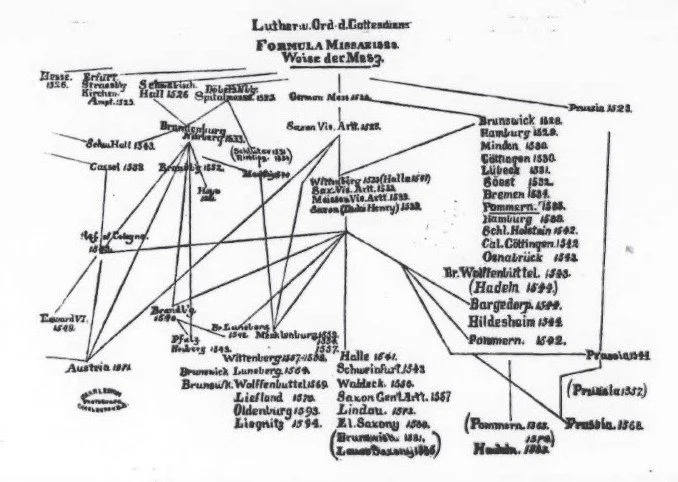
Edward T. Horn, in his article The Lutheran Sources of the Common Service (Lutheran Quarterly, April 1891), does an admirable job of conveying how this process was carried out, and I commend the entire article to your reading. While reproducing the entire text will not be practical in this article, it will be provided in installments, with charts, in future posts. Horn presents an admirable chart of some of the primary liturgical sources of importance in the compilation of the Common Service and their interrelationships (below), and gives some definite shape to the notion of “400 liturgies.” Most of these are closely interrelated, with many of them so close as to be nearly identical.
Horn then goes into very thorough detail on the distinct parts of the service, and I will provide an excerpt of his work:
——————
The first report of the joint Committee (Phila., May, 1885) promptly adopted by the three General Bodies, gave the parts and order of the Normal Lutheran Service thus:
I. Introit
II. Kyrie.
III. Gloria in Excelsis.
IV. Collect.
V. Epistle.
VI. Alleluia.
VII. Gospel.
VIII. Creed.
IX. Sermon.
X. General Prayer.
XI. Preface.
XII. Sanctus and Hosanna.
XIII. Exhortation to Communicants.
XIV. Lord's Prayer and Words of Institution or Words of Institution and Lord's Prayer.
XV. Agnus Dei.
XVI: Distribution.
XVII.; Collect of Thanksgiving.
XVIII. Benediction.
Of these parts the Formula Missae omits X. and XIII, and puts XII. after the Words of Institution and before the Lord's Prayer. The German Mass 1526 has all but III., X., XI., XV., putting the Sanctus during or after XVI. Wittenberg 1533 has all (the Da Pacem instead of a lengthy prayer after the Sermon) and transposes the Sanctus to the place of the Agnus Dei. The Visitation Articles 1533 has all but II, VI., XI.; the Da Pacem as in foregoing; for VI. “a spiritual song;" and allows the Sanctus instead of XV. Brunswick 1528 has all, putting XVI. before XV. and XIII. before XI. Brandenburg-Nürnberg 1533 has all but XI., thus: XIIL, XIV., XIL, XVL, XVII., the Agnus Dei during the Distribution, and inserts the Pax and Benedicamus. Pommern 1535 has all in order. Saxon 1539 has all but X. Mecklenburg 1552 has all, putting a Psalm in place of VI. and not prescribing XV. during the Distribution.
To these may be added: Teutsch-Kirchenampt 1525 has all; putting VIII., IX. and XIII, before XV. The Prussian Landesordnung, 1525, has all but the Sermon, and puts XIII. after XIV. Schwäbish-Hall, 1526, omits the Epistle and Agnus Dei. Döber's Mass, 1525, (in Schlüter, 1531) omits IX., X., puts XII. after XIV. and XIII. after XV. Liegnitz, 1534, omitting only XV. and putting instead of the Creed a hymn to the Holy Ghost, puts the Lord's Prayer after the Sermon and VIII., XIII. before XI. [….]
To summarize: the following Orders of those we have instanced, HAVE ALL THE PARTS: W., 1533; Br., 1528; Pom., 1535; (Saxon, 1539;) (Meckl., 1552;) Strassburg Kirchenampt, 1525; (Prussia, 1525;) Hamburg, 1539; Halle, 1541; (Pommern, 1542;) Pf.-N., 1543; (Stralsund, 1555).
Döber's Nürnberg Spitalmesse, 1525, BN, 1533, Liegnitz, 1534, Bremen, 1534, OMIT ONLY ONE PART.
Nordheim, 1534, B, 1540, Ref. Col. 1543, Form. Missae, 1523, HAVE ALL THE PARTS BUT TWO.
The Meissen Vis. Artt., 1539, S. H., 1526, and Edward VI., OMIT ONLY THREE. [….]
The true statement of the case then is: The new elements in the Lutheran Service are 1. the reintroduction of the Sermon, which had fallen out of the Roman Mass, 2. the restoration of the General Prayer, and 3. the insertion of an Exhortation before the Communion.
These are characteristic elements of the Lutheran Service, but the early Orders did not at first know how to assimilate them; some omitting one or the other; some…letting the Sermon precede the whole, or as S. H., 1543, letting the Sermon come after the Holy Supper; and others wavering as to whether the Preface and the Exhortation were compatible, the Exhortation being a sort of preface too. The historical significance of the Preface was not immediately seen. On one other point there was diversity—some kept the Agnus Dei as the principal song in the Distribution of the Holy Supper; others thought it enough to require appropriate song; and some preferred another hymn, especially John Huss's Jesus Christus unser Heitland. This explanation covers nearly every variation noted and greatly strengthens the authority for the “Normal Service."
And now as to the order of the parts of the Service. At first it may seem to the bewildered reader that there is very little agreement among these liturgies. But let him turn back and look again….We submit that any one examining these Orders with the simple purpose to find what the parts of a full Lutheran Service are, would be compelled to admit that every one given in our list belongs to it; and that, in spite of the variations in the order of the parts, the order given in the Common Service is established by Lutheran usage as well as by the pre-Reformation Service and sound liturgical principles.
——————
Horn then goes on to describe certain modifications that were made in the Common Service with regard to the majority of sixteenth century Lutheran liturgies, largely consisting in the moving or addition of hymns and placing the confession at the beginning of the service with the invocation. I will largely leave these discussions for your review when the full text is made available, save only to note that when Zank stated that “there is no 16th century liturgy that started with the pastor standing in the front saying, ‘In the name of the Father, and of the Son, and of the Holy Spirit,’ that was a novel thing,” (0:55:34) it is blatantly false, as Horn notes that the Strassburg-Erfurt Kirchenampt of 1525 begins precisely in this way, and further analysis by Seth Kasten of Scholastic Lutherans finds that this takes place in nearly a dozen other sixteenth century sources.
The Common Service, more heavily influenced by the Formula Missae strain of Lutheran liturgy common in cities was, undoubtedly, a distinct change from the existing German liturgy of the LCMS, which was drawn primarily from Saxon agendas and tended more toward the Deutsche Messe tradition of Lutheran liturgy (this being rather more of a spectrum than a binary). But could you make any reasonable case that it was a change, in any essential way? Since gastronomic analogies seem to carry the day, it is roughly the equivalent of celebrating Thanksgiving dinner using your maternal grandmother’s china rather than your paternal grandmother’s china. Is it different? Yes. Is it the same thing as hurling your grandmother’s china out the window, piece by piece, and asking, each time it shatters, if it is allowed? Transparently not.
One hopes that any future debates or discussions will be able to provide clear and concise definitions, as well as practical examples of the practices in question so that these urgent and important issues can be properly discussed. However, in the meantime, it is worth noting that one of the core confessional questions was entirely missing from the debate: Has contemporary worship, in the language of AC 15, brought about tranquility and good order, which is one of the intended purposes of liturgical usages? Or has it been a disruptive force in the life of our entire Synod, an introduction that has brought no end of bitterness and strife, that has bred factions and wars and divisions? Any honest observer has no choice but to respond that this has undoubtedly been the case. The “worship wars” spawned by the introduction of “contemporary worship,” however it is defined, can by no means be seen as an example of “tranquility and good order”.
To put it more bluntly, the answer to the question “How many things can I break before you get angry?” isn’t to go through, item by item, and respond to each of them one by one, but instead to ask, “Why are you so intent on breaking things?”