

We Have Got to Talk About Usury (Part XVII): C.F.W. Walther and the Nineteenth Century Struggle Against Usury—1838 to 1868
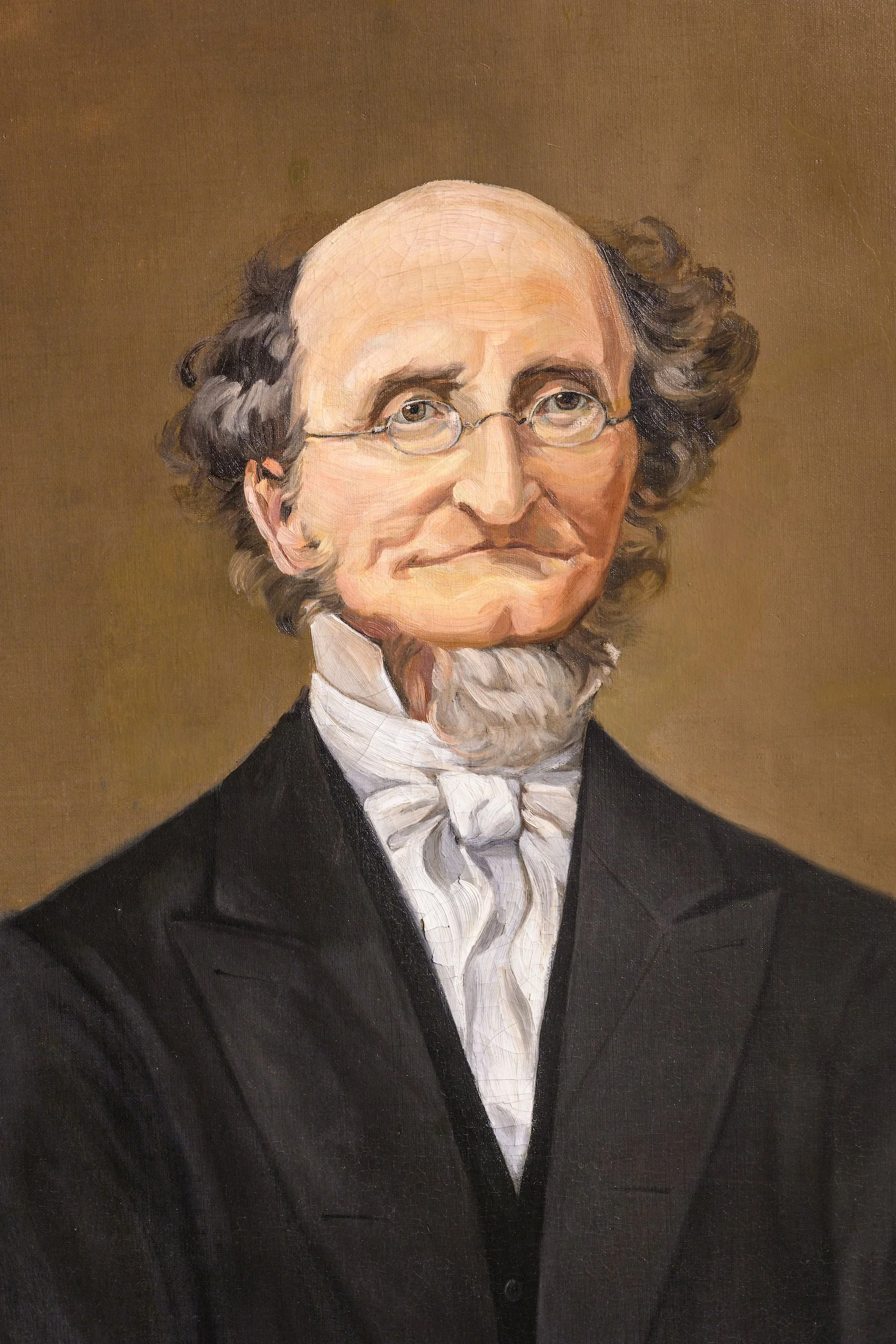
A painting depicting C.F.W. Walther at the LCMS International Center in St. Louis, photo by LCMS Communications/Erik M. Lunsford.
The following post is the seventeenth in a series on usury by the Rev. Vincent Shemwell. Rev. Shemwell serves as pastor of Bethlehem Lutheran Church in Johnson City, Tennessee. He graduated from Concordia Theological Seminary in Fort Wayne with the M.Div. in 2022, and received his STM from CTSFW in 2024, writing his thesis on Johann Georg Hamann. The previous installments can be found below:
Part I: Introduction
Part II: The Old Testament
Part III: The New Testament
Part IV: The Church Fathers—Clement of Alexandria through Hilary of Poitiers
Part V: The Church Fathers — The Cappadocians
Part VI: The Church Fathers — Church Councils and Ambrose
Part VII: The Church Fathers—Chrysostom through Leo the Great
Part VIII: Medieval Theologians
Part IX: The Medieval Church Continued—Councils, Canon Law, Dante, and Other Matters
Part X: Luther—His First Foray, in Translation
Part XI: The Strauss Affair and Luther’s Long Sermon
Part XII: Luther on Why Pastors Must Preach against Usury
Part XIII: Miscellaneous Mentions by Luther and a Few Misconceptions
Part XIV: After Luther—Spangenberg, Melanchthon, Brenz, Aepinus, Chemnitz, and Selnecker
Part XV: Rhegius, Hunnius, Gerhard, and the Setting of a Bright Sun
Part XVI: The Regensburg Dispute of 1587
In the previous part of our series, we saw how political and economic pressures brought a decisive end to the traditional understanding of usury championed by Luther. The Andreae-Gerhard position prevailed throughout the seventeenth century, thereby establishing a way for interest to be regarded, under certain conditions, as morally licit for Christians. As the distinction between the Zinskauf trade and ordinary lending gradually collapsed, the charging of interest on loans of every kind soon became widely accepted, provided, at least in theory, that the poor were still protected from economic harm.
Owing to this historic shift in emphasis from the intrinsic nature of the loan contract itself to the status of the borrower and the practical outcome of the transaction, by the eighteenth century, usury had largely ceased to function as a central moral concern. Unsurprisingly, as theological reflection fell silent, practice soon followed.
As Loy observes in his brief study of the Regensburg Dispute, quoted at the conclusion of the previous part of our series (“Der Regensburger Wucherstreit: Ein Beitrag zum Kampf des Luthertums gegen den Kapitalismus,” Beiträge zur bayerischen Kirchengeschichte XXXI (1925), 3-28, here 27): “To the [Regensburg] pastors, charging interest seemed emblematic of an economic system from which the spirit of the Christian command to love was increasingly departing, to the detriment of those who were economically vulnerable.”
In retrospect, the suspicions of the Regensburg “Exiles of Jesus” appear to have been correct. Once usury ceased to be treated as a serious moral question, even the nominal concern for protecting the poor was slowly but steadily sidelined. As the moral breach widened and civil authorities grew progressively permissive, the modern credit economy did not merely expand but became structural. In the eighteenth century, moral reasoning yielded to economic calculation. By the nineteenth century, lending at interest, regardless of the status of the borrower, had become almost entirely normalized, and far too many Christians came to understand usury not in biblical or historical terms, but as little more than the problem of excessive interest. And this unfortunate development was not confined to Europe, but extended equally—if not more so—to the American context.
It is at precisely this point that the Confessional Revival enters our narrative. But I certainly do not need to run through this whole story for you, dear reader. What is especially revealing is that when our Saxon forefathers arrived in America in the late 1830s, the Code for the Credit Fund of the Lutheran “Gesellschaft” Emigrating with Herr Pastor Stephan to the United States of North America (for reference, see Appendix B in Philip Stephan’s In Pursuit of Religious Freedom: Bishop Martin Stephan's Journey), which governed borrowing for settlers’ land purchases, the charging of interest was allowed, so long as the agreed rate conformed to local law. The Code did forbid compound interest and further stipulated that Christian charity had to take priority over the collection of both interest and principal when borrowers were experiencing economic distress. Nevertheless, the fact that interest on ordinary loans was considered acceptable is itself indicative of the economic and moral world in which C.F.W. Walther found himself.
By the 1840s, Walther was leading a body of Lutheran immigrants, and, in time, an emerging church body, within a cultural and economic world in which Christians were in large measure silent on the question of usury, in which civil authorities almost universally sanctioned it in some form, and in which widespread participation in interest-bearing lending had already advanced to the point of national dependence. We do not know precisely how Walther initially regarded this situation during the very early years of the Saxon immigration. However, at some point in the 1840s, as he began to study the writings of Luther with renewed diligence, he discovered—or perhaps rediscovered—the reformer’s sustained and unwavering opposition to usury.
For Walther, this experience appears to have functioned as a kind of theological awakening, akin to the discovery of the Book of the Law by Hilkiah, read aloud by Shaphan before King Josiah, and recorded in 2 Kings 22. Upon hearing the words of the law, Josiah tore his clothes in repentance and holy fear, recognizing how grievously Judah had violated the covenant of the Lord. Something similar seems to have occurred in Walther’s own conscience when he grasped the extent to which the toleration of lending at interest had become commonplace among Christians.
This transformation experienced by Walther, and, in due course, by others as well, is reflected throughout the two primary synodical publications of the latter half of the nineteenth century, Der Lutheraner and Lehre und Wehre. Notably, just thirty-five days after the official founding of the Missouri Synod on April 26, 1847, Der Lutheraner published its first direct challenge to the modern understanding of usury: a series of excerpts from Luther on the subject, presented with minimal editorial comment (Der Lutheraner III (1 June 1847), 107–11).
A year later, in 1848, another article appeared of comparable provocation under the title “Der Kornwucher” (Der Lutheraner V (12 December 1848), 64). This piece recounts an episode from 1379 in the Pomeranian town of Damgarten, concerning a usurious grain merchant who, having purchased and hoarded large quantities of grain at the outset of a famine, found himself ruined when a subsequent harvest, one richly blessed, restored abundance to the region. Reduced to despair by the consequences of his own avarice, the merchant ultimately hanged himself in public. The article concludes with Paul’s counsel from 1 Timothy 6:6–8, as something of a warning to Americans, helplessly dependent on a credit economy and always hungry for more.
While a modest number of articles appeared throughout the 1850s, including one in which Walther remarks in a footnote that it is “incomprehensible for any Christian to demand or even accept interest” (Der Lutheraner IX (1 February 1853), 80), the conversation itself remained fairly subdued.
It was not until 1860 that the debate truly ignited. In that year, Rudolf Lange, professor of philosophy and the English language at the St. Louis seminary, presented a set of fifteen theses on usury to the Synod’s pastoral conference. This address effectively marked the opening salvo in what would become a decades-long struggle against usury within the Missouri Synod, and the theses were clear and uncompromising. The opening thesis, in particular, set the tone for what followed. It reads (Lehre und Wehre VI (November 1860), 321): “Not only does Christ, the Lord and Head of His Church, forbid the children of God to lend at interest, but the Holy Spirit also declares in Holy Scripture that lending at interest is a deed which brings the life of one’s neighbor to ruin, is an abomination before God, and is a transgression which not only excludes one from the congregation of God and results in eternal damnation, but which already in this life incurs temporal punishment as well.”
Lange’s theses articulate the traditional understanding of usury in terms essentially identical to those set forth by Luther centuries earlier, and they stand in deliberate opposition to the Andreae-Gerhard position that had come to dominate in the following century. Proceeding explicitly from God’s moral law, Lange maintains that all lending at interest must be rejected as a sin against both God and neighbor. In advancing this historic position, along with Walther, he emerged as one of the most forceful and consistent critics of interest-bearing lending in the latter half of the nineteenth century. Indeed, Lange’s theses later served as the foundation upon which Walther himself formulated an expanded set of theses.
With the publication of these theses in Lehre und Wehre—and, significantly, by a respected seminary professor—the debate entered a new and even more public phase. The question was no longer merely theoretical, but now pressed itself upon the life of the church. Accordingly, in early 1864, seven evening sessions were convened at Trinity Lutheran Church in St. Louis, during which Walther, as pastor, read aloud and led discussion on several of Luther’s writings on usury. The proceedings of these meetings were then published in 1869 under the title Die Wucherfrage: Protokoll der Verhandlungen der deutschen ev. luth. Gemeinde U.A.C. zu St. Louis, Mo., über diese Frage.
Die Wucherfrage is well worth reading for those proficient in German. Hopefully it can be translated soon. For now, though, I would like to share some representative excerpts.
At the outset of the text, Walther candidly admits the realities of his own context. In his day, lending at interest was evaluated almost exclusively in terms of outcomes: namely, whether the practice appeared to benefit both lender and borrower and whether it seemed advantageous to society at large. For Walther, however, as for Luther and the church fathers before him, usury was not chiefly a question of social utility but a fundamental violation of the first commandment. Of course, by the nineteenth century, this theological framework had to a great extent receded from view. The decisive question was no longer God’s approval, but whether the practice yielded material gain. Where it did, lending at interest was readily defended as an “act of love,” purportedly in keeping with Christ’s commands.
Against this argument, and alluding to Luther, Walther writes (Die Wucherfrage, 8): “This is why it is so difficult for many to believe that lending money at interest is a sin. One thinks: ‘I lend my neighbor my money at interest and thereby help him out of his distress, and do him a great favor. This work cannot be against love. For in this way I render my neighbor a genuine service of love and therefore practice love of neighbor.’ … But not everything that is regarded as a service of love and called such is therefore a godly service. Prostitutes and clients also render one another a mutual service and, in their own estimation, show love to one another. But who would say that, for this reason, prostitution is a work of love commanded by God and a godly service? Who would not instead call such a service a service of the devil?” A bit later, and employing the same analogy, he cites Chemnitz (22): “Permitting ‘moderate’ usury is no different than permitting ‘moderate’ prostitution.” For Walther, the true service of love is instead defined by obedience to Christ’s command in Luke 6:35: to lend without hope of gain.
Early in the proceedings, Walther also acknowledges the historically recognized exceptions to the prohibition of lending at interest, interesse and antidora: justified indemnities for demonstrable loss and voluntary gifts given at the conclusion of loans (9–10; 22–29). In doing so, he situates his argument squarely within the received tradition of the church. Although long-term price stability was more widely assumed in Walther’s day than in our own, he nevertheless recognized that the reality of monetary depreciation could, in certain cases, necessitate interesse as a legitimate form of compensation.
Walther further stresses that any retrieval of the historic teaching on usury must proceed with pastoral patience and careful instruction. In this respect, he follows Luther’s own counsel that church discipline be directed foremost toward “gross usurers,” those who persist in the practice with full awareness of its sinfulness and who exploit their neighbor through exorbitant rates (20–21). As for the average American Lutheran involved, he writes (32): “We should not immediately treat as beyond the pale one who holds moderate interest to be permissible. And we should not, without further thought, assume of the one who takes a modicum of interest: ‘Why, that is a depraved and godless person! Look how he commits so grave a sin!’ Nor should we at once descend with the lightnings and thunders of Sinai upon a person who, after the first or second instruction, is still unwilling to concede that taking interest is usury and a damnable sin…. Rather, we should regard the Christian who does not consider the taking of interest to be a sin as an erring brother, meet him with all love and kindness, instruct and admonish him with all gentleness and patience, and direct his attention to the clear passages of Holy Scripture that speak of usury, for example, Psalm 15 and Ezekiel 18.”
He then goes on to write (21–22):
We must consider in what kind of time we are living. In the present age, nearly the whole world practices usury, and almost no one regards the taking of interest as usury. Therefore, it is no wonder that Christians, too, charge five or six percent interest. But this is not to say that these small usurers do not sin at all. They do indeed sin. On account of their ignorance in this matter, the taking of interest does not cease to be a sin. For it is already a sin not to know the will of the Lord. Yet they are not to be regarded as so depraved as to be acknowledged as servants of the devil. Rather, it is our holy duty to instruct them with all patience and gentleness. Two things must stand vividly before us in this regard: 1) that the clear light of understanding which we possess in this matter we owe solely to the grace of God; and 2) that even now a general darkness concerning the question of usury still covers Christendom. For there is scarcely anyone in Germany who has realized that the taking of interest as such is usury. Even to the most zealous theologians, God’s Word remains sealed in this matter. Yes, so great is the darkness that many, when one says to them, “Taking interest is usury,” truly conclude that one is not quite right in the head. But to be certain, if Luther’s writings on usury were more diligently studied, then for many a light would soon dawn. However, this is not considered necessary, because people imagine it to be a settled matter that moderate interest is not usury. So they do not consider it important at all to study this subject thoroughly. And who among us has always stood above them? In the past, was it not similarly the case for us as it is for them now? And to whom do we owe our light? Do we not owe it—next to God above all—to Luther, whose writings God has placed into our hands? Therefore, when we see that the charging of interest is generally regarded as something permissible, we should not allow ourselves to be led astray in our teaching by this sad reality, but should rather thank God all the more fervently for the light by which we have been illumined.
When, during one of the sessions, a layperson appealed to later Lutheran theologians who had defended (under narrowly defined conditions, as discussed previously in this series) the Zinskauf trade and interest-bearing loans, Walther responded with lament (37): “Already in the seventeenth century the bright sun of the biblical teaching against usury had nearly set in the Lutheran church.” Walther was fully aware that he, and evidently already a considerable number of pastors within the Synod at that time, were engaged in an effort to resurrect an older position, one that had long since fallen into obscurity. And again, by his day, even the Andreae-Gerhard position had largely been set aside in both preaching and practice, with the result that even the poor and middle class were left unprotected from the usurer’s greed.
Walther understood perfectly well the uphill battle he was waging, but he nonetheless insisted on its necessity, in rather stark terms. He writes (45–46):
If this teaching is burdensome to this or that person, then for God’s sake let him be urged not to become embittered. Dear brothers, consider how plainly the text stands. It cannot be erased from the Bible. Heaven and earth shall pass away, but not a single word of God shall ever pass away. And a preacher is never permitted to conceal any divine truth, even if it is ever so repugnant to men. Woe to the preacher who, because he does not wish to incur the hatred of men, hides God’s Word willfully! Such a man will surely fall under the wrath of God. Therefore, consider this, dear brothers: What would it help us, what would it help you, if we were to refrain from preaching this doctrine, which stands so clearly in God’s Word? Perhaps now it would please you if we, too, were mute dogs on this point. But what then? What will happen on the Last Day, when Christ sets the usurers at His left hand and casts them into hell? What will you then say of us? Will the preachers then be praised who permitted usury, which God does not permit, in order to please men? Will not the usurers who were deprived of warning by their preachers then cry out: ‘Oh, if only I had been warned—but now it is much too late!’ Will they not then say to their preachers: “You wretched clergy, you should have warned us, but you did not, because you loved our favor too much. So if we must now go to hell, then you should likewise join us!”
Mindful of the severity of the doctrine on usury, which is surely “no laughing matter,” Walther then solemnly warns his fellow pastors, citing Matthew 5:17–19 (49): “Whoever would deliberately disregard this commandment and teach others to do the same will be called the least in the kingdom of heaven, that is, he will be regarded as nothing at all in the kingdom of heaven.”
He then states his case as clearly as possible (50):
Taking interest stands in opposition to the very nature of Christianity. For in what does Christianity consist? Does it consist merely in this: that a man confesses with his mouth, “I believe in God and in the Bible,” while at the same time living like other people? … No, in Holy Scripture, a Christian is described as one to whom the world is crucified, and who is crucified to the world, so that he concerns himself with the world no more than a dead man does…. True Christianity, therefore, consists in this: that we have died completely to mammon, cling to Christ alone, and live for Him alone. For this reason, a Christian simply cannot live like other people. His wealth is not on earth, but in heaven. A Christian does not become richer as a Christian when he gains money on earth, but rather when, through good works, through lending, giving, and allowing himself to be taken advantage of, he acquires for himself a reward of grace in heaven (Matt. 5:40–42; Luke 6:35). In short, his mind should not be set on what is on earth, but on what is in heaven.
One further excerpt is worth quoting, as it reflects Walther’s rather provocative assessment of the nineteenth-century American mindset, an assessment that remains strikingly familiar (50):
Is this commandment of God—“You shall not lend your money at usury”—burdensome to you? Do you perhaps wish you had never learned that all charging of interest in lending is sinful usury? And if, because of this, you are tempted to lend your money at interest despite God’s commandment, then ask yourself: What is the reason you are so eager to lend your money at interest? Is it not because you, too, have been infected by the American spirit? The spirit that is always striving to get ahead? The spirit that wants to become rich? That would be sad. That would be frightening! Examine yourself, dear Christian, with all seriousness, and call upon God to open your eyes, lest you deceive yourself. For here the question is whether you are still a true Christian. Here in America, to be sure, a man is considered a fool if he is content and allows himself to be satisfied with what he has. But the one who runs the race so as always to acquire more; who thinks day and night about how he might secure the greatest profit; who knows how to go about things cleverly so that his wealth steadily increases—such a man is regarded as a good businessman, as an honorable man. To want to become rich, that is truly the spirit of the American people. By this spirit almost everyone is ruled. Everyone strives to become rich. The desire to become rich is not regarded here as a sin, but as a virtue. Whoever does not wish to become rich is despised; yet one has a certain respect for deceivers who, in crafty ways and under the appearance of what is right, seize their neighbor’s property. Mammon is the national idol of the American people. Almost everyone serves this idol, and whoever serves him best and most zealously is held in the highest esteem. To this idol are sacrificed goods and blood, labor and toil, wisdom and cleverness, yes, even an honorable name and salvation. Only that has value by which one can gain something, and by this standard one determines how much a man himself is worth. The thought of becoming rich takes possession of almost everyone’s heart so entirely that nearly everything else is forgotten because of it. The poor man is dissatisfied with his lot because he wants to become rich. He sees how his neighbor has so quickly acquired wealth. Then the thought seizes him: “It would be an utter disgrace if I were left behind him.” And so, he begins running the race, worrying and chasing, so that he has no rest day or night. Yes, even Sunday may not be kept holy, for one must become rich. “What must I do to rise above?”—that is the only question that occupies him; it is the driving force of all his labor. Thus the poor man sacrifices his entire life to mammon. If he does not succeed, he quarrels with God and with all the world. Yet if he does succeed and gains something, he is still not appeased. This Moloch is never filled, for the eyes of the greedy are never satisfied.
As a final relevant observation from Die Wucherfrage, Walther also broaches the question of whether a Christian ought even to be involved with banking institutions at all (59–61). He concedes that the issue is deeply complex and that any responsible judgment necessarily presupposes concrete knowledge of a given bank’s actual practices in its dealings with borrowers. Faced with this intractable complexity, Walther proposes an exceedingly practical solution: that Christians should establish and operate their own banking institutions, ones that would permit interesse and antidora, yet rigorously exclude every form of usurious profiteering, and that would be ordered primarily toward works of charity. Under such conditions, he contends, Christians could more easily comply with the apostolic exhortation in 1 Thessalonians 5:22 to “abstain from all appearance of evil.”
A few months after these sessions were held at Trinity, the question of usury was taken up more formally at the St. Louis pastoral conference. The conference convened in six sessions over the course of three days and was attended by around three dozen pastors, along with several seminary professors. As a result of these discussions, Lehre und Wehre soon thereafter published excerpts from Chemnitz on usury, whose opposition to lending at interest was, by common admission, even clearer than that of Luther (Lehre und Wehre X (June-July-August-September 1864), 171–181; 196–199; 225–237; 257–263). This turn to Chemnitz—arguably the most compelling opponent of usury in the history of Lutheranism—suggests that the Synod’s position on usury, which was not necessarily official but strongly emphasized, was gaining broader support among Walther’s brothers in the ministry.
And Walther’s efforts in St. Louis evidently bore much fruit. In a letter dated February 25, 1865, to his pastor son-in-law, Stephanus Keyl, he reported that his entire congregation had resolved to abstain from all lending at interest. Taking note of this welcome development, Heinrich Christian Schwan, who became the Synod’s third president in the following decade, wrote to Walther requesting that he prepare a series of theses on usury, similar to those previously put forward by Lange, but intended for an even wider audience. At the time though, Walther declined. He instead insisted that the most effective means of persuading laypeople was not through the publication of theses, but through careful reading and pastor-led discussion of Luther’s writings on the topic, as had been done at Trinity.
In the interim, the Synod continued to publish material opposing lending at interest. Among these was an article by Friedrich Lochner, which cites a passage from the Baptist newspaper The Examiner and Chronicle expressing agreement with the Missouri Synod’s position on usury (Lehre und Wehre XII (January 1866), 31–32): “Moneylending is directly aimed at sucking dry and impoverishing everyone except the moneylender himself; and this occupation, when the matter is rightly understood, is nothing other than a circumvention of the burden of honest labor. The artisan or producer of a thing—the one who expends labor upon it—truly brings something into being, and the profit he demands can be paid by the world without anyone’s impoverishment. How absurd it is, by contrast, when the moneylender forces himself between creator and consumer and says: ‘Pay me a cent out of every dollar here!’ Of course, the stock market is entirely of this sort.”
By 1866, Walther finally consented, perhaps out of a growing frustration that Missouri appeared to be waging this struggle in relative isolation, and that a more public and definitive stance was therefore necessary. That year, in a letter dated February 9, written to Christopher August Mennicke, a pastor in Rock Island, Illinois, who was wrestling with the question of usury in his own context, Walther stated his position without the slightest hint of equivocation: “No Christian naturally would dare permit himself to practice usury” (as translated in Robert Kolb’s “‘No Christian Would Dare Practice Usury’: A Walther Letter on Charging Interest,” Concordia Historical Institute Quarterly 48, no. 4 (Winter 1975): 127–39, here at 133). In keeping with this firm conviction, and at last perceiving the need, later that year, Walther prepared a set of sixty-one theses against usury for the Rock Island pastoral conference, grounding his argument in Scripture, Luther, and other authorities. Although Walther himself was absent, the theses were presented on his behalf by Johann Buenger, president of the Western District, and were subsequently published in full by the Synod (Lehre und Wehre XII (November-December 1866): 325–63).
Walther’s “Theses on Usury” will soon be translated in its entirety. But in the meantime, I will quote a number of particularly pertinent theses.
“Thesis 2: Usury is, according to the Word of God, a mortal sin that, if committed knowingly, excludes one from the kingdom of God. See Psalm 15; Ezekiel 18:13, 17; 22:12.”
“Thesis 5: Just as Christians may neither do nor refrain from doing anything without sin simply because secular authorities permit it in their civil laws or declare it unpunishable, so also Christians may not, merely because civil legislation allows it, permit themselves a form of usury that the state deems tolerable without thereby committing sin.”
“Thesis 6: In God’s Word it is indeed said, ‘From a foreigner you may exact usury’; but nowhere is it said, ‘From the rich you may exact usury.’”
“Thesis 7: It is indeed stated in God’s Word, in particular, that one should not practice usury toward the poor (Exod. 22:25; Lev. 25:35–38). From this, however, it can no more be proven that one is therefore permitted to practice usury toward the rich than it can be proven that one may pervert the judgment of the rich simply because it is written only, ‘You shall not pervert the judgment of the poor in his dispute’ (Exod. 23:6). The difference between usury practiced upon the rich and upon the poor consists solely in this: that the latter is a sin that cries out to heaven, since the poor, generally speaking, are unable on earth to secure justice for themselves.”
“Thesis 11: If the question is raised as to the nature of the usury forbidden in God’s Word, it cannot be decided by investigating what the whole world today declares to be usury, but only by what God’s Word declares to be usury. When God’s Word speaks of good works, for instance, it means something entirely different from what the world means by them.”
“Thesis 12: … The German word Wucher originally meant nothing other than lending at any interest, precisely because the lender stipulates not only the return of the principal, but also an increase upon it. For wuchern properly means ‘to multiply’ or ‘to increase,’ as when one says: ‘The weeds are spreading’ (Das Unkraut wuchert); that is to say, they are multiplying.”
“Thesis 13: … The pope ultimately overturned his own law by permitting usury under the name of Zinskauf, or the purchase of rental income.”
“Thesis 15: The first Lutheran theologians who departed from Luther’s teaching on the question of usury were Jakob Andreae, Johann Gerhard, and Friedrich Balduin.”
“Thesis 16: Those Lutheran theologians who seek to justify the usury permitted by the state when it is practiced upon the wealthy do so above all for this reason: because they cherish the false principle of the scholastics, which was explicitly rejected by Luther, namely, that ‘ordered love begins with oneself,’ which is contrary to Luke 14:26 and 1 Corinthians 10:24.”
“Thesis 17: Another reason later theologians departed from Luther’s teaching on the question of usury is that they thoroughly misunderstood him, applying to usury in general what he says only in part: on the one hand about the purchase of rental income, and on the other about secular laws permitting so-called ‘usury from necessity’ (Notwucher).”
“Thesis 18: Since, in the question of what constitutes usury, the issue is whether something is sin or not, this question is a theological one, and it therefore belongs to the theologian to answer it from God’s Word.”
“Thesis 23: God has distributed the goods of the earth in diverse measure, so that love might be exercised therein: toward the utterly poor, who cannot give back, by the giving of alms; toward the needy, who can eventually give back, by lending. See Eph. 4:28; 2 Cor. 8:13–14; 1 John 3:17.”
“Thesis 26: Just as it would be sinful to love a person only on the condition of a certain interest rate, or to offer him alms or rescue him from danger only on that condition, so it is likewise sinful to be willing to lend to him only on the condition of interest.”
“Thesis 29: No contract is Christian which, contrary to love, is based on self-interest to the detriment of one’s neighbor. See 1 Cor. 13:5; 1 Cor. 10:24; Phil 2:4.”
“Thesis 31: An action is not to be judged first according to its consequences, but above all according to its agreement with God’s command.”
“Thesis 32: Usury is not made righteous by the fact that it may incidentally fail to burden a borrower and instead bring him significant material advantage.”
“Thesis 38: That the lender is poor and the borrower rich does not make the demand for interest in the act of lending any less sinful usury, just as the perversion of justice does not cease to be injustice merely because it is practiced upon the wealthy.”
“Thesis 39: To lend to one who does not need it is an unnecessary good work; indeed, if he is thereby supported in his desire to become rich, it is, in fact, a participation in another’s sin. See 1 Timothy 6:9.”
“Thesis 41: Seemingly small sins are to be avoided just as much as gross ones. See James 2:10.”
“Thesis 42: According to God’s Word, usury is not the demanding of high interest for lending, but interest itself, however small it may be.”
“Thesis 46: Usury is not sanctified by the fact that the interest charged is directed toward the supposed benefit of the church; rather, such usury is all the more reprehensible. See Isaiah 61:8; 1 Sam. 15:21.”
“Thesis 50: As unjust as it is to lend at interest, so, in the absence of genuine necessity, it is to borrow at interest and thereby to incite another to commit usury, to enrich oneself with another’s goods, and to plunge oneself into debt.”
“Thesis 53: To seek to live on interest without necessity is a twofold sin.”
“Thesis 56: Just as a preacher must rebuke all sins for the sake of his soul’s salvation, so also the sin of usury.”
“Thesis 57: The preacher is to preach the doctrine of usury only in general terms, but to reserve the very difficult questions that arise in connection with it for private instruction; and where secular law is involved, such as with interesse, he should direct people to conscientious jurists.”
“Thesis 58: Although usury has permeated all things and cannot be eradicated from the world, the preacher must never shrink from preaching against it, so that he may at least have fulfilled his duty and no one may accuse him on the Last Day of having remained silent.”
“Thesis 59: Because the teaching on usury has for some time been in a poor state even within the orthodox church, this sin ought to be addressed with discretion: above all, flagrant usury and usury practiced toward the poor should be punished with particular seriousness; but not all who, out of ignorance, still defile themselves with it should be threatened and treated as accursed usurers.”
“Thesis 60: The chief text for treating the teaching on usury in public preaching is the epistle pericope for Reminiscere Sunday, 1 Thessalonians 4:6: ‘That no one should take advantage of and defraud his brother in business, because the Lord is the avenger of all such things, as we also forewarned you and testified.’ Chemnitz writes (Loci theologici II (1653), 161): ‘In 1 Thessalonians 4, Paul also includes usury under the term πλεονεξία (avarice; defraudation). And he adds: ‘The Lord is the avenger of all such things.’’”
“Thesis 61: The proper use of one’s money consists in giving, lending, allowing it to be taken from oneself, and in such partnership contracts in which both parties share in profit and loss.”
After the publication of Walther’s theses, the debate over usury ramped up considerably. Two years later, Trinity Lutheran Church in New York City (today Trinity Lower East Side, ELCA) petitioned the Eastern District to render a definitive judgment on whether the charging of interest constituted a damnable sin. The committee appointed by the district president, Theodor Brohm, proved unable to reach a final unanimous decision on the matter. It was therefore clear that usury was going to be a major point of contention at the Synod’s convention the following year.
But as 1869 approached, Walther was confident that the position articulated in the Synod’s publications and taught at the St. Louis seminary would ultimately prevail. In a letter dated November 27, 1868, to his nephew and fellow pastor, Johannes Walther, he expressed his conviction that the Synod would succeed in recovering the historic teaching against usury, since Scripture itself speaks with unmistakable clarity on the subject. At the same time, however, he soberly acknowledged that the task would not be easy, observing that “the battle ha[d] just begun.”
God willing, in the next part in our series we will take up the events of 1869, examining both the developments leading up to the convention and the proceedings themselves. Until then, I commend to you, dear reader, the following dissertation: James W. Albers, “The History of the Attitudes within the Missouri Synod Toward Life Insurance” (D.Th. diss., Concordia Seminary, St. Louis, 1972). Professor Albers recounts the Synod’s history on usury with precision, especially insofar as it intersects with early LCMS opposition to life insurance. Most helpfully, he provides extensive citations to the numerous articles on usury published in Der Lutheraner and Lehre und Wehre. Only by consulting these many articles does the full scope of the debate come into clear view.
Stay tuned.