
King of Kings In Their Own Words
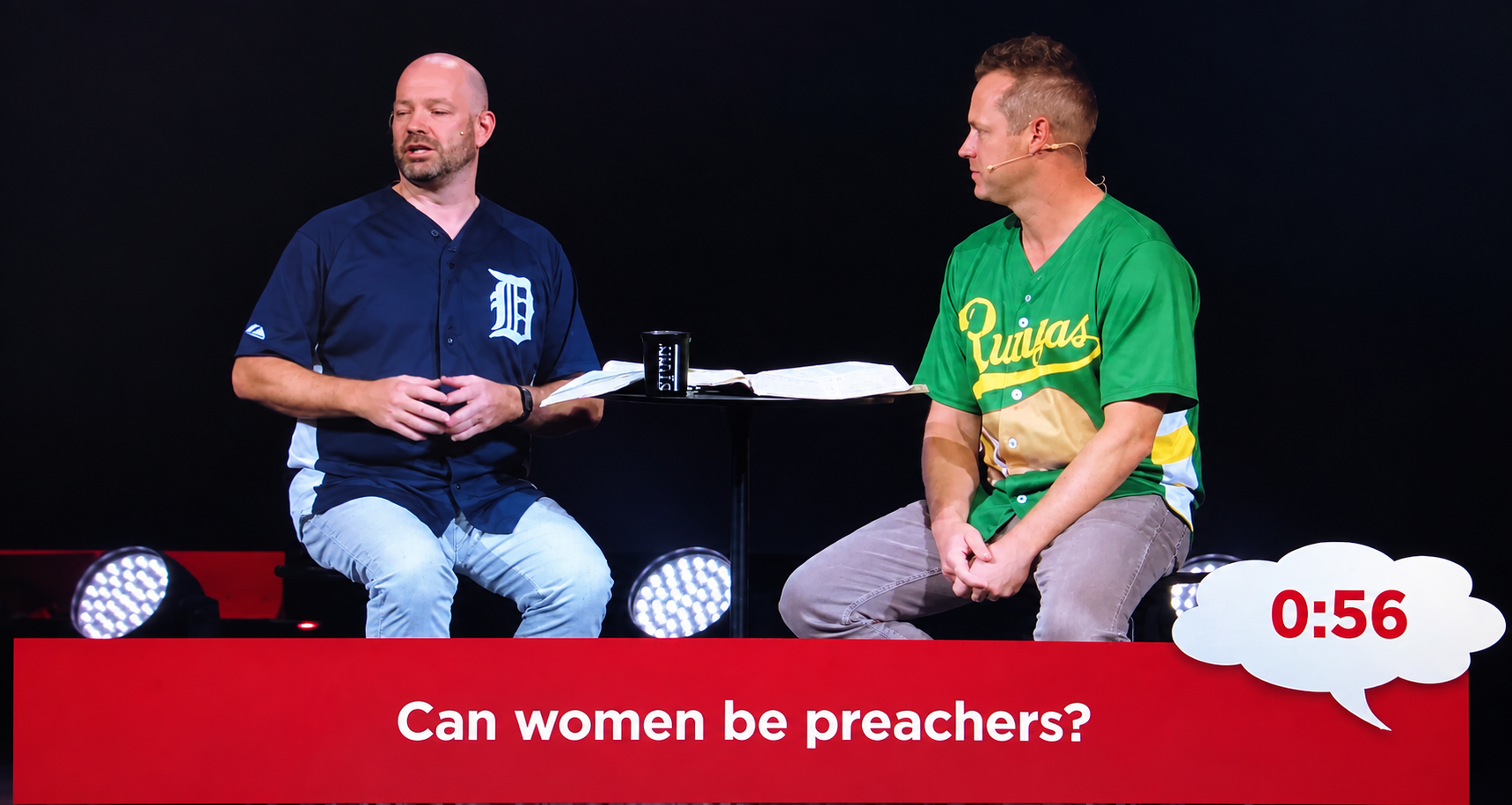
The September 6, 2026 “message” at King of Kings Omaha was a little different. It was a panel discussion where people posed questions to pastors Greg Griffith and Zach Zehnder. You can watch it here (until it is removed, of course), click on “Answering Your Questions” for September 6 - View Message.”
You can download the transcript here (well, at least for the time being).
Two questions were of particular interest. One involved “speaking in tongues,” and the other involved women “preachers.” Here is the transcript of those questions.
First, “speaking in tongues”:
So here we go. First question here is for Zach here. If I can't speak in tongues, is there something wrong with moi that's in tongues? That means me. Oh, okay. Thank you. The answer is no. Great. No, nothing's wrong with you. Speaking in tongues, right, it's a spiritual gift. The Bible talks about spiritual gifts. The way I like to say it is everyone has a spiritual gift, but not one person has every gift. And so I desire all the gifts, if I'm honest with you, but I've only got some of the gifts or a few of the gifts. And so nothing wrong with you if you can't speak in tongues. The point though is discover what your spiritual gift is and put it to use for the church. That's what all spiritual gifts are meant for. And we've got a great opportunity, Gigi, at our campuses next Sunday for Pizza with a Purpose, which we dive into a little more on spiritual gifts and how you can use your gift at our campus. So I would just put a plug in kingofkings.org slash pizza if you haven't signed up yet. We'd love to have you there. Yeah, yeah, discover that spiritual gift and God's wired us all differently to do that kingdom together.
Second, women “preachers”:
In a previous Asking for a Friend, I believe, you mentioned something that we didn't have the Easter story without women preachers. And so that's a big question today is can women be preachers? Yeah, that's a great question and in one minute we're going to solve this. I think one of the things we have to be really just aware of is that this is not an answer as far as can women be pastors? It's not an answer you're going to find in the Scriptures. What this is an answer is you look at denominations looking and KING OF KINGS CHURCH saying, well, we believe that in our hermeneutics this leads us to say women can be pastors or can't be pastors. And there's a lot of debate on that. I actually was just listening to a pretty famous pastor recently and he said, of course women can be pastors, but they can't be senior pastors. And so in their spot they're going, and so all of that's there. So we have to really be on guard of this. So why do we have those decisions? It's for sake of good order. It's so that those churches cannot have confusion within themselves and that they're walking together in some way. In our church body we say that women can't be pastors. Can women be preachers? Well, I think that we have to know the word preach. What does that mean? To proclaim the good news of Jesus Christ. And so any time you're proclaiming the good news of Jesus Christ to someone you are preaching. Whether you're a male or a female, you are preaching. And so we have this. We look at Romans 16. Paul commends the Roman church. He commends them to Phoebe, a servant of God. And so you've got to say what does that even mean? Was she proclaiming preaching? Probably. Right? And so I believe that women are great preachers. We see it through the scriptures. We see it at the empty tomb. I believe that women are great teachers. Men are great teachers and preachers. And so let us all continue to be preaching the good news of Jesus is the proclamation of the resurrection and leaving people to come to heaven. Nothing to add. I mean a lot to add.
My answer to the “speaking in tongues” question would be that this term as it is used in Charismatic and Pentecostal churches today is not what we see in the Scriptures (which was a miraculous ability to speak in human languages that one had never studied). By contrast, what is done in these modern churches is a kind of ecstatic gibberish. This was also found in the ancient world in various pagan cults, reminiscent of the Oracle of Delphi. Christian “speaking in tongues” was not that. It was recognizable human language.
What is called “speaking in tongues” today began at the Azusa Street Revival in 1906. This is not Christianity, but rather the kind of glossolalia that crops up in all religions. It is certainly not what Scripture and the Lutheran confessions teach. Decades ago, there was a group within the LCMS called “Renewal in Missouri” that featured this fakery. Within a few years, this group disbanded. This charismatic fad in the LCMS has pretty much died off.
Unfortunately, as LCMS megachurches worship like Pentecostals, it is possible that they are attracting Pentecostals to their services. If that were the case, I would surmise that would make it more difficult for their pastors to address “speaking in tongues.”
As for women “preachers,” this is a classic equivocation on the word “preacher” based on the various range of meanings of the word “to preach.”
In popular parlance, preach can mean “confess” - as when someone says: “Practice what you preach.” It can also popularly mean things like a parent giving a corrective lesson to a child. An advocate of alternative health issues may be said to “preach the gospel of homeopathy.” There are many such broader and metaphorical uses of the word “to preach.”
But while giving the impression that our prohibition of women’s “ordination” is just our particular “denominational” preference, strictly for the sake of “good order,” that it is really a kind of open question based on unclear biblical texts, King of Kings is redefining the word “preacher,” deviating from our shared and agreed - and even and avowed - Lutheran identity, as it is indeed confessed and professed in our Book of Concord. The word “preacher” appears 61 times in the Lutheran Confessions. A “preacher” in the confessional Lutheran understanding is a pastor, an ordained presbyter, typically the shepherd of a parish. Preachers are also chaplains, professors, and other vocations - but always within the Office of the Holy Ministry. For Lutherans, a preacher is a pastor, and a pastor is a preacher. Preaching is the public proclamation of the Word of God - not private instruction or confession. This equivocation leads people to an unclear confession. It allows a pastor to avoid the cost of speaking an unpopular truth by saying, “Of course, women can be preachers” - which can easily be misconstrued.
Moreover, the German term used in the Lutheran confessions for the Office of the Holy Ministry is “Predigamt” - that is, “preaching office.” That is the vocation of the pastor. And as Scripture unequivocally teaches, and as we members of synod unequivocally confess, women may not be pastors, may not hold the preaching office, and may not be preachers. Sts. Phoebe and Mary Magdalene deserve better than the treatment they get these days.
And I do believe radically changing worship forms involves the danger of radically changing the doctrine that is taught and confessed in those ceremonies - if nothing else, by losing one’s connection to our shared meaning and interpretation of words. Those who worship like Pentecostals run the risk of believing like Pentecostals. This is the danger of adopting the orandi (way of praying) of a non-denominational church: that you may eventually fall into the credendi (belief) of the non-denominational church. This goes hand in hand with the above issue about “speaking in tongues.” The story of the wildly successful Lutheran church growth father and CoWo pioneer, the Rev. Dr. Walt Kallestad, comes to mind. He stumbled on the formula for vast and explosive church growth: ditch the liturgy and provide entertainment instead. His Arizona church grew exponentially. Having severed themselves from Lutheran worship for decades, they finally went all the way and cut themselves off from Lutheranism entirely, becoming a Pentecostal church within the Assemblies of God - embracing fake tongues-speaking and denying the Holy Sacraments. You can watch him here rejoicing that he was also the preacher at a wet t-shirt contest. He seems nice.
Falling away from the Lutheran confession of faith is a very real danger for those who worship like non-Lutherans while trying to hold onto Lutheran doctrine. It probably happens by a thousand papercuts.
I agree with Pastor Griffith that our churches should not be about “confusion.” We should not confuse people with equivocation. We should avoid confusion by being clear about our context as Lutheran confessors - in the ways we use our words, in the way we exegete and submit to God’s Word, and even in the way that we are not ashamed to put the word “Lutheran” on our church sign and websites.
To give an example of equivocation, the word “intercourse” used to mean any kind of human interaction. In the 1700s, it became a euphemism for sexuality. By 1800, the use of the word “intercourse” for, say, things like commerce or conversation, was largely gone. Prior to that, a man might have said that he had very productive intercourse with the bank teller early that morning, followed up by pleasant intercourse with several of the ladies who were buying supplies in the market. “Phrasing,” as the kids say.
Equivocation about the words “preacher” and “preaching” can very well lead to confusion about the role of women in our churches and in our church body - even if unintentionally - and worse still, about what the Word of God teaches. People can hear what the speaker did not intend to say. We need to confess clearly about such topics as “speaking in tongues” and women “preachers.”
We are not called to confuse, but to confess, not to equivocate, but to articulate.
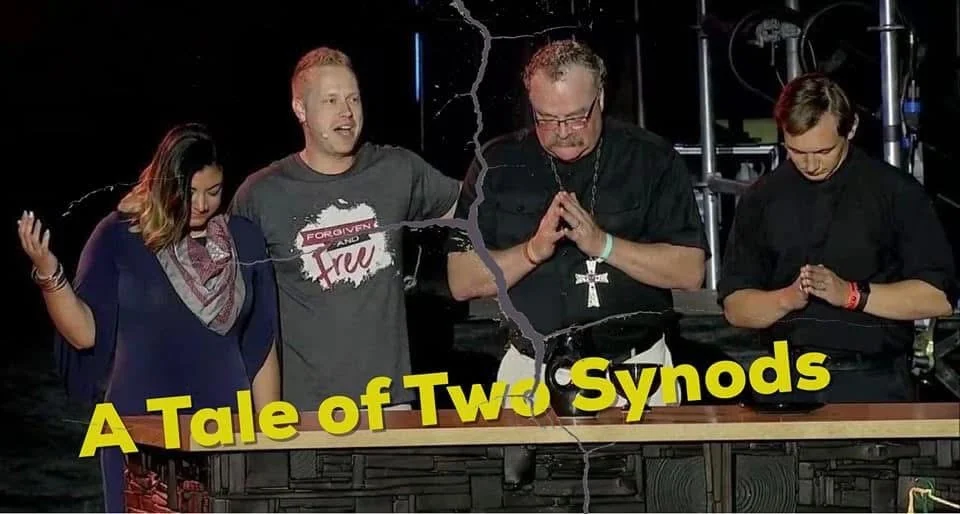
We are also called to walk together. Once again, we are a tale of two synods. We just believe different things.