
The Hunt for the Unicorn

I often hear advocates of “contemporary worship” (CoWo) make the claim that they are liturgical - they just use “modern instruments” instead of the pipe organ. And so, I have been on a hunt to find this elusive unicorn, imagining that somewhere there is a congregation using DS3 with a vested pastor celebrating the Mass with reverence in a chancel with altar, font, and pulpit, a congregation that has a band in the choir loft with drums, guitar, and lead singer instead of the organ and choir. What I typically find when I look at the congregations of people who make this claim is something completely different.
As he reveals in his “Reflections of a Recovering Praise Band Leader,” available here, our own Dr. Eckardt, decades ahead of his time, composed and performed a Rock Mass for use in Sunday worship. And there is a “Lutheran” pastor in Finland who leads heavy metal Divine Services (though he is part of the state “church” that “ordains” women. But in spite of the many times that I have heard about these liturgical CoWo services in the LCMS, I have yet to find one (and thanks be to God that the Chicago Folk Service has long since crossed the rainbow bridge).
Maybe the unicorn exists, or maybe they all drowned in the flood like the ancient Irish hymn confesses.
But to be fair, there are liturgical elements, even if scant, in some CoWo churches. The above service is such an example. It is from the congregation of one of the pioneers of the Lutheran Church Growth and Contemporary Worship movements: the Rev. Dr. David Luecke, author of the 1988 classic Evangelical Style and Lutheran Substance: Facing America's Mission Challenge - who continues to serve there as pastor emeritus. He is not in the above video.
The liturgy above can be summed up in this way:
Opening announcements by the celebrant
Invocation:
“Before we worship, we come together in the name of the Father and the Son and the Holy Spirit” with the sign of the cross.
Song performed by the band: “Found In You”
Reading from Matt 6
Confession and absolution
“Your sins are forgiven folks, that’s how much God loves you. You are forgiven.”
Song performed by the band: “Christ Be Magnified” (Bethel)
Nicene Creed
Announcements and ex corde prayer offered by the lady director of family ministry
Dismissal of the children
Announcements by the celebrant
Sermon by the preacher
Offering
Song performed by the band: “Goodness of God” (Bethel)
Communion exhortation
Open to those:
Baptized
Believe that they are sinful
Believe Jesus is the Son of God and personal Savior
Believe Jesus is “personally present”
Committed to a godly life
Consecration
Verba said not over any visible elements
Sign of the cross made twice at the end
Distribution with song performed by the band: “New Wine” (Hillsong)
Dismissal with another absolution and two signs of the cross
Prayer
Lord’s Prayer
Announcements
Aaronic benediction with three signs of the cross
Song performed by the band: “We Praise You” (Bethel)
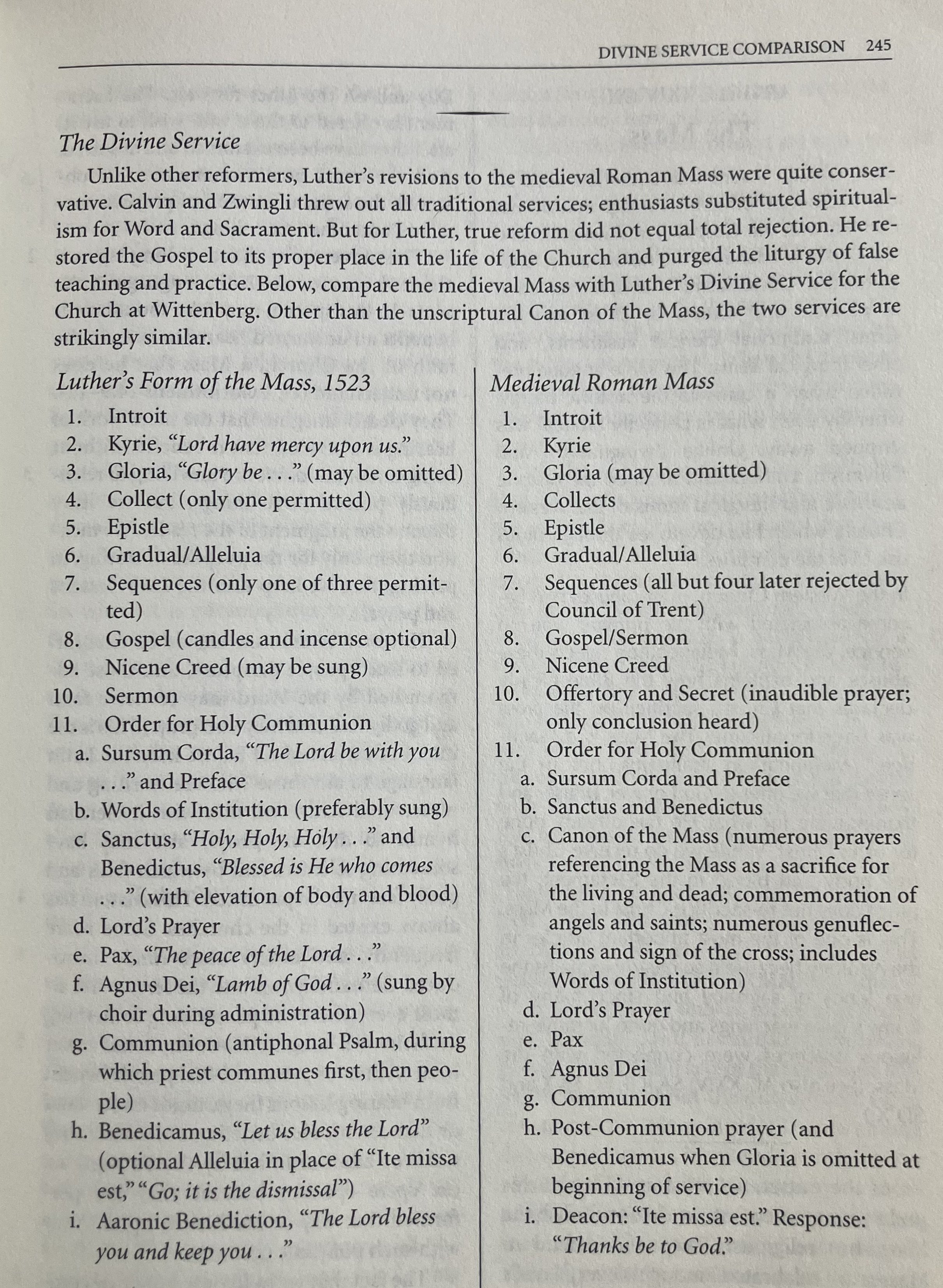
So this CoWo service indeed had elements of the Lutheran liturgy, but at the same time, there was a lot that was missing or moved around. There were no Kyrie, Gloria, Salutation, Collect, three paired readings, Offertory, Preface, Proper Preface, Sanctus, Pax Domini, Agnus Dei, Nunc Dimittis, Post-Communion Collect, Salutation, or Benedicamus.
This service was not my unicorn - but was still more liturgical than most. By comparison, here is the chart from the McCain edition of the Book of Concord comparing the Evangelical Style Mass of 1523 to the Roman Substance Mass of the same period.
The reader can decide if this CoWo service walks together with the rest of us. I’m sure opinions will vary. But even with some of the liturgical elements in this service (that are often missing elsewhere), the hunt for the unicorn continues.