

Deacons and Gender
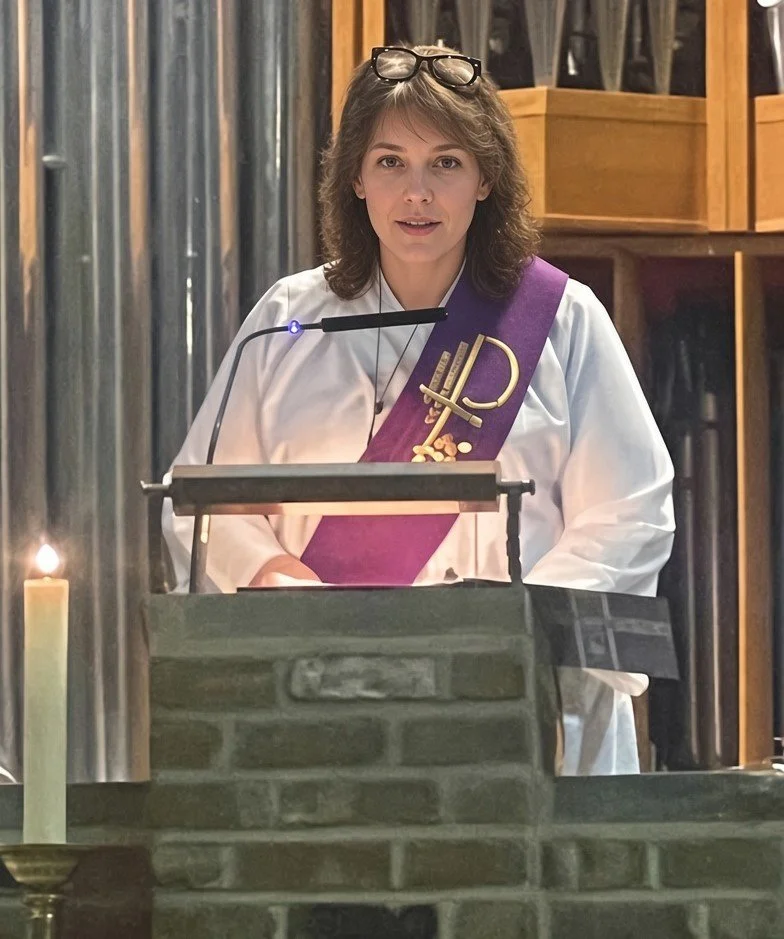
LCMS lady “deacon,” face altered by AI.
A lot of our rebellion against God’s created order and against His Word involves the concept of “gender.”
It started in the 1970s when the word “gender” replaced the word “sex” on forms. I believe this was a deliberate change designed to advance an agenda rather than just avoiding the word “sex” because of people’s prudish sensitivities. Far from it!
In the early eighties, I took Sociology in college. Our professor was an admitted Marxist. Our textbook was ahead of its time, delving into gender ideology and Critical Race Theory. I wish I had saved the book. It took decades for this nonsense to go mainstream.
They took the grammatical concept of gender and pushed it beyond linguistics. For that is all that gender really is: a grammatical category.
In English, we have three genders: masculine, feminine, and neuter (which is Latin for “neither”). In our language, a noun is categorized as one of these three genders. The masculine and feminine genders correspond to the natural biological sex of people and animals. Neuter is used for inanimate objects.
But there are exceptions. For example, ships and cars are often given the feminine gender (taking the pronouns “she” and “her”). The church is also of the feminine gender. Specific named hurricanes used to be feminine until a few years ago when feminists complained - giving us alternating binary masculine and feminine names. Eventually, the names also had to reflect non-western monikers. How long before the scheme is adapted to add a third category of gender non conforming or some other woke agenda? I’m surprised we aren’t there yet.
English follows the Latin in having three grammatical genders. In Latin, the nouns follow patterns called declensions. The first declension consists of nouns that end in “a” and are nearly always feminine. The second declension consists of nouns that end in “us” or “r” - and they are nearly always masculine. But there are exceptions. There are a few first declension words that are masculine in gender, but behave grammatically as if they were feminine - including the Latin words for farmer (agricola), poet (poeta), and sailor (nauta). Then there is the word for inhabitant (incola) which is a first declension word that may be either masculine or feminine (“common gender”) depending on the sex of the inhabitant.
Modern languages have two or three genders. French has two, German has three. In French, a shirt is feminine (une chemise), while a tree is masculine (un arbre). And in German, a girl (Mädchen) is grammatically neuter. This doesn’t mean the Germans think girls are not human or are gender non binary. It’s just a grammatical quirk that was probably inherited from an earlier form of the language. Like French, German assigns a gender to nouns that represent inanimate objects (and they can be masculine, feminine, or neuter!). These are simply peculiarities of language.
Greek, like Latin, is an inflected language, and it too has three genders. But there are some words in Greek that are “common gender.” Like incola in Latin, they are words that function grammatically like one gender, but can be either masculine or feminine based on the sex of the person the words describe (the antecedent). One example is the word “deacon” (διάκονος - diakonos). The word has a range of meanings, from a general word for servant, to the specific role of a waiter or waitress of tables, to the specific ecclesiastical office (who may be ordained or not) of the minister who vests and serves with the pastor at the altar. And, again, to further complicate matters of interpretation and translation, this is a “common gender” word in Greek.
So in Greek, the word “diakonos” acts like a masculine word grammatically, but it can either be masculine or feminine based on the sex of the person. And diakonos can also mean very different things.
Those who want to ordain women and/or admit women to ecclesiastical diaconal service of the type that they were not created or called to do - neither in the Book of Acts, nor in the early church, nor in the medieval church, nor in the reformation church, but only within the last few decades following the world’s “sexual revolution” - exploit this grammatical irregularity as some kind of hidden Bible code granting divine approval to a program of sex-role change. And the example of St. Phoebe is often trotted out (Rom 16:1), since the Greek text refers to her as a diakonos. This is interpreted by feminists as proof that she performed the same role as the seven men chosen by the church in Acts 6 and by historical deacons like St. Lawrence, and that there is no biblical sexual differentiation between the roles of a male and female diaconate - since the Greek word is the same regardless of gender. See how that works? See how duplicitous that is? We can certainly commend the devil for his shrewdness.
I recently heard one LCMS podcaster unabashedly arguing for an expanded role for women in the church based on the grammatical nature of diakonos in Greek. He mistakenly said that the Greek word for deacon is “non-gendered” when it is actually “common gender.” Phoebe would not be referred to by masculine pronouns, nor as being of a neutral sex - but is still called “she” or “her” in Greek. The gender of diakonos is the same as the gender of the specific antecedent (in this case, “Phoebe”).
In English, we do have both words “deacon” and “deaconess” with genders corresponding to biological sex. We used to do this more often in English, such as “aviator” and “aviatrix.” It was not that long ago that we commonly used the words “waiter” and “waitress” (now gender-neutered into “server”). We spoke of “hosts” and “hostesses” - but now the masculine form is used to describe both. In commercial flight, the typical “stewardess” and the less common “steward” have now been given the dehumanized, bureaucratic, and bloodless-sounding “flight attendant.” Interestingly, German still has gendered terms for most vocations, such as “pilot” (Pilot/Pilotin), “doctor” (Artz/Ärztin), or “teacher” (Lehrer/Lehrerin).
But again, we do have “deacons” and “deaconesses” in the English language (as does German). And their roles are quite different. And like the Greek word diakonos, there is a range of meaning. In the LCMS, we have a rostered female diaconate: deaconesses. We also have unofficial, non-rostered deaconesses, such as pastors’ wives and other ladies of the church who love and serve their neighbors who are women and children in the congregation, and help the pastor give them pastoral care. Some churches refer to their board of (lay) elders as deacons. In my congregation, I have a consecrated (not ordained) deacon who vests and serves with me at the altar - but does not preach or administer sacraments. When I was on vicarage, I was similarly consecrated as a deacon. In the Lutheran Church - Canada - all rostered lay church workers are referred to as “deacons” and “deaconesses.” So to a dishonest person looking to being “change” to our churches and to our synod, these words are fertile ground for equivocation and gaslighting.
In the Atlantic District, and maybe in other more liberal districts, they consecrate women at the district level not as “deaconesses” but as “deacons” - just like the men. They cross-dress them in albs and cinctures and stoles worn on the diagonal, and they assist at the altar. If a pastor, a female “deacon,” and a vicar were all serving together in the Divine Service, the message would be clear: the lady “deacon” exercises authority over the male vicar. For like the pastor, she is vested in a stole: the symbol of the yoke of the office of the holy ministry.
This is the kind of gender and sex mischief that goes on in the LCMS, and has for decades.
Interestingly, there are other “common gender” words that are used in the New Testament. “Apostle” (ἀπόστολος - apostolos) is one. So a dishonest argument could be made to have women preaching, baptizing, teaching, and administering sacraments based on this grammatical quirk in the language, just as some in the LCMS are argue that we should have women deacons. The word for virgin (παρθένος - parthenos) is also such a word. It can describe either sex, but mimics the masculine gender form. The Blessed Virgin Mary is a parthenos, but the “common gender” and declension paradigm of the word in Greek have nothing to do with her sex. Apparently, there are some cases in Koine Greek where the word for god (θεός - theos) is treated as “common gender” (as opposed to using the feminine form θεά - thea) for a goddess. This quirk in grammatical gender usage does not reflect the ontological nature of God (Θεός - Theos) - the Father, Son, and Holy Spirit - though once again, you can always find a gaslighting feminist trying to bamboozle the church - at least for now, outside of the LCMS. We need to be clear in our confession of male and female, and not allow confusion regarding grammatical gender to muddy the waters.
There is an interesting illustration that comes from French. Jesus is assigned the pronoun “she” (elle) in John 1. This is because the word “Word” (“In the beginning was the Word”) is the French word Parole, and it is a feminine noun. Therefore, the pronoun “she” (elle) is used to describe our Lord. The word “Word” is found in all three genders in various languages. Feminine in French, neuter in English (though we use the masculine pronoun in John 1), neuter in Latin (Verbum), neuter in German (Wort), but masculine in Greek (Λόγος - Logos). None of this is a reflection on the biological sex of the Son of God, who is the icon of the Father.
Grammatical gender is not a hidden Bible Code to leverage libertine sex roles in the church. Those who have an agenda use this to gaslight people based on the bamboozling that they are already getting from the pronoun-addled sexually-confused secular culture and among others who claim to be Christians (or even Lutherans). Watch for it, and beware. For what they are really proposing is a question: “Did God actually say?”