

How Did [Lutheran] Church Music Get So Bad?
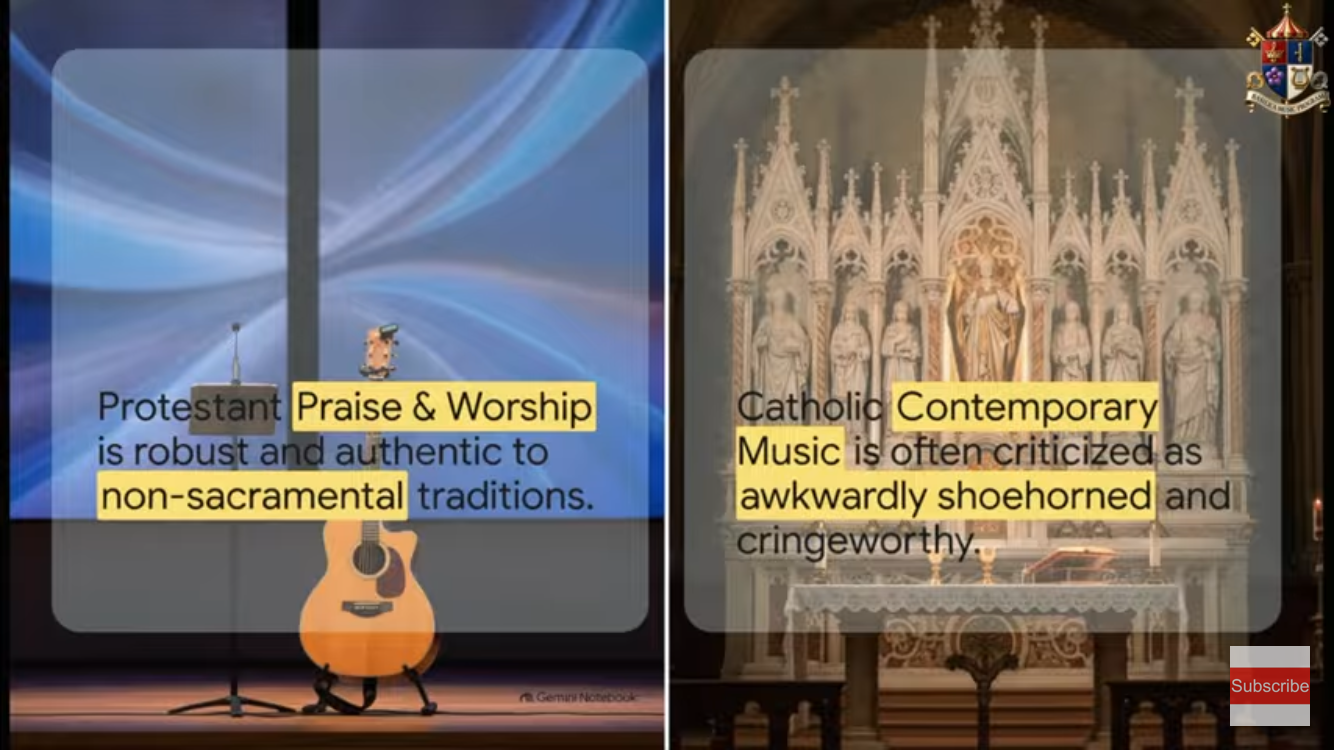
The above video by a Canadian Roman Catholic organist cuts to the heart of why “contemporary worship” is incongruent with Lutheran worship. Of course, he’s not defending Lutheran worship (although he does love “A Mighty Fortress”), but rather the kind of music that is fitting for the Mass (which, of course, we Lutherans have not abolished) within the context of sacramental worship. I think a lot his historical explanation hits home, and you could almost just substitute the word “Lutheran” every time he says “Catholic.”
This section where he talks about how the Roman Catholic Church imported “Protestant” (meaning “Neo-Evangelical”) style contemporary and praise music is applicable to us as well. And he presents it in a way that is respectful of the Protestant tradition. I think his analysis is spot on. I have added emphasis in a few places. This is a transcript from about 16:09 - 19:10, though, once again, I think the entire video is worth a listen.
Why does modern Catholic music often feel so lacking when you compare it directly to the contemporary traditions of Protestant denominations? Analysts argue that Protestant churches successfully execute praise and worship music because it organically fits their specific non-sacramental traditions. It's totally authentic to their worship style. But when Catholics attempt to force these exact same pop and rock styles into the highly structured sacramental Mass, well, it often feels embarrassing, disjointed, and just tepid. It's literally like trying to fit a square peg into a round hole. The aesthetic simply clashes with the ancient ritual of the Mass.
Experts like author Thomas Day point out another huge issue. This reliance on modern styles in Catholic parishes often devolves into this heavily amplified solo performance by a cantor up front. Instead of encouraging the congregation to actually sing, the overwhelming amplification treats everyone in the pews like a passive audience. Ironically, this totally contradicts the very goal of active participation that the Vatican 2 reforms were supposedly trying to achieve in the first place.
Now, I need to be particularly careful with this point because if you've watched this channel for any length of time, you know I have enormous admiration for great Protestant hymnody. Some of the finest hymns ever written came out of Protestant traditions. “A Mighty Fortress,” “Love Divine, All Loves Excelling,” “Praise to the Lord,” “Holy, Holy, Holy,” extraordinary music. So the argument here cannot simply be Catholics borrowed from Protestants, therefore Catholic music became bad. That would be nonsense. What happened was much more specific.
Catholic parishes increasingly absorbed elements of contemporary evangelical praise culture, amplification, solo leadership, popular song structures, and emotionally immediate music. And sometimes those things fit awkwardly inside the Catholic liturgy. Why? Well, because Catholic worship has a different theological structure. The Mass is not primarily a praise concert. The music is supposed to inhabit the liturgical action rather than constantly become the event itself. And this is where I think we need to make another important distinction.
There's tremendous difference between congregational singing and an audience singing along with a performer. Those can look identical from the back of the church. They're not necessarily the same thing. If everything depends upon the amplified singer at the microphone, have we really restored congregational singing? Or have we simply moved the performance from the choir loft to the sanctuary?
That's an uncomfortable question. And it applies to organists, too. If I play every hymn like the finale of the Saint-Saëns organ symphony, and nobody can hear themselves singing, I'm not helping either. My verdict, the problem isn't Protestant music. The problem is importing a musical model without asking whether it serves the Catholic liturgy.