

Ever to Emmaus
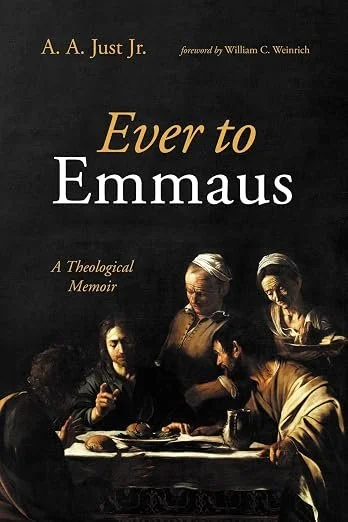
The title of Arthur Just’s recently released memoir is as intriguing as the memoir itself. Ever to Emmaus: A Theological Memoir (Eugene, Oregon: Wipf & Stock, 2026. 274 pages) is Dr. Just’s autobiography, told in terms of how he sees his own life’s experiences as if participating as a fellow traveler with the two disciples on the Emmaus Road on Easter Sunday (Our chief blogger Larry Beane briefly called attention to the book in his July post alerting people to Just’s interview with Brian Stecker at On the Line).
The Lucan account of the Emmaus disciples provides the framework for the entire memoir, and indeed, of Just’s own pilgrimage through life. In the account, the two disciples were met by the resurrected Jesus as they walked, but “their eyes were held back so as not to recognize him” (Luke 24:16) until, after they had compelled Him to abide with them as they arrived at Emmaus, He took bread, blessed it, broke it, and gave it to them. At this point “their eyes were opened and they recognized him” (Luke 24:31), whereupon they exclaimed, “Did not our hearts burn within us while he talked to us on the road, while he opened to us the Scriptures?” (Luke 24:32), and hurried back to Jerusalem to recount this event to the other disciples still gathered there, telling them “how he was known to them in the breaking of the bread” (Luke 24:35). Just places himself in that Gospel, seeing his own life’s unfolding as if he were one of those on the road to Emmaus, and in fact he knows that this is an exemplary way for a preacher to consider the Gospel pericope on which he expounds: to plant, as it were, the hearers themselves in the Gospel they have heard. The Emmaus Road pericope in particular is for Just a critical place for doing this, as the unfolding of those events provides a pattern for Christians on their pilgrimage through life. So Just recounts various times in his own life when his own eyes had been held back from understanding Jesus, until they were opened to see Him, through the mentoring of professors who were instrumental in Just’s formative theological years. At the end of the story is the breaking of the bread, which, in his own case, is the gaining of a deep appreciation of the central place the liturgy, hearing the Word of God, and receiving the Sacrament must have in Christian life, for it is here, above all, that we ‘see’ and recognize Jesus.
But Just also saw this pattern repeat itself throughout his years as a professor at Concordia Theological Seminary in Fort Wayne, and also in Russia, in Spain, and in the Dominican Republic, as he saw his students’ eyes being opened to see Jesus through his own mentoring, and as they, too, gained an appreciation for the liturgy, and thus for the Word and the Sacrament. We get a glimpse of what he taught in this memoir, as he provides insightful commentary on various key passages and themes of the New Testament.
And the point, I think, of the writing of this memoir, is that readers of it may also join this myriad of pilgrims on their various Emmaus roads, as their eyes, too, are opened and they recognize Jesus in the breaking of the bread.