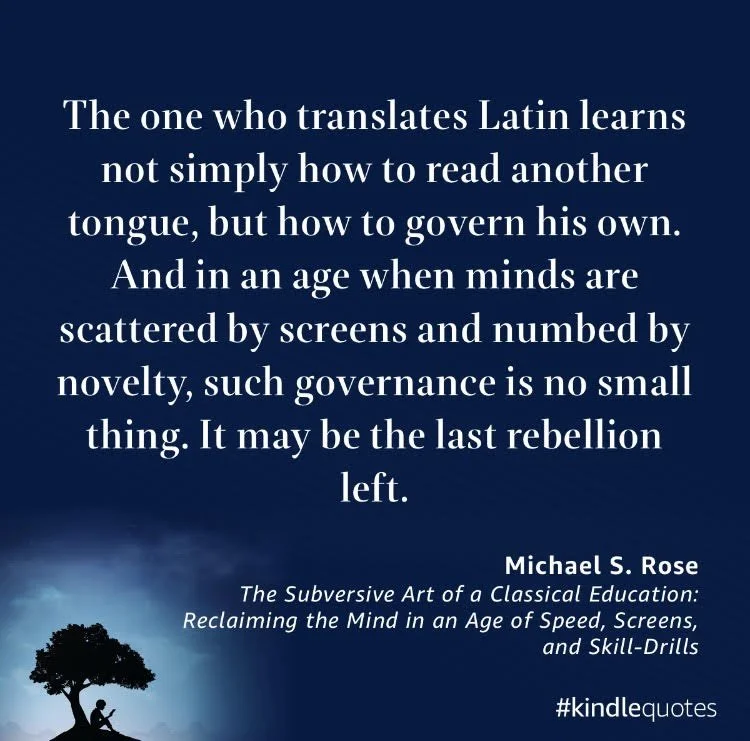

Classical Education!
We have all watched in horror as our American education system has degenerated. It’s not just over the past few years, but it has been on a slide that goes back generations. And this hits home for us Lutherans, as education has been front and center for us since the Reformation itself.
In looking at our more recent American history, we see that the triumph of the Progressive model (over and against the Classical model) has been a disaster. But instead of just complaining about it, how do we fight back? How do we truly educate our own children, and perhaps chart a new course for even those outside of the church?
In 1999, a handful of Lutheran educators met and started a new organization, not knowing how the Lord would use them to restore the classical model of education within confessional Lutheranism. As of 2026, that organization has grown, blossomed, and has become a force to be reckoned with.. Those humble seeds that were sown a quarter century ago have since borne fruit and multiplied. This organization has become known as CCLE: The Consortium for Classical Lutheran Education.
Today, the CCLE is a wealth of knowledge and practice. It is an accrediting organization. They also certify teachers. There are even adult online classes for those of us who had no classical options growing up. New classical Lutheran schools are emerging all over the country, and existing Lutheran schools are becoming classical. CCLE provides practical help in this endeavor - to all kinds of schools: parochial, association, online, and homeschool. Classical education encourages students to read original texts - in the original languages where possible. Paradoxically, Progressive education’s elimination of Latin as a mainstream subject did not lead to a better mastery of English, but has proven the opposite. Our classical students who study Latin are far better able to express themselves in English - especially within the classical study of Grammar, Logic, and Rhetoric (known as the Trivium). Classical education teaches the student how to think and how to learn. This is why it has become so popular in recent years.
I’ve been privileged to teach at Wittenberg Academy (an online worldwide classical Lutheran junior high and high school) since 2014. I’ve been attending CCLE conferences since that time, and I have seen an explosion of classical education in our synod. Many of my own students have gone on to become classical teachers themselves, as well as young men making their way to seminary. I’ve also served as the chaplain at Wittenberg Academy since 2019. Classical education encourages a healthy appreciation for liturgical continuity and the appreciation for our rich hymnody - from the ancient church, through the middle ages, through the Reformation and Renaissance, and into the modern world. There is especially a renewed interest in chant, in chorales, in organ, in classical music, in choirs, and in the beauty of our ecclesiastical heritage. As far as I can tell, none of our classical schools have opted out of reverent liturgical worship, nor have any of them chosen to replace our traditional hymnody with the “praise and worship” genre, or “contemporary” or “modern” worship forms. Classical education fosters a deep love for the liturgy, and a sense of home and comfort in the timelessness of it.
Classical education is a reorientation to a healthy relationship to our past, learning that wisdom of old, and applying it to the present and to the future. And the same is true with the riches of our liturgy and hymns. The Classical Lutheran tradition emphasizes goodness, truth and beauty; the Bible and the Confessions, Word and Sacrament, and a sense of belonging that transcends age - whether the age in which one lives, or how old one is.
I am looking forward, as always, to this year’s conference, to be held at Concordia University - Chicago, July 14-17, 2026. The line-up is spectacular! Given that this is the 250th year of the independence of these United States, the theme is timely: “Foundations of Faith and Freedom.” And as much as I enjoy and benefit from the presentations, the fellowship and collegiality with colleagues - both pastors and teachers - the part that I love the most is seeing our young men and women: high school and college aged young people. They are doing the very things that we have been told for decades cannot be done. It is a joy to see parents and even very young children everywhere, with even the little ones rejoicing in being included in the learning and in the worship. The choirs at the services (mainly Matins and Vespers) are comprised of young children and more mature youth. In addition to the plenary and break-out sessions, the conference includes tracks for ages 3-5, 6-12, and 13-18.
I also really love the joyful collegiality among everyone: presenters, teachers, kids, homeschool parents, pastors, etc. If you’re looking for a conference for big egos, you will be disappointed!
It is glorious to see gaggles of young people crowded around the organ and taking turns playing. The impromptu “flashmobs” of young folks singing chorales - sometimes with new arrangements - are beautiful, and provide hope for a glorious future in our churches. It is wonderful thing to hear young people debating philosophy, talking theology, reciting poetry, engaging in wordplay, and supporting one another - and also just having fun with each other in a normal, wholesome way.
It is inspiring! Classical education is a subversion of the subversion, a rebellion against the rebellion. And it is joyful!
If you want to learn more about Classical Lutheran education, check out CCLE’s website. It debunks a lot of misconceptions about it, and also provides valuable contact information. I believe the Classical Lutheran education movement is laying the groundwork for the long-term future of our churches and schools.
Venite et videte! Come and see!