

Liturgical "Re-racination"
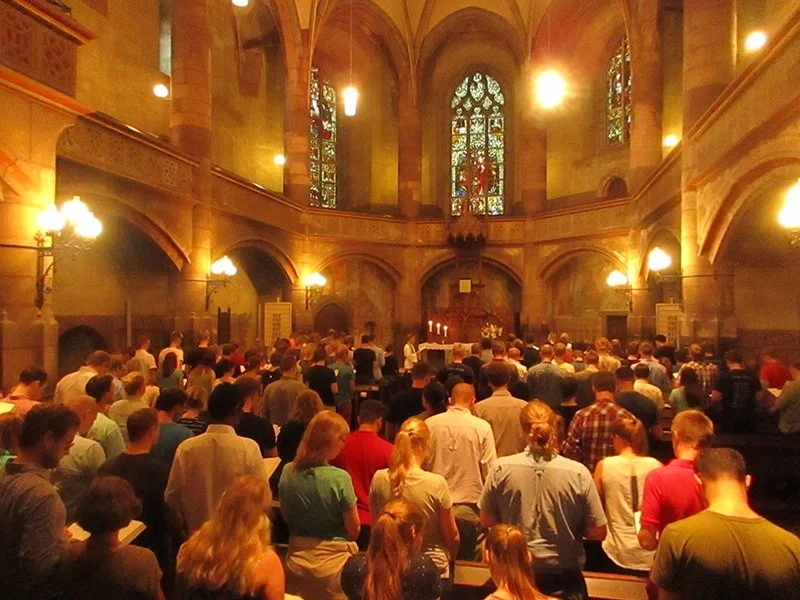
Young Lutherans at the Corpus Christi conference in Halle, Germany, 2017
Back in the last millennium, I had a friend named Jim. He was in his fifties and was the grandson of Sicilian immigrants. He raved about his mother’s homemade bread. The recipe came from her mother and her grandmother in Italy. For that is how family recipes used to continue their existence: one link in the chain at a time, from mother to daughter. Jim lamented that now that his mother was gone, so was the recipe. Jim had a sister who was a career gal, and not interested in things like old recipes. So that was the end of it. The recipe was not preserved. All Jim had was his memories. His children won’t even have that.
This is an example of “tradition,” what St. Paul calls “paradosis” (1 Cor 11:2), which he changes to a verbal form (paradidomi) when he speaks of passing along the Words of Institution of the Lord’s Supper as they were “handed over” to him (1 Cor 11:23ff). While tradition has been abused by equating it with the Word of God, both by Pharisees and later by Christians, there is also godly tradition - including the Gospel itself (e.g. 2 Thess 2:15).
Since pastors ordain other pastors, there is a chain of ordinations stretching back to the days of the apostles - even if we don’t have written records. We were all taught the Gospel, whether by parents, teachers, pastors, or friends, and that too is a chain that goes back to Jesus and the original disciples. And even though none of us has it mapped out on ancestry.com, and though there are significant gaps in our genealogical records, we can all confidently claim literal biological descent from Adam and Eve, as well as from Noah, and from every patriarch in between. We are the products of many such unbroken chains.
Jim’s mother received what was handed over from her mother, as did her mother. In all likelihood, this chain extended back through the centuries, maybe even to the days of the Roman Empire. I say “extended” (past tense) because all it took was for one generation to break the chain, and that’s the end of it.
Maybe’s Jim’s children or grandchildren have since managed to get granny’s old papers before her things were tossed in a dumpster or sold at an estate sale. Maybe one of the kids or grandkids found the old bread recipe and rekindled that traditio. Or maybe not. Maybe Jim’s descendants are content to get by with the industrial stuff that comes in a plastic bag with boilerplate corporate branding, preservatives, and a “best used by” date on a plastic twist tie. Or maybe they went to YouTube and found a generic Italian or Sicilian recipe that might approximate Jim’s mother’s bread. But either way, the loss of the tradition is tragic - not only for people like Jim, but also for unborn generations who have been cut off - even if they don’t know it. All it takes is one unfaithful generation to lose it all.
Our modern and postmodern age is one characterized by progressivism - which is the worldview that believes that humanity is evolving and improving, that the present is better than the past, that the new is better than the old. The “me generation” grew into adulthood (and now old age) with this very kind of optimistic worldview that celebrated youth (when they were young) and old age - their old age - (when they became old). Anything from the past, from before one’s own time, is immediately suspect. Better to forget all of that and blaze a new path. Let those bad old ways die. For it’s far better to have young women flying fighter jets and managing corporations than baking bread like their insignificant little Sicilian grandmothers. “Well-behaved women seldom make history” as the bumper stickers used to confess.
The term for this severance from tradition is “deracination.” It comes from the French (racine) for “root” - which in turn comes from the Latin (radix). It is related to the word “radical” (not to mention “radish”). “De-racination” means to de-root, to pull out by the roots.
For hundreds, or maybe even for thousands, of years, Jim’s mother’s recipe - combined with small, conservative changes here and there (lessons learned in the practical carrying out of the recipe by collective wisdom over the course of generations) - remained intact. But then, a radical new set of values deracinated Jim’s family, Jim’s nationality, and Jim’s country, severing them from their roots. It was about the same time as the radical “youth movement” of the 1960s that the Roman Catholic Church had a radical doctrinal and liturgical movement of its own: Vatican II. And some of these deracinated forms of worship spread to us Lutherans in a kind of counterfeit tradition. And this radical revision to liturgy and worship led to further deracination and a new “tradition” called “contemporary worship.”
This kind of deracinated worship was largely ‘traditioned’ to us from neo-Evangelical megachurches: confessions that deny baptismal regeneration, deny the Real Presence in the Eucharist, deny Holy Absolution, and misconstrue the work of the Holy Spirit as an expression of our own reason and strength.
What could possibly go wrong?
Emotional pop ditties replaced chant, polyphony, chorales, and modern hymnody, hands waving in the air replacing the sign of the cross, with the reverent consecration of the elements treated like something embarrassing that has to be emotionally ginned up. In time, in some places, altar, font, and pulpit themselves were uprooted, removed, and replaced by a stage.
The show must go on!
Liturgical deracination destroys our ancient collective memory, destroys our sense of identity and belonging, and destroys our unity with one another as the church. It destroys our continuity and connection to our roots. It is, at its root, a destructive methodology. And this destructionism is seen by its adherents as a positive good, like tearing down an old building in order to replace it by something new is seen by many as an improvement - even if a beautiful, ancient cathedral is being replaced by a ticky-tacky strip mall or soulless, brutal government building.
Progress is progress.
Why have Gregorian Chant when we can have Hip Hop? Its purveyors do not even see the unintended consequences: the tragic loss of connection, or the opportunity cost of this deracination.
Confessional Lutherans around the world have a shared identity. The basis of this identity is, of course, the Gospel, which is traditioned to us in Word and Sacrament, especially at our baptism. We confess God’s Word, and that confession is articulated in the Book of Concord. This is our faith. And that faith, the catholic faith of twenty centuries, and our own so-called Lutheran tradition within that faith, as practiced in the last 500 years by the churches of the Augsburg Confession, has given us a shared vocabulary, music, customs, liturgy and ceremony, and other things that make us feel at home, and in community with one another.
That is what we mean by our Lutheran identity.
In a naked attempt to make any and all forms of worship equal, some try to minimize and denude Lutheran identity to only the Bible and the Confessions - as if we Lutherans have no other touchstones, nothing else that we have in common with one another all over the world, no shared history and heritage, other than our doctrine expressed cerebrally in the abstract (and not concretely in the flesh). This is an attempt to deflect the reality that we Lutherans do have an identity, and we will push back against this intentional deracination and replacement. The fact that Lutheran identity cannot be reduced to the Bible and the Book of Concord is easily proven. The word “Lutheran” is a big part - even a constitutive part - of our Lutheran identity. But it is a word that is found in neither the Bible nor the Book of Concord. It is rather a part of our history and heritage, an identifying marker of who we are as named by friend and foe alike. And in spite of its exclusion from Scripture and Confessions, it is who we are. Minimalists will have a hard time explaining why the word “Lutheran” is not a part of Lutheran identity. This violates the law of identity itself. They also have some explaining as to why Article 24 seems to have been removed from their minimalist definition of Lutheran identity as Bible and Confessions. There are many other writings that are part of our identity as well: the Heidelberg Disputations, Bondage of the Will, the first Lutheran hymnal of 1524 (the Achtliederbuch), the Magdeburg Confession, and even more modern writings like Pieper’s Dogmatics and the works of our own theologians and artists. Our subsequent succession of five centuries of hymnals - both liturgy and hymns - are also part of our identity. They are our history. They are part and parcel of who we are. For a further critique on the proposed reductio of Lutheran Identity, see “Lutheran Identity, the PSD, and an Attempted Steal.”
Again, our identity includes our hymnody: both pre- and post-Reformation. The very best of our hymns have been distilled and retained, while the chaff has blown away. Or maybe another way to think of it is panning for gold. We keep the nuggets, but toss back that which is not gold. Hence in our current LCMS hymnal, LSB, we have golden hymns by Clement of Alexandria, Ambrose, Gregory, John of Damascus, Bernard of Clairvaux, Bernard of Cluny, Abelard, Aquinas, and Hus. We have hymns composed in Latin whose authors are unknown to us. We have Reformation era hymns that are well-known all over the world, having been translated into every language. You can attend a function of the ILC (International Lutheran Council) and you will find these hymns sung even when worshipers from different continents are gathered together: Luther, Gerhardt, Bach, Heermann, Nicolai, Crueger, Kingo, Olearius, etc. And more modern hymnists are part of our tradition as well, writers like Vajda and Franzmann. We have also appropriated many other hymns from outside of our tradition, such as Christmas carols of Latin, English, and German origin. These hymns are treasures to be held in trust, not garbage to be thrown away. They bind us to one another and root us to our past.
Our Lutheran chorales, in particular, many of which were written in a time of confession and/or persecution or other suffering, are especially valuable. In the unpredictable times of human crisis and tragedy, during times of temptation and Anfechtung, these time-tested hymns - especially those of Paul Gerhardt - are comforting confessions and articulations of the mercy of God. They are explicitly cruciform and Lutheran in doctrine and confession. They are rich devotions that can be read or sung, and they are saturated with the the Word of God and the Gospel. Nothing in Christendom even comes close. These are our treasures!
It was not all that long ago that every single LCMS church used the same hymnal. But now, in our deracinated church, we have entire congregations of people who have never even seen a hymnal, have never heard a hymn by Paul Gerhardt, have never sung “A Mighty Fortress is our God” or “Lord, Keep Us Steadfast in Your Word.” They have been robbed by deracination, having the gold nuggets replaced by plastic Mardi Gras beads. Weak “songs” replaced the theologically rich hymns of our Law and Gospel, Christocentric, cruciform heritage, replaced by weak-sauce entertainment. Timeless beauty has yielded to ephemeral mediocrity. Pastors who deracinate their congregations are in a real sense breaking the seventh commandment, stealing their parishioners’ birthright out from under them, taking away comfort that is rightly theirs in time of need. And they don’t even know that the bandits have broken in and robbed them.
Men, how can you do that to your own people? How do you even live with yourselves?
A few years ago, I met a young man who was visiting Fort Wayne interested in studying for the Holy Ministry. He said that he had never before seen a liturgical service. His pastor should be arrested for theft. How could you do this to someone? How could you rob a person of his birthright? And if he had never been to a liturgical service, there is no way he was raised on the corpus of hymns that Lutherans all around the world know and love, from which they draw strength and comfort, bolstering their faith by the confession of the pure Word of God, rooted in five centuries of usage. How can deracinated Lutherans worship together as circuits or districts, at retreats and synodical functions? How can our chaplains come together for training if we had no common services or hymns?
The bad news is that, at least in the LCMS, we do have large, rich, powerful congregations that have practiced liturgical deracination for quite some time now. Our leaders let us down for decades, allowing the rot to spread - if not encouraging it. And now in our own day, the masters of deracination, our podcaster-oligarchs, are lobbying the convention to disenfranchise itself by giving the large, deracinated congregations more votes, proposing the taking away of votes from normal-sized churches. May it not be so! Let’s hope that the delegates don’t take the bait. Don’t be bullied by the self-important who make promises of numerical “success” that only the Holy Spirit can deliver.
But the good news is that even with their deracination, this is, unlike Jim’s mother’s bread, not something that is lost forever.
The liturgy can be restored. Hymns can be re-learned. Worship can be re-oriented toward the cross and refocused in the loci of altar, font, and pulpit. And generationally, there is ample reason for hope. A lot of the cheerleaders for deracination are from the “me-generation,” and they are riding off into the sunset. Younger people across Christendom want “re-racination.” Once moribund Roman Catholic orders are once again recruiting nuns and sisters - and they again are wearing the habit. Young priests are wearing the cassock and reconnecting to that which Vatican II severed. The Latin Masses are the services that are the most youthful and well-attended. We are seeing young neo-Evangelicals, even in the non-denominational world, reconnecting with ancient liturgical practices and traditional hymnody. Some are staying in their churches and moving them along in a more traditional direction, while others are leaving in search of greener liturgical and sacramental pastures.
We Lutherans are already well-positioned as this generational shift continues.
We already have a vibrant liturgical tradition and lively hymnody. We are indeed seeing young pastors wearing cassocks, and vesting more intentionally for the Divine Services of the church - in which deracinated ceremonies are being restored. Young men in particular are flocking to the liturgy and to our catholic-Lutheran identity. Though it isn’t a tidal wave, we are seeing some young women (and some older women as well) reconnecting with the traditional and biblical piety of head-covering. Younger people in particular have seen the effects of deracination - both in church and in society - and they are longing to reconnect. They want to restore the family, restore tradition, restore the Christian life, restore societal sanity, and restore Christendom. They want to rebuild the broken walls, like Nehemiah. The classical education movement is in the vanguard of this reconnection to our Lutheran identity and its treasures.
Maybe the radical youth-culture hegemony of deracination is over, now that the “don’t trust anyone over thirty” crowd is pushing eighty. Maybe the new rubric will be “don’t trust anyone under three hundred.” At any rate, as one of the me-generation’s greatest voices said, “The times, they are a changin’.”
Let us encourage this ongoing liturgical re-racination!