

Liturgy: Adiaphora or Confession?
By Chris Streeper
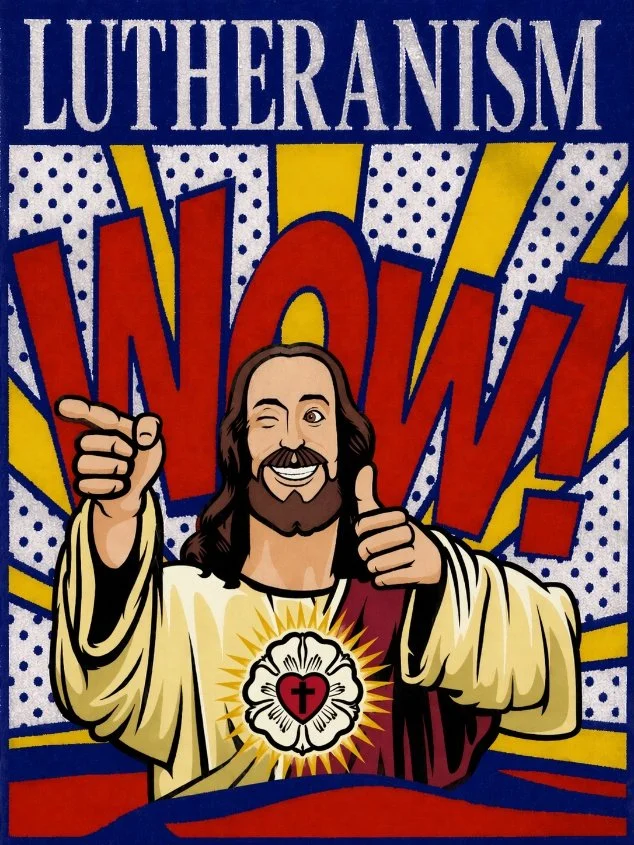
The 1999 Kevin Smith film Dogma introduced the world to the “Buddy Christ.” In the film, late comedian George Carlin portrayed Roman Catholic Cardinal Ignatius Glick. In a spoof of modern evangelism efforts, Glick introduced “Catholicism WOW!”, a campaign designed to modernize the “passé, archaic institution of the Church.” His character stating, that in modern times, people found the Bible to be “obtuse and even hokey.” During a speech to local reporters, Cardinal Glick stated the Catholic church would be ditching the Crucifix in favor of the Buddy Christ, proclaiming that, Jesus didn’t come to earth to “give us the willies,” but that He “came to help us out… He was a booster!” All this takes place within the first few minutes of the film. It goes downhill from there.
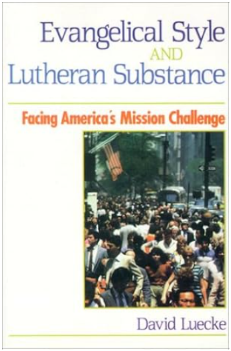
A little over a decade prior, LCMS Pastor David Luecke published a book titled Evangelical Style and Lutheran Substance: Facing America’s Mission Challenge. The thesis of Luecke’s book was that the Lutheran Church-Missouri Synod could integrate and adapt some of the elements of “Evangelical Style” while maintaining it’s Lutheran “Substance” (or identity). Broken down into three sections, Luecke proposed many of the methodologies presented by the Church Growth Movement. In the first chapter of his book, he discussed how Old Churches could move forward by adopting new “styles.” In the second chapter, Luecke examined and assessed different styles of Evangelism, and offered a few “touchpoints for Lutheran adaptations.” In the final chapter, Lueke postulated that churches would grow in the future would need to focus on a more “camp style of audience contact,” and integrate more expressions of personal faith and develop more leadership through the identifying of their personal spiritual gifts. Ultimately, Luecke suggested that church growth is directly tied to a church’s style, which itself is a matter of adiaphora.
He says this on pages 21-22,
Congregations or church bodies have as their substance the part of their identity which has to remain unchanged. Style can be identified as how a church expresses that substance. Style can and does change over the years, just as languages and cultures do. Adopting new styles of church expression amounts to adapting to changes in culture.
Style can be recognized primarily in the way church people communicate what they believe and do and in the ways churches organize to sustain themselves and to carry out their work. Wide diversity in such matters is evident among American Protestants today. Evangelicals in particular have developed styles that differ from those usually seen in historic mainline churches today.
For most churches the line between style and substance remains unclearly drawn. For some Lutherans there may be a question of whether liturgical worship belongs to their substance. They would resist treating it as style, as implied earlier. But in fact, Lutheran worship practice has considerable variance and has had that over the centuries. For Lutherans, substance revolves around beliefs, which are readily identified in the Confessions that define Lutheranism. The Confessions recognize considerable latitude in matters of practice and thereby in style. The conceptual term for what is at issue here is “adiaphora.”
Today it seems, nearly everything in our Synod can be called an issue of adiaphora. Worship music? Adiaphora. Liturgy? Adiaphora. Vestments? Adiaphora. Lutheran identity? Adiaphora. Confessions? Adiaphora. Pastoral formation? Adiaphora. You get my point… But a better understanding of exactly what adiaphora is and isn’t, and how it is understood by our confessional documents, can put some of these disagreements to bed.
What then is adiaphora? The term adiaphora is derived from the Greek word ἀδιάφορον (pl. ἀδιάφορα) which refers to “indifferent things.” Specifically, things which are neither commanded by, nor forbidden by Scripture. Strictly speaking, it is grey area. Theologically speaking, adiaphora are generally related to practice or beliefs which are not essential to faith. In the context of Confessional Lutheranism, adiaphora are a protection against establishing requirements which might add something to Christ’s completed work of salvation. This is where Lutherans find the basis for having a bit of freedom, or leeway, in our rites and ceremonies.
But what exactly do our Confessions have to say about issues of adiaphora? Many things in fact, but since the style of worship is the core of what this brief essay is about, I’ll stick to what they say about the substance and style of Lutheran worship specifically. Let’s examine the following article:
AC. Art. VII – The Church: [1] Our churches teach that one holy Church is to remain forever. The Church is the congregation of saints [Psalm 149:1] in which the Gospel is purely taught and the Sacraments are correctly administered. [2] For the true unity of the Church it is enough to agree about the doctrine of the Gospel and the administration of the Sacraments. [3] It is not necessary that human traditions, that is, rites or ceremonies instituted by men, should be the same everywhere. [4] As Paul says, “One Lord, one faith, one baptism, one God and Father of all” (Ephesians 4:5–6).
A few things are important here. First, Art. VII defines what Lutherans consider to be “the Church.” Specifically, we consider this to be the body of Christ gathered around the Word (meaning the preaching of the Law & Gospel) and the Sacraments. Next, we move to the topic of unity. It is enough to agree about doctrine and the administration of the Sacraments. Finally in line [3] the Augsburg Confession addresses the issue of adiaphora for the first time saying, it is not necessary, that the Church’s rites and ceremonies look the same everywhere.
Beginning on line [30] the Apologia addresses adiaphora a bit more in depth.
Ap. Art VII and VIII (IV) – The Church: [31] … We are speaking of true, spiritual unity. Without faith in the heart, or righteousness of heart before God, such unity cannot exist. Similarity of human ceremonies, whether universal or particular, is not necessary. The righteousness of faith is not a righteousness bound to certain traditions. The righteousness of the Law was bound to the Mosaic ceremonies. But righteousness of the heart is a matter that enlivens the heart. Human traditions, whether they are universal or particular, contribute nothing to this new life. Neither are traditions effects of the Holy Spirit, as are self-control, patience, the fear of God, love for one’s neighbor, and the works of love.
[33] We believe that the true unity of the Church is not injured by dissimilar ceremonies instituted by humans, just as the dissimilar length of day and night does not injure the unity of the Church. However, it is pleasing to us that, for the sake of peace, universal ceremonies are kept. We also willingly keep the order of the Mass in the churches, the Lord’s Day, and other more famous festival days. With a very grateful mind we include the beneficial and ancient ordinances, especially since they contain a discipline. This discipline is beneficial for educating and training the people and those who are ignorant ‹the young people›. [34] We are not discussing now whether it is helpful to keep them because of peace or bodily profit. We speak of something else.
What is this something else? We keep certain rites and ceremonies, and willingly keep the order of the Mass, and other beneficial and ancient ordinances for a few reasons. As noted in the Apology, because they contain a spiritual discipline for believers to practice their faith. Secondly, for good order and theological education. Not because they merit salvation in any way and not to bind consciences in any way, but because these things are beneficial for the Christian. The Apology continues to discuss this further in depth throughout the rest of the Article.
This line of thinking is further developed in Art. XV:
AC. Art. XV – Church Ceremonies: [1] Our churches teach that ceremonies ought to be observed that may be observed without sin. Also, ceremonies and other practices that are profitable for tranquility and good order in the Church (in particular, holy days, festivals, and the like) ought to be observed. [2] Yet, the people are taught that consciences are not to be burdened as though observing such things was necessary for salvation [Colossians 2:16–17]. [3] They are also taught that human traditions instituted to make atonement with God, to merit grace, and to make satisfaction for sins are opposed to the Gospel and the doctrine of faith. [4] So vows and traditions concerning meats and days, and so forth, instituted to merit grace and to make satisfaction for sins, are useless and contrary to the Gospel.
Here our Confession states quite clearly that ceremonies and other practices which are “profitable for tranquility and good order” out to be observed and may be observed without sin. Furthermore, the reader is reminded that following these ceremonies is in no way necessary for salvation. To say it another way, the order and form of worship is a matter of unity and good order. Or to say it another way, all our churches should look very similar to each other. If this matter wasn’t made clear enough, it is addressed within the Apology as well.
Ap. Art XV (VIII) – Human Traditions in the Church: [3]… We do not merit the forgiveness of sins or grace by celebrating human traditions. [13] Why do we need a long discussion? No tradition was set up by the Holy Fathers for the purpose of meriting the forgiveness of sins, or righteousness. Rather, they were instituted for the sake of good order in the Church and for the sake of peace. [21] The Fathers celebrated human rites for the body’s benefit. For example, by such rites the people would know what time they should gather so that, for the sake of example, all things might be done in order and properly in the churches [1 Corinthians 14:40] and that the common people might receive a sort of training. Distinctions of times and the variety of rites help in reminding the common people. The Fathers maintained the rites for these reasons. We also conclude it is proper for these reasons to keep traditions ‹good customs›.
[38] We cheerfully maintain the old traditions made in the Church for the sake of usefulness and peace. We interpret them in a more moderate way and reject the opinion that holds they justify… [44]… we earnestly keep Church discipline, godly ceremonies, and good Church customs. [45] We teach this about the putting to death of the flesh and discipline of the body. Just as the Confession states, a true and not a false putting to death [mortification] happens through the cross and troubles, by which God exercises us. In them we must obey God’s will, as Paul says, “Present your bodies as a living sacrifice” (Romans 12:1). They are the spiritual exercises of fear and faith. [46] In addition to this putting to death, which happens through the cross, there is also a necessary, voluntary exercise. Christ says, “But watch yourselves lest your hearts be weighed down with dissipation” (Luke 21:34). And Paul says, “I discipline my body and keep it under control” (1 Corinthians 9:27), and so on. [47] These exercises are to be accepted not because they are services that justify, but because they are assumed to control the flesh, should overindulgence overpower us, and make us secure and unconcerned. This results in people indulging and obeying the tendencies of the flesh.
What does this mean? The order of worship, the forms and ceremonies… these things guide the faithful in a practice of holy and dignified worship of God. We discipline ourselves by bringing our flesh in tune with the rhythm of the Church, not the melody of the world, which would result in “indulging and obeying the tendencies of the flesh.” Again, the authors of our Confessions are not saying that the form of worship is a matter of salvation, but a matter of good order. They go on to say in line [51] that Christian freedom (adiaphora) should have some constraints so that the true doctrine of the Gospel doesn’t get lost. Furthermore, they state that nothing in customary rites should be changed without a reasonable cause. To nurture unity within the Church, old customs that can be kept without sin or great inconvenience should be kept.
So far, everything that the authors of our Confession have mentioned about the way the Lutheran church practices worship has to do with education and unity. In Article XXIV, they specifically address what the Mass (aka, the Divine Service) should look like in Lutheran Churches.
AC. Art. XXIV – The Mass: [1] Our churches are falsely accused of abolishing the Mass. The Mass is held among us and celebrated with the highest reverence. [2] Nearly all the usual ceremonies are also preserved…
Most of the rest of the article has to do with the Roman abuses of the Mass. Interestingly though, in line [34] the specific purpose of the Mass is mentioned as being for the giving of the Sacrament. For this reason, it is stated, that we have Communion every holy day! (How many of you have Communion every week?) In line [40] the Confession states that our Mass follows the example of the Church, and is derived from Scripture and the writings of the Church Fathers. And, once again, it states that we keep the public ceremonies, which are for the most part, very similar to those in the Roman church. Per usual, we get a bit more context and detail in the Apology.
Ap. Art. XXIV – the Mass: [1]… we do not abolish the Mass, but religiously keep and defend it. Masses are celebrated among us every Lord’s Day and on the other festivals. The Sacrament is offered to those who wish to use it, after they have been examined and absolved. And the usual public ceremonies are observed, the series of lessons, of prayers, vestments, and other such things.
I truly wonder how many Lutherans know that vestments are specifically mentioned in our Confessions. As we continue to read the Apology, we learn the intent of the ceremonies used in the Church. [3]… ceremonies should be celebrated to teach people Scripture, that those admonished by the Word may conceive faith and godly fear, and may also pray. After another lengthy discourse about the Roman abuses of the Mass, the Apology addresses the liturgy of the Mass, which is the “public ministry” of the Church. The articles closing statement is as follows: [99] We have briefly said these things about the Mass for the following reasons. First, we hope that all good people everywhere understand that we keep the dignity of the Mass and show its true use with the greatest zeal.
Thus far in our Confessions it has been continually stated that the rites, form, ceremonies and orders of worship within the Lutheran church do not look extremely different from that of our Roman brethren. It is also maintained throughout our Confession that we retain these things, not because they merit any type of salvation, but because they are useful for education of the people, and for the good order of the Church. This will be expounded upon in the final article.
AC. Art. XXVIII – Church Authority: [51] It is necessary that the doctrine of Christian freedom be preserved in the churches. In other words, the bondage of the Law is not necessary in order to be justified, as it is written in the Epistle to the Galatians, “do not submit again to a yoke of slavery” (5:1). [52] It is necessary for the chief article of the Gospel to be preserved, namely that we obtain grace freely by faith in Christ, and not by certain observances or acts of worship devised by people. [53] What, then, are we to think of the Sunday rites, and similar things, in God’s house? We answer that it is lawful for bishops, or pastors, to make ordinances so that things will be done orderly in the Church, but not to teach that we merit grace or make satisfaction for sins. Consciences are not bound to regard them as necessary services and to think that it is a sin to break them without offense to others… [55] It is proper that the churches keep such ordinances for the sake of love and tranquility, to avoid giving offense to another, so that all things be done in the churches in order, and without confusion (1 Corinthians 14:40; comp. Philippians 2:14). [56] It is proper to keep such ordinances just so long as consciences are not burdened to think that they are necessary to salvation.
So, what are we to think about Sunday worship? The Confessional answer to this question; “It is lawful for bishops, or pastors, to make ordinances to that things will be done orderly in the Church. No one in our Synod insists that a liturgical form of worship should merit the satisfaction of sins, and no one ever should. (Similarly, liturgical worship should not be made into an idol of our fellowship.) But under the ecclesiastical authority of the Church, the elected leadership of the Synod does in fact have the right to establish and maintain such ordinances “for the sake of love and tranquility” so that things are “done in the churches in order, and without confusion.” Again, maintaining order in the Church is the purpose of structured worship, never to give the appearance that God somehow approves the liturgy as righteousness, and never to burden the conscience. This is specifically mentioned in the Apology.
Ap. Art. XXVIII (XIV) – Church Authority: [15] In the Confession we also have discussed to what extent they may legitimately enact traditions, not as necessary services, but only for the sake of order in the Church and for peace. These traditions should not entrap consciences, as though to require necessary services. [16] The use of such ordinances should be left free, so long as offenses are avoided and they are not determined to be necessary services. In the same way the apostles themselves ordained many things that have been changed with time. Neither did they hand them down in such a way that they never could be changed. They did not depart from their own writings, in which they greatly labored should the Church be burdened with the opinion that human rites are necessary services. [17] This is the simple way of interpreting traditions: they are services that are not necessary. Yet, for the sake of avoiding offense, we should observe them in the proper place. [18] Many learned and great people in the Church have understood it this way.
Lutheran worship lives in the tension outlined here in the Apology. As mentioned throughout our Confessions, the Lutheran style of worship should resemble something akin to the Roman Mass, replete with vestments, liturgy, etc. It may be imposed for good order and for the benefit of theological education, but this style of worship cannot be made to bind the conscience or merit the forgiveness of sins. And while this style of worship may not be considered as necessary, it may be considered as beneficial, and because of this, the elements of worship should not be discarded without good reason. It is incorrect to read it in any other manner, and it is disingenuous to infer it states otherwise.
Having thoroughly explored the Confession and Apology, I now must return to Luecke’s assertion that the Lutheran Church-Missouri Synod could integrate and adapt some of the elements of “Evangelical Style” while maintaining its Lutheran “Substance.” To put it bluntly, the claim is patently false and borderline absurd, because it dismisses exactly who we are... Confessional Lutherans. We bind ourselves to Scripture and Confession. It is our “substance.” That is our identity as a Synod. It makes us who we are and sets us apart from other church bodies. And part of that Confession is that we define our “style,” which is liturgical in nature. It has been this way since day one and always has been. This may not be the case for other church bodies, but for those of us who are serious about our Scripture and Confession, we cannot rightly separate our “substance” from our “style” because the two are intrinsically linked.
Like it or not, traditional liturgical worship is part of our DNA because we grew out of the ancient Christian church. For us, the form and style of worship cannot rightfully be considered a matter of adiaphora because it is not an issue which is bound to salvation and it does not merit the forgiveness of sin. For us, the form and style of worship is used for the benefit of maintain good order within the church, promoting theological education, and ensuring a clear proclamation of the Gospel. It sets us apart from the secular world and distinguishes us from other church bodies. Worship is not a matter of adiaphora, but a matter of confession. A confession which all member congregations of our Synod agree to uphold, and a confession which all pastors within our Synod vow to vigorously defend at their ordination.
But I digress. What do I know? I’m just an SMP guy. Seriously though, let’s drop these divisions between “Missionals” and “Confessionals” and get back to who we really are; a united Synod who walks together with a clear confession of faith and practice. Children of God. Saved by grace through faith.
Rev. Streeper serves as SMP vicar at St. Paul Lutheran Church in Valley City, Ohio.