

The Finding of the Holy Cross in Lutheran Use
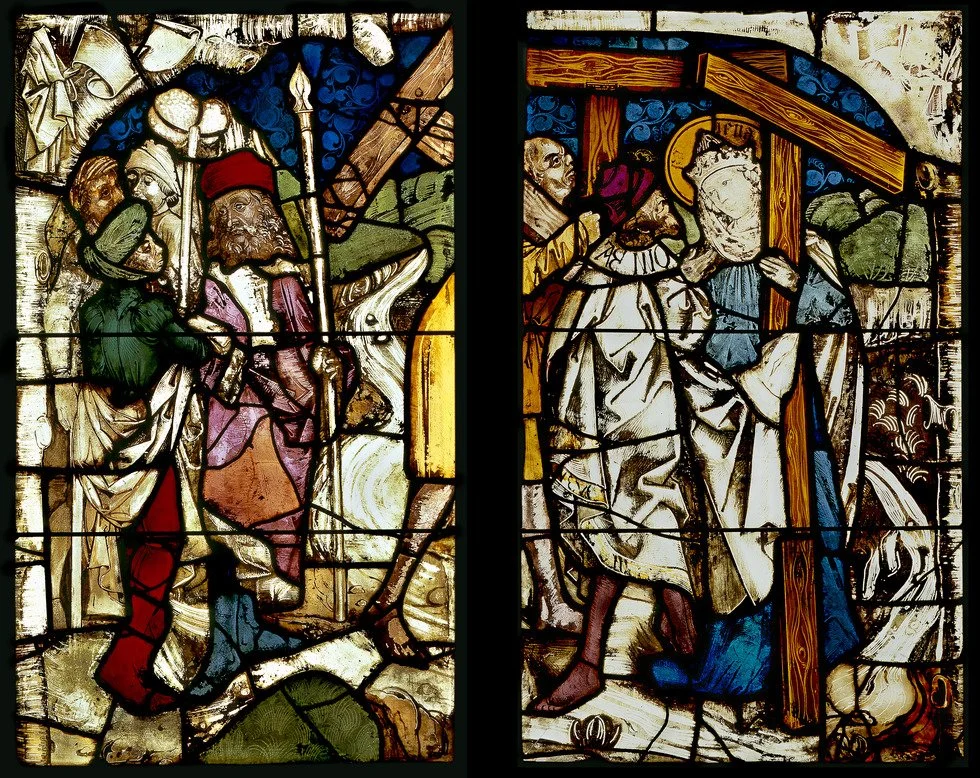
This approaching Sunday, May 3, is the great feast of the Finding of the Holy Cross. Sometimes also called the Invention of the Holy Cross, as a transliteration of the Latin title, Inventio Sanctae Crucis, this feast commemorates the discovery of the Holy Cross by St. Helena, the mother of Constantine, and is not to be confused with the Exaltation of the Holy Cross (September 14th), which commemorates the dedication of the original Church of the Holy Sepulchre in Jerusalem, as well as the recovery of the cross some centuries later.
Luther and Melanchthon on the Feasts of the Holy Cross
Both feasts of the Holy Cross faced no small opposition following the Reformation, with Dr. Luther saying in his 1523 Formula Missae (emphasis my own):
We think that all the feasts of the saints should be abrogated, or if anything in them deserves it, it should be brought into the Sunday sermon. We regard the feasts of Purification and Annunciation as feasts of Christ, even as Epiphany and Circumcision. Instead of the feasts of St. Stephen and of St. John the Evangelist, we are pleased to use the office of the Nativity. The feasts of the Holy Cross shall be anathema. Let others act according to their own conscience or in consideration of the weakness of some — whatever the Spirit may suggest. (AE 53:23)
“There you have it!” the iconoclastically-inclined reader crows, “the festivals of the cross are anathema and should by no means be celebrated, nor the feasts of the apostles or St. Stephen, or any others.” This would, of course, fly in the face of all of Lutheran history and the Lutheran Confessions.
But rather than building a house on the tiniest sliver of a phrase, let’s take a further look at Dr. Luther’s own words. In the 1527 Festpostille, Luther expands on his thoughts in his sermon on the Finding of the Holy Cross:
First, there is the practice of paying great reverence to the holy cross. This is the reason that it is gilded with silver and gold. This in itself I do not reproach. But I attack the abuse that results. For many simple people are seduced by this and go astray. They run here and there to the holy cross, up to Torgau, down to Dresden, and wherever else they go, to these crosses upon which Christ has never suffered…You dream in error that the cross in Torgau works this for you and the other one somewhere else cannot….
Therefore where this abuse and error occurs in the worship of images and the cross, the cross or picture should be removed and destroyed and even the Church building itself be demolished. I would not entirely do away with images and especially the figure of the crucified Christ. For we have in the Old Testament this figure of the bronze snake commanded in the wilderness by Moses, as you just heard in the Gospel. All who were bitten by the fiery snakes were cured when they looked up to the bronze snake. That is what we also must do to be healed in our sins. We must also look at the crucified Christ in such images and believe on Him. But when the Jews began to pray to the snake as a god, and no longer regarded it as just a symbol, the good Hezekiah went ahead and destroyed it.
Our bishops and prelates should do the same with these images if one of them is sought in that way. They should do away with those churches and everything in them. But what do they do now? They go and dedicate more churches and images and also perpetuate the idolatry. They place a heavy burden on the people. They do it to gain money, and unfortunately, souls for themselves. What can one say? They are wolves and remain wolves.
The other abuse: It might be that a few places have a little piece of the holy cross, but there are so many pieces everywhere that a great house could be made of them. And yet they are all considered as if they were from the cross of Christ. That is also, then, not a small dishonor committed against the holy cross. It would be better that it had never been found. It only gives occasion for great sins and idolatry. (trans. Joel R. Baseley in Luther’s Festival Sermons, Dearborn, MI: Mark V Publications, 2005)
Luther’s primary concern — really, his only concern — is the idolatry and abuse associated with relics. He does not object to paying reverence to the cross, to gilding it in silver and gold, but rather to placing one’s confidence in any created thing, even the wood of the cross itself. While voicing skepticism about the veracity of some of the relics of the cross, he doesn’t seem to doubt at all that the cross itself was, in fact, found by St. Helena — that seems quite obvious to him, even as he rues the abuses that have resulted. The human heart is, in the end, the true manufacturer of idols, and can turn even the gifts of God into idols, whether the bronze serpent or the wood of the cross.
Luther spends the remainder of this section speaking at length about how this feast ought to instruct us on bearing our own crosses, but I will, for the sake of brevity, provide only the conclusion and leave the rest for your perusal:
For just as our works do not save us, so also our cross or suffering does not save us. Christ alone is our salvation. He has established it with His death and cross. So you believe that you are saved and have eternal life. You must be brought to it through your death as through a door, so you also must, for that reason, patiently suffer the cross. By that your neighbor will also be incited to bear his cross patiently. In that way we rightly celebrate the discovery of the holy cross and this feast must comfort us in affliction. But now, the way we celebrate it, it would have been better that the cross had never been discovered or lifted up so that we parade around with it like children playing with sticks. God grant that we once more confess our offense and that He give us a right understanding of the matter. Christ Jesus our Savior help us in this. Amen.
Later on in the same postil, on the feast of the Exaltation of the Holy Cross (September 14th), Luther speaks again at length about the use and abuse of the holy cross, though a brief excerpt will suffice:
Churches are endowed with the wood upon which Christ died and this cross is then displayed with other external decorations, with gold, silver, and jewels even to the point that it is dripping with them. Throughout Wittenberg, also, even the monastery is endowed with the crown of thorns and many fees and rents are woven into it, which is not the right use nor the right kind of veneration. Now if you would want to trample the holy cross that would not be good. That it be honored is fine. But that you would fall down in worship upon it, establish churches for it, set the soul’s salvation upon it and forget about the true cross which is more necessary, is wrong.
Dr. Luther says, as before, that the holy cross itself is worthy of honor, but the relics of the cross have become the center of a multitude of abuses.
In his postil, Philipp Melanchthon, quite characteristically, refrains from Luther’s thunderous condemnations, but voices a matter-of-fact belief that St. Helena did, in fact, find the Holy Cross, and spends most of his time speaking at length about the historical circumstances surrounding its finding and restoration:
Helena, the mother of Constantine, had the Cross of Christ sought for, and is said to have found it. Be it so; she is said to have found it in Jerusalem. I believe that it happened. It does not please me to mock all histories. There is a certain diligence, especially fitting for a woman. She was one of those women who came to anoint Christ. If I were a free man and able to travel, I would most of all wish to see those very places where the Son of God left his footprints, and where such great revelations of God were made. (Corpus Reformatorum, XXV:498ff.)
The two feasts of the Holy Cross would be continue to be rather sporadically featured in Lutheran postils for the next two hundred years, including that of Valerius Herberger, but we now turn our attention to the liturgical material.
The Mass and Office for the Finding of the Holy Cross in Early Lutheran Use
The 1589 Missale for the use of the Havelberg Cathedral, authored by Matthaeus Ludecus, includes a full mass for the Exaltation of the Holy Cross. Ludecus, the dean of the cathedral and editor of this volume, was sometimes prone to long prefaces for various masses, variously extolling the virtues of the feast or denouncing the abuses that have now been put to rest. Somewhat notably, in spite of the heated words of Dr. Luther regarding this feast, no lengthy preface is included prior to this feast, seemingly indicating no need for explanation. The only note at the beginning of the mass is this marginal reference: Socrates Scholasticus, lib. I, cap. 17, directing the reader to the following passage:
Helena, the emperor's mother (from whose name having made Drepanum, once a village, a city, the emperor called it Helenopolis), being divinely directed by dreams went to Jerusalem. Finding that which was once Jerusalem, desolate 'as a Preserve for autumnal fruits,' according to the prophet, she sought carefully the sepulchre of Christ, from which he arose after his burial; and after much difficulty, by God's help she discovered it. What the cause of the difficulty was I will explain in a few words. Those who embraced the Christian faith, after the period of his passion, greatly venerated this tomb; but those who hated Christianity, having covered the spot with a mound of earth, erected on it a temple to Venus, and set up her image there, not caring for the memory of the place. This succeeded for a long time; and it became known to the emperor's mother.
Accordingly she having caused the statue to be thrown down, the earth to be removed, and the ground entirely cleared, found three crosses in the sepulchre: one of these was that blessed cross on which Christ had hung, the other two were those on which the two thieves that were crucified with him had died. With these was also found the tablet of Pilate, on which he had inscribed in various characters, that the Christ who was crucified was king of the Jews. Since, however, it was doubtful which was the cross they were in search of, the emperor's mother was not a little distressed; but from this trouble the bishop of Jerusalem, Macarius, shortly relieved her. And he solved the doubt by faith, for he sought a sign from God and obtained it. The sign was this: a certain woman of the neighborhood, who had been long afflicted with disease, was now just at the point of death; the bishop therefore arranged it so that each of the crosses should be brought to the dying woman, believing that she would be healed on touching the precious cross. Nor was he disappointed in his expectation: for the two crosses having been applied which were not the Lord's, the woman still continued in a dying state; but when the third, which was the true cross, touched her, she was immediately healed, and recovered her former strength. In this manner then was the genuine cross discovered.
The emperor's mother erected over the place of the sepulchre a magnificent church, and named it New Jerusalem, having built it facing that old and deserted city. There she left a portion of the cross, enclosed in a silver case, as a memorial to those who might wish to see it: the other part she sent to the emperor, who being persuaded that the city would be perfectly secure where that relic should be preserved, privately enclosed it in his own statue, which stands on a large column of porphyry in the forum called Constantine's at Constantinople. I have written this from report indeed; but almost all the inhabitants of Constantinople affirm that it is true. Moreover the nails with which Christ's hands were fastened to the cross (for his mother having found these also in the sepulchre had sent them) Constantine took and had made into bridle-bits and a helmet, which he used in his military expeditions. The emperor supplied all materials for the construction of the churches, and wrote to Macarius the bishop to expedite these edifices.
When the emperor's mother had completed the New Jerusalem, she reared another church not at all inferior, over the cave at Bethlehem where Christ was born according to the flesh: nor did she stop here, but built a third on the mount of his Ascension. So devoutly was she affected in these matters, that she would pray in the company of women; and inviting the virgins enrolled in the register of the churches to a repast, serving them herself, she brought the dishes to table. She was also very munificent to the churches and to the poor; and having lived a life of piety, she died when about eighty years old. Her remains were conveyed to New Rome, the capital, and deposited in the imperial sepulchres.
Again, our fathers in the faith seemed not to have the slightest doubt about the historical veracity of the finding of the cross by St. Helena, but only protest against the later abuses that so readily spring up in the human heart.
The mass itself begins with the Introit Nos autem gloriari, as on Maundy Thursday, and the Epistle is from Galatians 5:10–12; 6:12–14. Following the Epistle is an Alleluia drawn from the Fortunatus hymn Pange lingua gloriosi [praelium certaminis], after which is added in a number of sources (and assumed in still more sources) Pascha nostrum, ubiquitous throughout Eastertide:
Sweet the wood and sweet the nails:
Sweet the burden that thou bearest;
Which alone was counted worthy
To bear the King and Lord of heaven.Alleluia. ℣ Christ our Passover, is sacrificed for us.
Let us keep the feast with the unleavened bread of sincerity and truth, alleluia.
After the Alleluia is sung Laudes crucis attolamus, the stunning sequence hymn by Adam of St. Victor. If the melody of the sequence seems vaguely familiar, that is because it shares a melody with Lauda Sion salvatorem, the sequence hymn for Corpus Christi, which gave rise to the melody for Gott sei gelobet und gebenedeiet, more familiar to us as the Eucharistic hymn “O Lord, We Praise Thee.” The sequence beautifully recounts the types and foreshadowings of the cross in the Old Testament, from Jacob’s ladder and the wood that sweetened the waters at Marah to the staff of Moses that struck the rock and the sign of the cross made by the blood of the lamb over the doorposts on the night of the Passover. A slight abridgement is provided in English translation below.
Be the Cross our theme and story,
We who in the Cross's glory
Shall exult for evermore.
By the Cross the warrior rises,
By the Cross the foe despises,
Till he gains the heavenly shore…Ladder this, to sinners given,
Whereby Christ, the King of Heaven,
Drew to Him both friends and foes:
Who its nature hath expended
In its limits comprehended
All the world's four quarters knows.No new Sacraments we mention;
We devise no fresh invention:
This religion was of old;
Wood made sweet the bitter current,
Wood called forth the rushing torrent
From the smitten rock that rolled.No salvation for the mansion
Where the Cross in meet expansion
On the door-post stood not graved:
Where it stood, the midnight blast
Of the avenging Angel passed,
And the first-born child was saved.Wood the widow's hands collected,
When salvation unexpected
Came, the Prophet's mystic boon:
Where the wood of faith is wanted,
There the Spirit's oil is scanted,
And the meal is wasted soon…Types of old in Scripture hidden
Setting forth the Cross, are bidden,
In these days, to fuller light;
Kings are flying, foes are dying,
On the Cross of Christ relying
One a thousand puts to flight.This its votaries still secureth,
Victory evermore assureth,
Weakness and diseases cureth,
Triumphs o'er the powers of hell:
Satan's captives liberateth,
Life in sinners renovateth,
All in glory reinstateth
Who by ancient Adam fell.Tree, triumphal might possessing,
Earth's salvation, crown, and blessing,
Every other prætergressing
Both in bloom and bud and flower:
Medicine of the Christian spirit,
Save the just, give sinners merit,
Who dost might for deeds inherit
Overpassing human power.
The plainsong with English text can be found in Mr. Matthew Carver’s Lutheran Sequences. As is the case with many of the Victorine sequences, some portions of the text are in 887 887 meter, and can be set to the familiar melody Alles ist an Gottes segen (cf. TLH 282).
The Gospel is John 3:1–15, the same text appointed for Trinity Sunday, in which Our Lord speaks to Nicodemus of His crucifixion: “And as Moses lifted up the serpent in the wilderness, even so must the Son of man be lifted up: that whosoever believeth in him should not perish, but have eternal life.” Though Ludecus does not specify the Proper Preface that ought to be said, the nearly universal medieval use prescribed the Passiontide preface (“…who on the tree of the cross didst give salvation unto mankind, that whence death arose, thence life also might rise again…”), which would have been quite obvious to his original readers.
While Ludecus’ Missale of 1589 had no prefatory note, his Vesperale has a brief note referring the reader to the Tripartite History, book II, chapter 18, and to Ambrose’s funeral sermon for Emperor Theodosius, but taking care above all to note that the language used in the hymns and chants for the occasion referring to the cross is metonymy, and is truly understood as referring to the crucified. Interestingly enough, this mirrors a common medieval rubric on Good Friday at the veneration of the cross, seemingly derived from Honorius of Autun’s Gemma Animae, III.96: Et nullus sapiens crucem, sed Christum crucifixum adorat, crucem tamen venerando salutat. “And no one who is wise ‘adores’ the cross but Christ crucified; rather he hails the cross with veneration.” (PL 172:667) The piety of the Christian is not directed toward the cross itself, but toward the Crucified, and Ludecus would like to be certain that his readers understand that with clarity rather than falling into the errors denounced by Dr. Luther above.
The liturgical formulae provided for the occasion continue onward with the existing pre-Reformation texts, and so the antiphon for the psalms at first vespers is Helena desiderio: “Helena, full of longing, prayed with tears, saying: ‘Show Thou, O Lord, the wood on which our salvation was hung, alleluia.’ ”
Before we leave Ludecus behind, I cannot help but include an excerpt of the funeral oration by St. Ambrose for Theodosius that he referenced. It is truly beautiful.
How fortunate was Constantine to have a mother like this, who when her son was emperor sought for him the support of divine protection, that he might take his place in battles unharmed, and be without fear of danger! How great was the woman, seeing that she found something to bestow on the emperor, which was very much greater than anything she could receive from him! A mother anxious for a son to whom rule of the Roman world had fallen, she sped to Jerusalem, and thoroughly examined the scene of the Lord's passion.
They claim that she was originally the hostess of an inn, and as such known to the elder Constantius, who subsequently obtained imperial office. Good hostess, who so painstakingly searched for the manger of the Lord! Good hostess, who knew about that inn-keeper who cared for the wounds of he man set upon by robbers! Good hostess, who preferred to be esteemed as dung in order to win Christ! That is why Christ raised her from the dung to royalty, according to what is written, that He ‘raises the poor from the dust and lifts the needy from the dung.’
So Helena came, she began to visit the holy places once more. The Holy Spirit inspired her to search for the wood of the Cross. She approached close to Golgotha, and said: 'Behold, the place of combat, but where is the victory? I am looking for the banner of salvation, but I cannot find it. Am I,' she said, 'to be with kings, while the cross of the Lord lies in the dust? Am I to have gold all round me, while the triumph of Christ lies among rubble? While this object remains hidden, so does the palm of eternal life! How can I consider myself redeemed, if redemption itself is not visible?
I see what you have done, Satan, to make sure that the sword which destroyed you was covered up. But Isaac dug out the wells, which had been covered up by foreigners, and did not permit the water to lie hidden. Therefore let the rubble be shifted so that life may be seen; let the sword be displayed by which the head of the true Goliath was cut off, let the earth be opened up so that salvation may shine forth. What did you achieve, Satan, by hiding the wood, other than to suffer a second defeat? Mary defeated you, when she gave birth to the conqueror, when without any impairment to her virginity she brought Him forth, who was crucified to conquer you, who died to subject you. You will be defeated again today, when a woman uncovers your snares. The holy one bore the Lord, I shall search for His cross. She gave proof of His birth, I shall give proof of His resurrection. She caused God to be seen among men; I shall raise the divine banner from the rubble to be a remedy for our sins.'
So she opens up the earth; she clears away the soil; she lays bare three forked gibbets tangled together, which rubble had covered up, and the Enemy had concealed. But the triumph of Christ could not be effaced. Doubtfully, she hesitates, woman-like she hesitates, but the Holy Spirit inspires a particular line of investigation, because of the fact that two thieves had been crucified with the Lord. So she picks out the middle piece of wood; but it was possible that the rubble had jumbled up the crosses and accidentally interchanged their positions. She goes back to the Gospel passage, she finds that on the middle gibbet there had been an inscription: ‘Jesus of Nazareth, King of the Jews.’ From this, a true line of reasoning was deduced: the inscription revealed the cross of salvation. This is what Pilate answered to the Jews when they protested: ‘What I have written, I have written’ that is: 'I have not written these things to please you, but that future ages may know them, I have not written for you, but for posterity.' He was virtually saying, 'Let Helena have something to read, by which she can identify the cross of the Lord.'
So now, she found the inscription; she adored the king — most definitely not the wood, for this is Gentile error and the folly of the impious, but she adored Him, who hung on the tree, whose name was cited on the inscription, who like a scarab cried out so that His Father might forgive the sins of His persecutors. Eagerly the woman was in a hurry to touch the elixir of immortality, yet she was afraid to trample on the mystery of salvation. With joyful heart but hesitant footstep, she did not know what to do; she nevertheless made her way towards the resting place of truth. The wood shone, and grace sparkled, because just as previously Christ had visited a woman in the person of Mary, so now the Spirit visited a woman in the person of Helena. He taught her what being a woman she did not know, and led her on to a path that could not be known by any mortal. (translated by J.H.W.G. Liebeschuetz in Ambrose of Milan: Political Letters and Speeches, Liverpool: Liverpool University Press, 2005)
You can see even in the time of St. Ambrose of Milan that there is a special concern to direct Christian piety not to the cross, but to the Crucified, a theme which is echoed again and again in the Lutheran fathers, who stand firmly on the shoulders of the ancients in this regard.
The Feasts of the Cross in Recent History
Given all the preceding, the next chapter is, quite frankly, rather strange. The May 3rd feast of the Finding of the Holy Cross feast disappears from view, and we instead find the September 14th feast of the Exaltation of the Holy Cross appearing in the Missouri Synod in most editions of the Kirchen-Gesangbuch from 1880 onward with the name “Tag der Kreuzes-Erhöhung.” It is then absent in English language sources for nearly a century, missing from the Evangelical Lutheran-Hymn Book (1892 and 1918) and The Lutheran Hymnal (1941).
The Exaltation of the Holy Cross only resurfaces in The Church Year: Calendar and Lectionary (1973), the sixth volume in the Contemporary Worship series (a series of pamphlets with test materials from the Inter-Lutheran Commission on Worship), now with the name “Holy Cross Day.” A footnote in this volume notes that Holy Cross “is a popular title for Lutheran churches,” and that since it falls close to the beginning of the academic year, “it presents the opportunity for relating schools and colleges to the cross of Christ.” Nowhere is it noted that this is, in fact, a traditional feast day among at least some American Lutherans, and in a further sign of the disconnect of the ILCW from the liturgical heritage of the Lutheran Church, the footnote concludes by noting that “in the Roman calendar this day is called The Triumph of the Cross.” A cursory look at preceding Lutheran books would have quickly revealed that this naming tradition is also the one present in Lutheran use, if in a slightly differing translation. The appointed readings for the day also reveal a lack of familiarity with Lutheran precedent. While the texts appointed in KELG (and most of Western tradition) are Philippians 2:5–11 and John 12:31–36, The Church Year: Calendar and Lectionary instead assigns 1 Corinthians 1:18–24 and a different cutting of the Gospel (John 12:20–33), neither of which seems to be found in any Lutheran — or, in fact, any other sources at all prior to this date — which is made all the more bewildering by the clear borrowing of the Collect (a new composition by Massey H. Shepherd), Psalm and Old Testament reading (Psalm 98:1–4 and Isaiah 45:21–25, respectively) from the Episcopal Church’s 1970 Services for Trial Use (sometimes called the “Green Book”). Ignoring one’s own heritage and borrowing haphazardly from everywhere else is, alas, an all-too-familiar pattern in the LBW project and its predecessors, but this is just…odd.
The feast then officially enters the English-language hymnals of American Lutherans with the aforementioned propers largely in place in Lutheran Book of Worship (1978) and Lutheran Worship (1982), though LBW further waters down and neuters the Massey Shepherd collect, and LW replaces it altogether with “Merciful and everlasting God the Father…” (no. 29), also said in that volume on Wednesday of Holy Week. Thus we arrive at Lutheran Service Book (2006), which largely adopts the propers as found in LW, though it replaces the Isaiah 45 Prophecy with one from Numbers 21 — fittingly depicting the “lifting up” of the bronze serpent — and lengthens the Epistle by one (1) verse.
In some ways, the history of this feast over the last 150 years serves as a living, breathing, mangled testament to the influence of modernity. The feast disappears from view after the transition from the German liturgical tradition, and then is resurrected 100 years later….with almost completely different texts. The outward form is retained, but the substance is almost entirely changed. A set of texts is proposed seemingly out of thin air in 1973, adjusted in 1978, again in 1982, and is revised once again in 2006. But it’s hardly the exception, and really is the rule — you might be familiar with the Roman Catholic three-year lectionary that was invented in 1969, spawned a decade of chaotic and competing revisions finally consolidated in the Common Lectionary in 1983, only to be replaced with the Revised Common Lectionary in 1992, but which exists in LSB (2006) as a revision of the 1982 Lutheran Worship lectionary, which predates both the Common Lectionary and the Revised Common Lectionary. And all this under the guise of “Christian unity” and “ecumenism,” of course. Who could argue with that?
Well……
Or maybe we could step back from the chaos. Learn from and listen to our fathers in the faith. Root our traditions in the wisdom of the ages, sharing in the joy of Helena and the poetic beauty of Ambrose, paring back the abuses with Luther, reading the history of the nations and how it intersects with the story of salvation alongside Melanchthon, or singing and reading Holy Scripture with Adam of St. Victor while saying mass with Ludecus and C.F.W. Walther.
But we could also go with the tradition that thinks it’s really nice to have Holy Cross Day because it happens near the beginning of the academic year. Those two traditions definitely seem equally valid and profound.
Right?