

A Statement of the Israeli Evangelical Lutheran Church on the Celebration of the Passover Seder
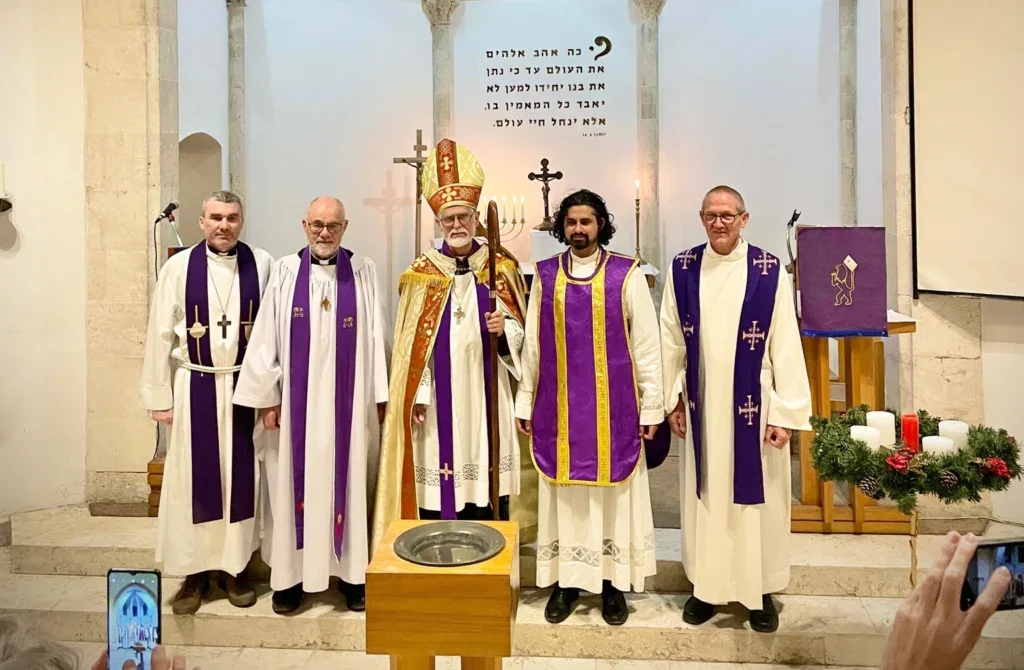
The installation of the Rev. Sahar Sadlovsky as priest and missionary in Tel Aviv, presided over by Bishop Bengt Ådahl of the Mission Province of Sweden, which you can read about here.
The following letter was written by the Rev. Sahar Sadlovsky of the Israeli Evangelical Lutheran Church, a newly formed Hebrew-speaking church based in Tel Aviv, regarding the celebration of Passover seders by Christians.
Today the feast of Passover (פסח) is celebrated in almost every Jewish home in Israel. According to Shmuel Rosner in his book Israeli Judaism: A Cultural Revolution, about 60% of Israelis read the entire Haggadah at the Passover Seder. This means that most people in Israel, from secular or atheist to ultra-Orthodox, take part in the Seder in one way or another. For this reason, the question of the Passover Seder, and of the other feasts that shape the rhythm of life in Israel, cannot be ignored by us as Israeli Jewish Christians.
First, from a theological point of view, we confess as Lutherans that the Exodus Passover pointed to and has found its fulfilment in Israel’s Messiah, Jesus Christ. What was once given as a shadow has now given way to reality. On the night in which He was betrayed, our Lord instituted the blessed Sacrament of His Body and Blood. In this Supper, He gives us the benefits of the new Exodus: forgiveness of sins, life, and salvation, as often as we eat and drink.
Second, we recognise a broader development among many Evangelical churches. Under the influence of Zwinglian piety, they have often lost their connection to the Church’s liturgical life that grew out of the temple and the synagogue. At the same time, many of them show a strong interest in rabbinic Jewish practices such as the current Passover Seder. This reflects a desire to recover a richer liturgical life. It also reveals a thirst for ritual that certain forms of Protestant piety have diminished.
Yet a clear distinction must be made between a pedagogical setting and an act of worship. It can be helpful to learn about the Passover and to understand how it is perceived by a community that does not confess Jesus as the Messiah. But to adopt the Passover Seder as a Christian act of worship goes beyond instruction and leads into theological confusion, and in some cases even syncretism.
When Christians celebrate a Passover Seder, they make a statement, whether they intend to or not. Within the Church, the Lord’s Supper alone stands at the centre as the divinely mandated celebration of redemption. Even Jewish Christians, who have a particular historical and cultural connection to the Passover, must recognise that the Lord’s Supper is its true fulfilment.
The old Passover recalls God’s deliverance of Israel from Egypt and Pharaoh. The Lord’s Supper gives us Christ Himself, who delivers us death and the devil. What the Passover could only foreshadow, the Messiah now gives in full.
To replace the Lord’s Supper, especially on Maundy Thursday, with a Passover Seder as an act of worship is therefore an error. Such a practice constitutes a religious regression from fulfilment back to shadow, detracts from the centrality of Christ, and obscures the means of grace given in the New Covenant. Christians must not allow the shadow to obscure the substance.
At the same time, particular care is needed for Christians of Israeli-Jewish background, as additional pastoral and cultural considerations arise. We therefore state the following:
1. We recognise that there a distinction between an act of worship per se, and a cultural family event that includes religious references but that is not an act of worship in the same way as a service at the synagogue would be.
2. We therefore encourage our members who have grown up with the Passover tradition to join their families on Passover Eve. In doing so, they may express cultural and national solidarity and participate with understanding in light of their faith in the Messiah. As the Lord grants opportunity, they may also bear loving witness to their families concerning the true Passover Lamb of God, who takes away the sin of the world.
3. As a Church, we do not celebrate the Passover Seder as a liturgical or worship event. In our religious activities, we live within the reality of fulfilment. We therefore uphold the Lord’s Supper as the highest and definitive expression of God’s redemption, the new Exodus, the fulfilment toward which the Passover pointed.
As an Israeli Lutheran Church, we pray for our people and join the heartfelt prayer of another Jewish Lutheran, Paul the Apostle:
“My heart’s desire and prayer to God for Israel is that they may be saved” (Romans 10:1).
—Rev. Fr. Sahar Sadlovsky
The Israeli Evangelical Lutheran Church