

Asphalted Hearts: Helmut Thielicke on the Parable of the Sower
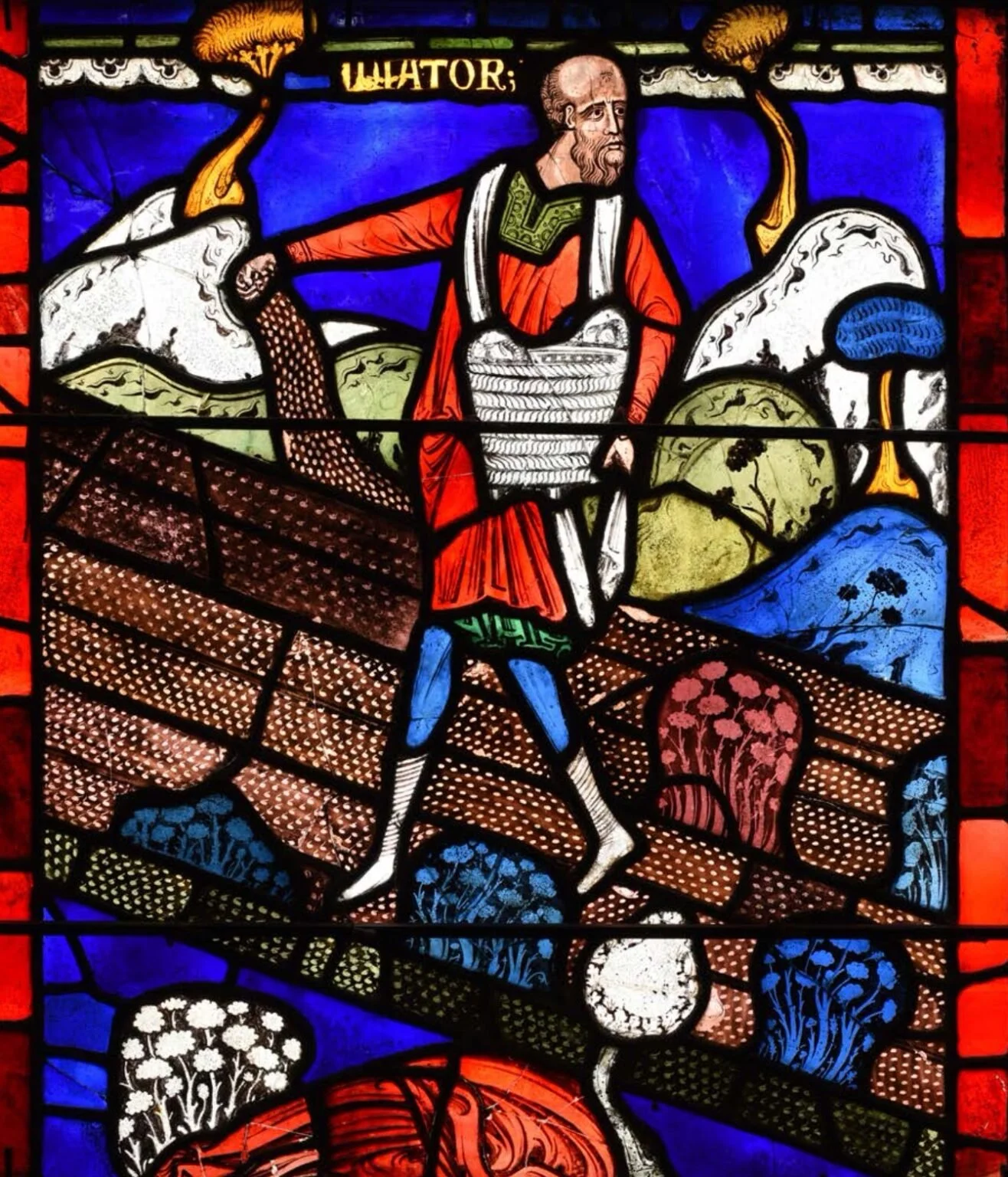
Canterbury Cathedral, The Sower Among Thorns and on Good Ground, Second Bible Window (c.1180)
There are a few books that I come back to again and again, and one of them is Helmut Thielicke’s The Waiting Father: Sermons on the Parables of Jesus (New York: Harper and Brothers, 1959), translated by John W. Doberstein from the German original (Das Bilderbuch Gottes. Reden über die Gleichnisse Jesu, [Stuttgart: Quell-Verlag, 1957]). The sermons in this volume were delivered at St. Michael’s in Hamburg, and are exceptionally perceptive meditations on fifteen parables. Rather than trying to convince you of their value, I will simply reproduce a portion of the chapter pertaining to the Gospel for Sexagesima. As in all things, I encourage any reader who picks up the volume to “eat the meat and spit out the bones.”
An Excerpt from Chapter IV: The Parable of the Seed and the Soils
First let us get the scene itself clearly before us. The path, which is spoken of here, is not intended to receive seed; its function is to enable people to walk upon it. It is beaten down and quite smooth. There are even asphalted paths and there are asphalted hearts too. They are smooth and often they look quite presentable. In human intercourse they play their part. Paths and streets also have names; you must know them if you want to get somewhere. And there are a great many people whom you must know—just as you must know these streets—if you want to get somewhere. They hold key positions, they are influential, and only through them will you get somewhere. This is good and quite in order. Nobody will blame a person for being influential. And nobody will blame a path for not being a field or for being hard. On the contrary! But that which is an advantage in one way can be a hindrance in another. The fact is that seed cannot very well take root on a much-traveled and smooth-beaten path.
A person who is only a path through which the daily traffic passes, who is no more than a busy street where people go rushing by hour after hour and where there is never a moment of rest, will hardly provide the soil in which the eternal seed can grow. People who are always on the go are the most in danger.
A person who can no longer be receptive "soil" for at least fifteen minutes each day, who never allows himself to be "plowed” and opened up, and never waits for what God drops into his furrow, that person has actually already lost the game at the crucial point. The rich and the great people of this world, whose names everybody knows, because they are always out where the traffic is thick, are often very poor people. It is so dangerously easy for them to think they are something great when the rushing, heavy traffic keeps constantly passing over them. And yet they are infinitely poorer than a poor, nameless furrow where fruit is springing up.
Traffic and bustle are not fruit, but only lost motion. Poor busy people! Where will they be when the great Reaper and King comes with his sickle and crown and gathers his wheat into his barn? The great asphalt street, the "Forty-second Street and Broadway," which is their heart, lies empty and deserted; only a few patches of weeds sprout from the cracks in the gutter. This is all that the Eternal finds when the traffic of men is finally stilled. Which of us does not recognize his own heart in this picture of the empty asphalt street?
But we ought not to think only of the great people with well-known names. We smaller folks are in this picture too. This we see in the image of the birds, which, after all, haunt not only the great highways but also the humble field paths. If we are really to understand what this picture of the birds means to say to us we must first get it straight that when the Word of God fails to take root in us this is not merely because of our lack of religious aptitude or simply our want of understanding, but rather because there are other forces in the field that destroy the divine seed and prevent it from germinating.
What those forces are can only be determined by each one of us for himself, if we are prepared to subject ourselves to relentless self-examination under the eyes of Jesus.
There is one thing, however, that can be said in general. In our hearts there are still many other thoughts and desires which keep pulling us into their wake and prevent us from pausing to hear God's call. In every one of us there are definite thought forces which are seeking to dominate us and making a tremendously vigorous totalitarian claim upon our hearts. I am thinking, for example, of our ambition, of everything connected with the word "sex," our urge to power, our desire for recognition and prestige.
The devout of all times have been aware of these sources of domineering appeal and have therefore mobilized other forces against them. Above all, they meditated upon the Scriptures and prayed. But how the great ones in the kingdom of God did that! For them every reading of the Bible was a battle and every prayer a sword stroke. Why is it that so often our prayers do not help us? Why is it that they scarcely rise to the ceiling of our room and fall back with broken wings? Why is it that the Word of God becomes a mere jingle of words that simply bore us? Because we read it and because we pray as if we were skimming through a picture magazine or chatting with a neighbor. We simply do not fight in deadly earnest. When a person is reading his Bible in the morning or just beginning to pray and the thought of bingo or numbers, the next business letter, or the coming meeting enters his mind, he has already blown an inaudible supersonic whistle and summoned whole flocks of birds which one-two-three snap up the poor little seeds.
In other words, the Word of God is demanding. It demands a stretch of time in our day—even though it be a very modest one—in which it is our only companion. We can't bite off even a simple "text for the day" and swallow it in one lump while we have our hand on the doorknob. Such things are not digested; they are not assimilated into one's organism. God simply will not put up with being fobbed off with prayers in telegram style and cut short like a troublesome visitor for whom we open the door just a crack to get rid of him as quickly as possible.
Earlier generations and many servants of God today speak, not without reason, of meditation upon the Scriptures. To meditate means to ponder the Word of God in our hearts, contemplate it, think about it, and constantly apply it to ourselves. Then and only then can these words become a power of thought which is able to do battle with the other forces. Then there comes into being a divine "pull" which draws into its wake our imagination, our feelings, and also our thoughts.
Who today knows anything about this kind of "pull" or power? Oh, modern man meditates and contemplates all right. But it is depressing to observe that his meditation is confined almost exclusively to a single area: the realm of the sexual. Here he rivets his fantasy upon specific images, contrives vivid situations in his imagination, revels in secret ecstasies, and thus creates within himself an undertow which must eventually suck him into its vortex.
The spirit of care and worry also is a kind of meditation. We visualize dreadful pictures of what is going to happen and here too we allow to form in our minds eddies and suctions which, like "fire, water, dagger, and poison," rob us of our peace.
This, precisely this, is what the birds are that fly in and keep pecking away. This is the devil who creates this false whirlpool within us. Is it any wonder then that all of a sudden the seed of the divine Word should disappear? And then we ourselves are likely to say, "The seed is sterile. Christianity no longer has any attraction. God stopped speaking long ago." Naturally, when the storm is roaring within us we shall never hear a pin drop; but God, when he comes, comes only on the feet of doves, and we must be still.
So we must be mindful of the thought forces and the suctions and pulls in our hearts. We must be careful of the birds, sitting expectantly and ready to swoop from the telephone wires all around us even around this church while the seed of God's Word is being scattered. Luther once said: "We can't stop the birds from flying over our heads, but we must take heed lest they build their nests in our hair." Once they feel at home and get a foothold in our heads or even in our hearts the seed is done for.