
A Brief Septuagesimatide Reflection
By Latif Gaba
A Brief Septuagesimatide Reflection on Palm Branches, Their Burning, & the Imposition of Ashes
The palm branches we receive on Palm Sunday are in no way mere props for the Palm Sunday liturgy but are in fact tangible aids to the Christian life of faith and devotion. They are rich in meaning, and hence can feed one's meditation when gazing upon them or passing by where they are displayed in the home or dorm.
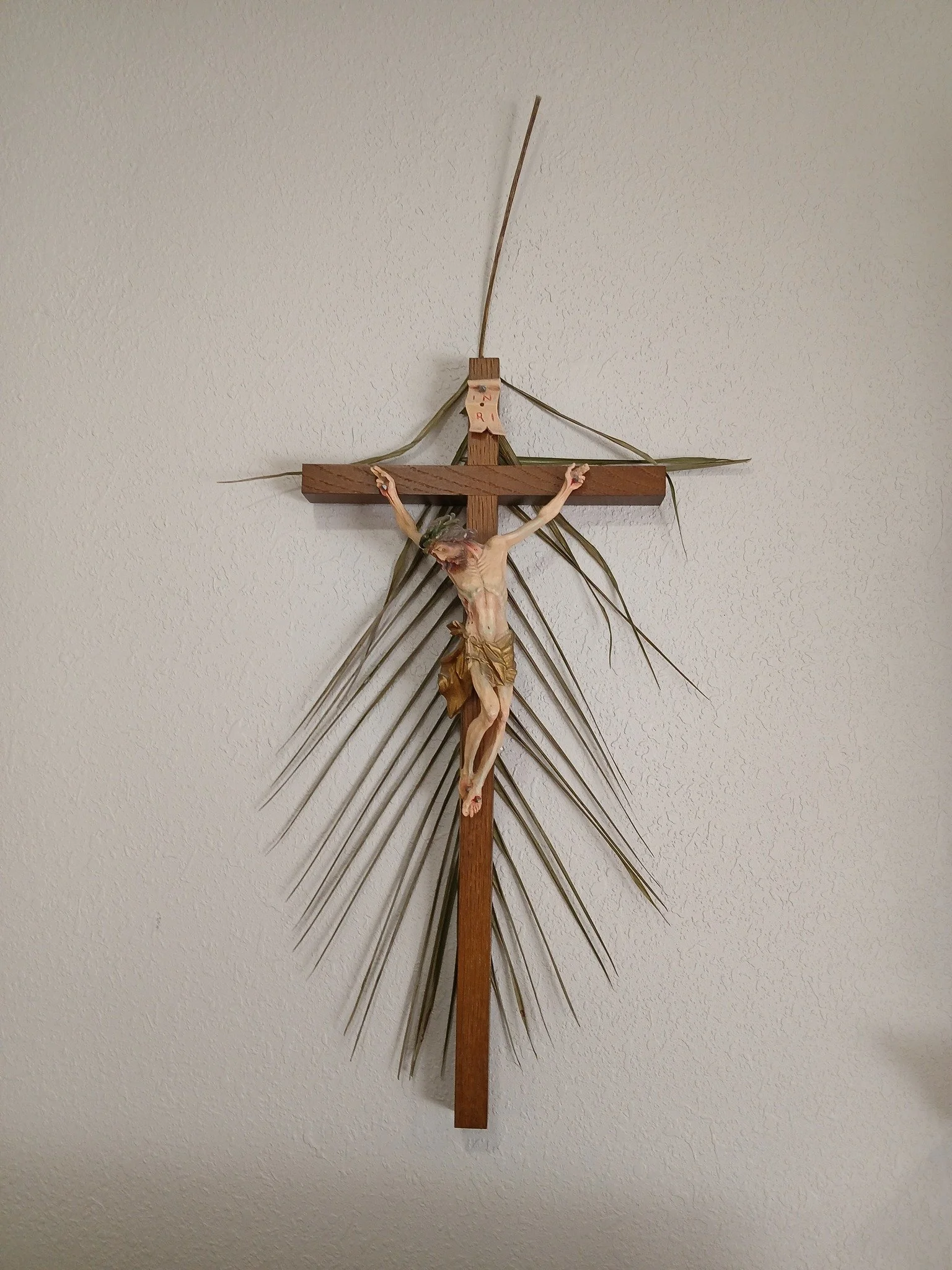
And what is that meaning, you may ask? First we must be clear that tradition does not give us these customs packaged neatly with a guidebook spelling out their precise meaning and significance. Hence, those who might tell you that the significance of the blessed palm branches is precisely X, and nothing else, suffer from regrettably limited imagination. Like the sacred scriptures themselves, the blessed palm branches that are visually displayed at home, often accompanying a crucifix, are rich food for our meditation. As Lutherans often recite in thanksgiving after dinner, in the words of the 147th psalm, the Lord "giveth fodder unto the cattle." Likewise the believing Christian finds endless fodder in the Lord's Word, and also in devotional customs which flow out of that Word. But we might offer a brief word on what the palm branches can mean for us.
They remind us that Christ is King. While this world's prince, the wicked foe, is always on the prowl, seeking whom he may devour, we rejoice that Christ is King and Lord of all, and that we are His. Hence the palm branches can be a prayer for God's kingdom to come, yes, among us also. He is the king who has the victory, and we have the victory in Him. As St. Isidore of Seville said in the seventh century, "In the branches of palms was signified the victory, by which the Lord was going to conquer death by dying, and with the trophy of the Cross was going to triumph over the prince of death, the devil."
In eucharistic terms, the palm branches are a way of hailing our Lord's advent among us, His entry, His gracious Parousia, especially by His Word and Sacrament. In the Eucharist we join the worship of the armies of angels, of whom we sing with the ancient hymn, "Rank on rank the host of heaven spreads its vanguard on the way; as the Light of Light, descending from the realms of endless day, comes the powers of hell to vanquish, as the darkness clears away." The palm branches can be an outer ring suburb of eucharistic worship. They can remind us to pray for the Eucharist, and to be thankful for the gift so astounding we can't help but refer to it as Eucharist.
Palm Sunday Branches are the Hosanna of Christian devotional art. We need saving, and Jesus, true to His Holy Name, is the God Who saves. So we call out to Him, Hosanna, that is, Come, and bring us Your salvation. For we are sinners in a world undone. And yet, this is not a cry of desperation, but a cry of faith and joy. The branches are thus a reminder that, as we said above, He comes to us, with all that He is and brings. With the gift of His own gracious presence, there is forgiveness, and forgiveness is such an astounding life changer that with it there is also life, new life in Christ, and indeed salvation. What happens at the altar does not stay at the altar, but avalanches into every corner and avenue of our lives, including the home, where we live and relate to those closest to us, and whence we are driven each day into the world.
The palm branch, placed right behind a crucifix, changes the cross visually back into a tree. So it reminds us that the cross is lively and fruitful. How can it not be? for it bears the One Who is Life itself. His claim 'Ego sum vita' is an eternal truth, not a condition which He set aside at His death, or that is contradicted by it. In fact, the passion and death of Jesus is the eternal atonement, and the fountain of our life. By His death He gives us life. Christ is for us the Tree of Life, the Lignum Vitae. He is the central presence of our paradise. The Man Who is truly Blessed is just like that tree, the one planted by the water-side, which brings forth his fruit in due season. We who were baptized at that water-side, the river that ultimately flows from the Pierced One, and hence are found in Christ - we are His fruit. In our baptism we are the fruit of the womb of the Church, which is the fertile soil, the paradise, into which Christ plants the seed of His Word. And so we are also the fruit which in due season the lively lignum bears. And what is true of Christ is true of those who are in Him, those who are His members, for His life is now in them. Thus, they, we, too are the tree that bears fruit in due season. Incorporated into the Paschal Mystery, the New Man comes forth and arises, and we now get to bring forth much fruit, multum fructum, πολὺν καρπὸν. We are Christ's Polycarp, and then He brings forth more of it in and through us. Our life in Christ is cruciform, and ultimately that means that it is fruitful and full of life in ways the world could never understand. Worlds upon worlds are opened to us. As we sing with Johann Franck, Jesus our Eucharistic Lord is our "joy into all life expanding."
Again, it is worth underlining the fact that Jesus Christ is the King, but not a far away king. He is our Emmanuel, the proof and manifestation of the God Who wants nothing more than to be with us. No other religion can or would dare say that of their god. And so these truths, these invaluable facets of the truth of God, the One Who says that He is the Truth, are not just for one day of the year, Palm Sunday, but for our consolation and joy in all seasons of life. Hence we take the branches home, for we want the home to be a place of prayer and of joy and comfort in Christ alone.
Of course the time comes, as one season flows into the next, that finally we stand at the portal of Lent, and we get to see in a most fascinating way how the ups and downs of the past year are connected and come to a consummation in the One Whose death is the telos of all of it. For at about this time of year, those branches are at the perfect degree of desiccation and ready for their reverent burning into ashes, which when mixed with a bit of olive oil a few days hence, on Ash Wednesday will be imposed, visibly and tangibly, on our foreheads in the form of the sign of the holy cross. It is worth remembering that the pastor did the same for you at your Baptism, only without the ashes. On that occasion the pastor handed over to you the beautiful heritage not only of the Lord's Prayer but also of the Sign of the Holy Cross. It is good to remember, then, that the Imposition of Ashes, as it has evolved over many centuries, is first of all the pastor blessing you in a most tactile way with the Sign of the Cross. And this blessing is left on you in a visible and unmistakable way, by means of the ashes you carry with you throughout your day. This then also becomes a richly meaningful aid to our life of faith and devotion, and helps us enter into Lent on the right note. We enter into Lent, the Fasting Season, the same way we enter each day, with the sign of the cross, with repentance and faith, with dying to the flesh, and with the joy of life in Christ. We desire to know nothing but Christ and Him crucified. And I dare say we desire not to be known except in terms of Christ and Him crucified. Back in the 80s they would make us sing, "They'll know we are Christians by our love." Maybe there's truth in that. But on Ash Wednesday they'll also know we are Christians by our ashes, that is, by the ashy smudgy cross on our foreheads. What could be more christocentric and on-message? Yes, the ashes on the forehead, in the form of the sign of the cross, are a proclamation, to the world, and even to the devil. But they also serve as a reminder to oneself, and a call to live prayerfully, soberly, and in repentance. They are a reminder to go to Confession, and to return often to the Blessed Sacrament of the Altar.
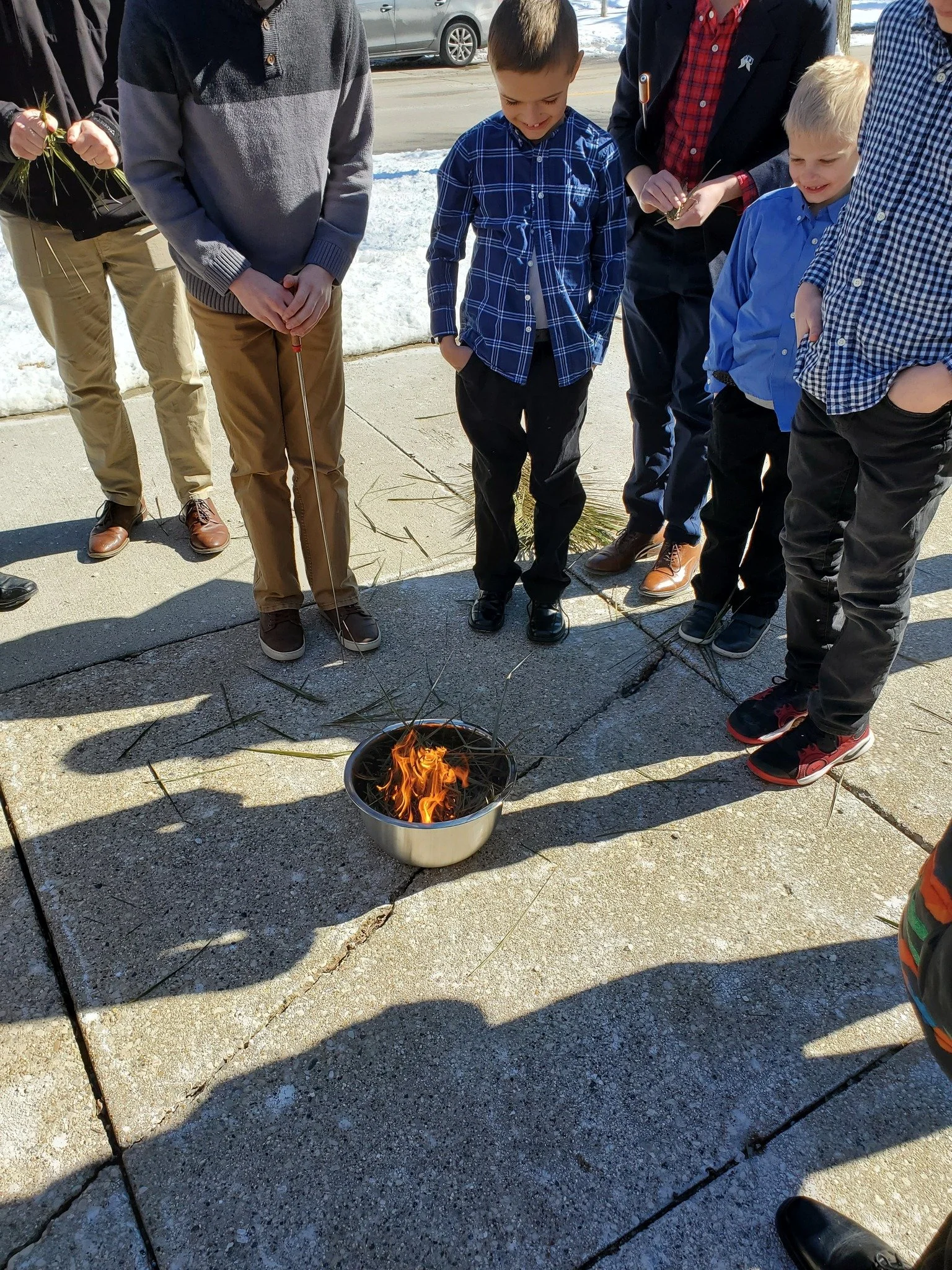
Bring your palm branches from last Palm Sunday back to church, that they may be converted to renewed holy use, as outlined above. If your church does not practice the Burning of the Palm Branches in a known or public way, bring them to your pastor anyway. He will know how to dispose of them reverently, and might even be induced to use the resulting ashes for Ash Wednesday. At our parish this burning of the Palm Branches is done each year on the afternoon of Quinquagesima. The branches will first be broken up into smaller pieces and deposited into a large metal bowl, while we pray a psalm and ponder the changing of the sacred seasons. The bowl will then be taken outside, where we'll set fire to the broken branches, and be reminded of the fire that will be renewed right there on the most holy of nights about seven weeks later.