

Service Architecture Comparisons
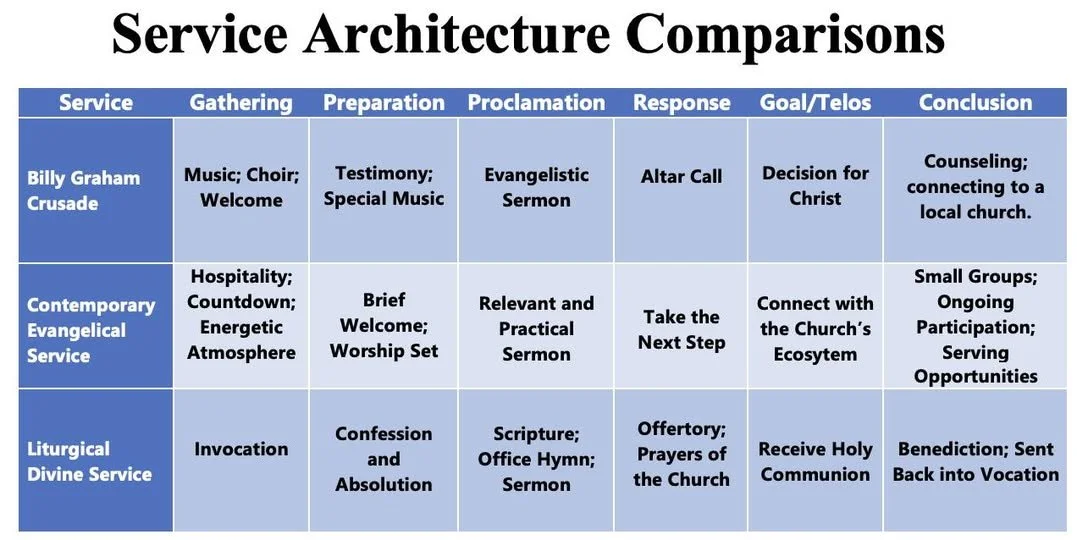
By Matt Richard
Note: This was published at Pastor Richard’s Facebook October 3, 2026, and published here with permission. — Ed.
Listen up. It is time to set the record straight on contemporary worship services. We are not dealing merely with style. We are dealing with a fundamentally different theology of worship.
Take the chart above as an example. At first glance, someone might assume that the difference between a Liturgical Divine Service and a Contemporary Evangelical Service is simply a matter of preference: guitars versus organs, praise bands versus hymns, screens versus hymnals. But the chart shows something much deeper. Now, pay attention: The architecture of the services differs because their goals differ.
The Contemporary Evangelical Service moves toward response, next steps, connection, and integration into the church’s ecosystem. The Liturgical Divine Service moves toward reception: Christ gives His gifts through His Word and Sacraments so Christians can return to their vocations. That is to say, these are not merely different styles accomplishing the same thing. They reflect different theological assumptions about what worship is, who is acting, and why the congregation is there.
That is why the so-called “worship wars” cannot be reduced to instrumentation or aesthetics. Indeed, the issue is much deeper than guitars versus organs. It is about theology embodied in the service's structure.
And this is precisely why the Confessional Lutheran Church must take the ordo seriously. You see, Lutherans should not be naive enough to think that the historic order is merely an empty shell waiting to be filled with whatever style happens to be popular. The ordo has a theological direction. Its architecture confesses something.
And here is the point: The shape of the service reveals its theology. Change the shape long enough, and you may eventually change the theology with it.