

On the Twelfth Day of Christmas…
Ben Maton is an English church organist with an interesting YouTube channel. He visits different English churches, plays their organs, and comments on church and musical history.
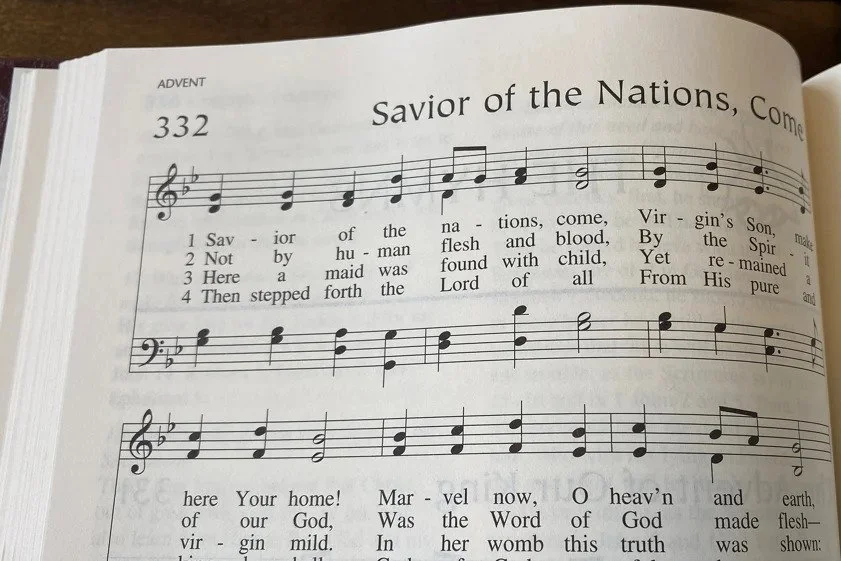
In the above video, Mr. Maton reflects on “Savior of the Nations, Come.” And before someone argues that this hymn or that is “ackchyually” older, stop. Just stop. That’s not the point.

This hymn was originally written in Latin by the great Bishop St. Ambrose of Milan (d. 397). We are still singing this hymn today (well, most of us, anyway). It is a treasure, a hymn that is so confessional as to almost be a creed, one that confesses the two natures of Jesus, but does so poetically, lyrically, and devotionally. It has stood the test of time because it is pure gold. Around 1100, its melody was enshrined in plainchant. In 1523, Martin Luther translated it into German, and modified the plainchant to accommodate his German paraphrase. Two hundred years later, Johann Sebastian Bach fashioned it into a cantata for the First Sunday in Advent.
No doubt, this hymn was sung by the great Bishop St. Augustine of Hippo (354-430), who converted to the Christian faith in Milan under the pastoral guidance of Bishop Ambrose. This hymn survived the Christian civil war that split Catholic from Arian. It survived the debate between Augustine and Pelagius. It survived the fall of Rome. It survived the Great Schism between East and West. It survived the fall of the Eastern Empire and the incursion of the Muslims. It survived the Reformation, even becoming more popular thanks to Luther’s German translation. It survived the so-called “enlightenment” and the increasing secularization of the era of revolution. It survived higher criticism, the world wars, modernism, feminism, and liberalism.
The only thing that threatens this hymn today is selfish faithlessness.
The hymn is secure in confessional and historical churches - including confessional Lutheran churches. But it has fallen into disuse in the “church growth” churches that claim membership in the LCMS, a victim of the myth that old texts and hymns are no longer “relevant,” that people today are not capable of such sublime art as we were capable of - kings and peasants alike - for sixteen centuries.
Now we have churches - even those bearing the name “Lutheran” - who have never sung it, whose people have never heard it - being cut off from their own history and heritage, replacing its beauty with lowbrow garage music, or even rhythmic grunting. All it takes is for one generation to sever the ties, and subsequent generations are left bereft, not even knowing what they have missed. The good news is that there is a spirit of recovery among younger Christians - including young Lutherans - eager to rediscover and regain true relevance, transcendence, beauty, belonging to something greater than themselves, and more lasting than a phony theater stage-set and affected emotional twaddle.
In my first year of seminary, our beloved Rev. Dr. William Weinrich had us memorize the hymn, mainly by requiring that we sing it at the beginning of his lectures in the History of the Early Church. The best construction is that this is still required of our seminarians, even those who opt out of residential training. Men who pre-enrolled in Memento will note that memorizing this hymn was part of our manly discipline for Advent.
Meanwhile, the hymn still resounds in churches around the world - in every language and across confessional boundaries. It is a truly catholic hymn, and it bears the marks of our Lutheran contribution to Christendom.
Ben Maton’s channel is great fun. And as a bonus, here is his video in which he plays one of my favorite hymns, J.S. Bach’s “Jesu Joy of Man’s Desiring,” in a beautiful English country church building originally built in the 12th century.
Merry Christmas!