

The Blessed Virgin Mary, Semper Virgo, and the Perennial Nature of Helvidiocy
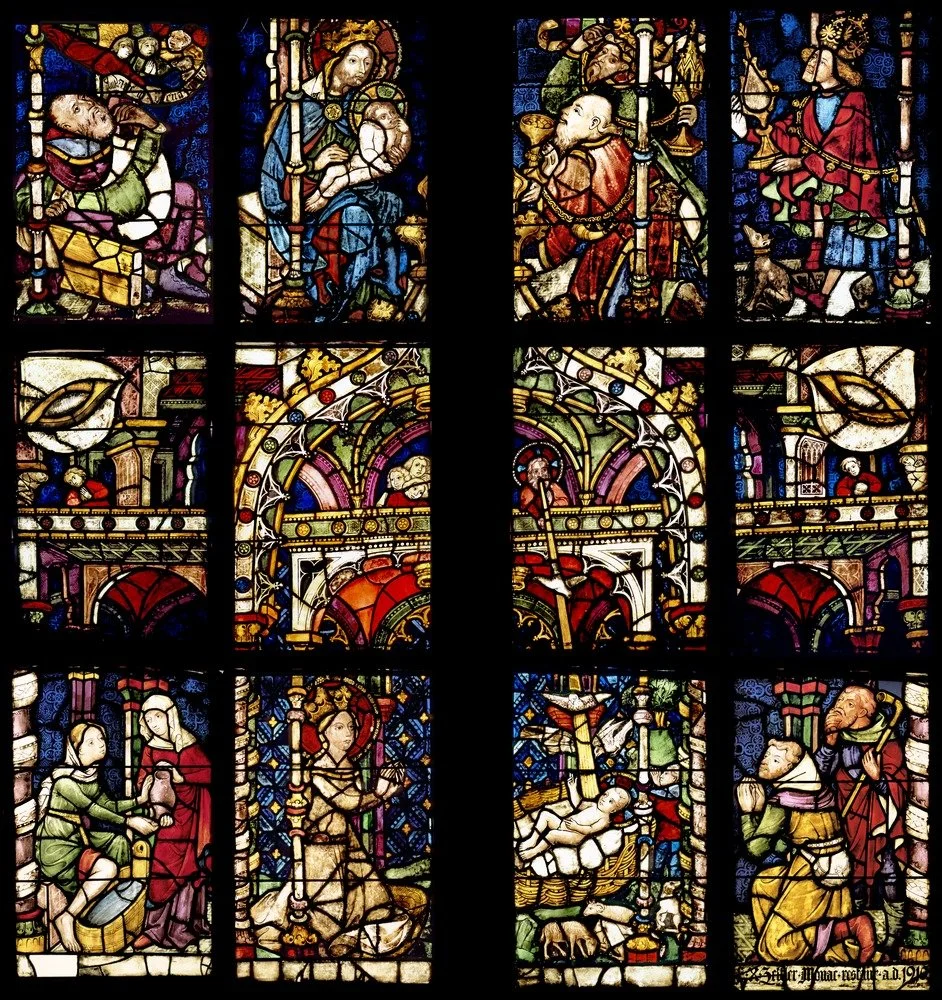
The time of Our Lord’s nativity, the fifth day of which we mark today, draws us to not only reflect on His incarnation, but, by extension, also to the one by whom He took on flesh: the Virgin Mary, most blessed among women (Lk. 1:42) and Mother of God. Along with that discussion come various frequent topics of discussion, perhaps regarding the clauso utero birth (cf. FC SD VII), the assumption, or, perhaps, the perennial favorite: the perpetual virginity [semper virgo] of the Blessed Virgin Mary (cf. every Christian writer under the sun until about five minutes ago).
The documentation concerning the church’s witness on the latter question is so voluminous that a multi-volume encyclopedia would be required to catalog it in its entirety, though the foundational text on the question, St. Jerome’s Against Helvidius (c. 383), lays out the primary points of discussion. The following words of St. Ambrose (Commentary on Luke, II.6–7) provide an illustrative response to objections raised on the basis of Matthew 1:25:
Nor need you be upset by those words of the Evangelist: “And he knew her not until she had brought forth her Son (Mt 1:25). In Scripture, this is a way they have of speaking. Take this text for example: “until your old age, I am” (Is. 46:4). Does it mean that after their old age God will have ceased to be? Or take the case of that verse in the psalm: “The Lord said to my Lord, ‘Sit at my right until I make your enemies my footstool’ ” (Ps. 110:1). Does it mean that afterwards He will no longer sit at the Lord's right?
Or again, if you are pleading a cause, and have said all that is sufficient to prove your case, you do not enquire into what is superfluous. It suffices to deal with the case on hand, and not to enquire into what follows after. Having undertaken to show that the mystery of the Incarnation took place without carnal intercourse, the Evangelist did not consider that it was for him to make protestation regarding Mary’s virginity. Had he done so, he would appear to be defending the Virgin rather than asserting the Mystery. Truly, when he teaches us that Joseph was just, he has said enough to indicate that such a man would never have profaned the Temple of the Holy Spirit, the Mother of the Lord, the Womb consecrated by the Mystery.
We have learnt the order of events; we have learnt the purpose of these events. But let us also learn the mystery. It is good that Mary is both a wife and a virgin, for she is a figure of the Church who is without stain (cf. Eph. 5:27), and yet a spouse. As a virgin she has conceived us by the Spirit; as a virgin she brings us forth without the pangs of labour. There may, too, be another reason why Holy Mary became fruitful by One who was not her husband, for the individual churches — made fruitful by the Holy Spirit (cf. Rev. 2:17) and by grace — are visibly united to a mortal bishop.
A brief quotation from the English translation of Franz Pieper’s Christian Dogmatics (1951) sums up the overall state of things very tidily: “If the Christology of a theologian is orthodox in all other respects, he is not to be regarded as a heretic for holding that Mary bore other children in a natural manner after she had given birth to the Son of God.” (II.308) (German: Wenn sonst bei einem Theologen die Christologie in Ordnung ist, so wird man ihn deshalb, weil er Maria nach der Geburt des Sohnes Gottes noch andere leibliche Kinder gibt, noch nicht under die Häretiker zählen.) Did you catch that? Rejection of the semper virgo does not make one a heretic by default, as it is a pious opinion rather than a doctrine. But Pieper doesn’t simply dismiss it as a frivolous question: he takes care to clarify that one is not to be considered a heretic “if [his] Christology…is orthodox in all other respects.” Denial of the semper virgo is something of a red flag, as the march of historical criticism to destroy belief in the virgin birth of Christ begins by trampling the semper virgo underfoot — a march that was well underway by the beginning of the twentieth century, and its rejection necessitates a closer look at one’s Christology to see exactly what else this rejection might entail.
The English translation of Pieper on this question is, quite interestingly, less than half the length of the original German text. The bulk of Pieper’s original discussion on the question is contained in lengthy and detailed footnotes, which are partially — but only very partially — incorporated into the body of the English text. The English text follows immediately below, followed by a translation of the German footnotes (courtesy of Mr. Matthew Carver).
Christian Dogmatics (II.308–309)
At this point we may discuss also the question concerning the semper virgo, that is, the question whether Mary, after she had become the mother of the Savior of the world through the miraculous working of the Holy Ghost, became the mother of other children in her marriage with Joseph. The early Christian Church, as did also Luther and other Lutheran teachers, answered the question in the negative. Luther thus writes: “Helvidius [a teacher of the fourth century whose writings were condemned by Jerome], that fool, was also willing to credit Mary with more sons after Christ’s birth because of the words of the Evangelist: “And [Joseph] knew her not till she had brought forth her first-born Son’ (Matt. 1:25). This had to be understood, as he thought, as though she had more sons after the first-born Son. How stupid he was! He received a fitting answer from Jerome.” In more recent times theologians disagree on the question. Luthardt remarks on John 2:12 that Sieffert, Wieseler, Neander, Weiss, Bleek, L. Schulze, favor brothers of Christ, in the proper sense of the term; in favor of cousins we find Hofmann, Lichtenstein, Lange. To the latter belong also Hengstenberg and Keil. David Brown, in the Commentary, Critical and Explanatory (ad Matt. 13:55), leaves the question open, while his collaborator Fausset decides in favor of cousin (ad Gal. 1:19). Dummelow, in the Commentary on the Holy Bible, weighs both possibilities (ad Matt. 12:46).
If the Christology of a theologian is orthodox in all other respects, he is not to be regarded as a heretic for holding that Mary bore other children in a natural manner after she had given birth to the Son of God. In his Systema (I, 159) Quenstedt gives this matter careful consideration. But we must emphatically object when those who assume that Jesus had natural brothers pride themselves on their more delicate “exegetical conscience” and disparage those who hold the opposite view. They certainly cannot prove their view from Scripture, at least not from the “till” (ἔως οὖ, Matt. 1:25) and the “first born” (πρωτότοκος, Luke 2:7). In his Harmonia Evangelica (ad Matt. 1:25) Chemnitz shows that ἔως οὖ, donec, priusquam, which mean “until then” or its equivalent, do not declare that the things that did not take place “till then” did occur at a later time. Chemnitz proves this fact, on the one hand, by Gen. 19:22; Lev. 12:4; Acts 25:16; and, on the other, by Gen. 8:7; 1 Sam. 15:35; 2 Sam. 6:23; Matt. 28:20, and similar passages. This second group of passages Chemnitz correctly describes as follows: “It denies the past without determining the future.” Meyer agrees as regards the ἔως οὖ, but holds that πρωτότοκος entitles him to conclude that Mary gave birth to other children besides Christ. Chemnitz, however, says of “first-born” (prototokos): “The answer is simple; for in the Law, when they are commanded to offer the first-born to the Lord, the sense is not that there must be born another after the first. Not only he is called ‘first-born’ after whom others are born, but rather he before whom none was born, even though he be the only child.” Decisive proof cannot be supplied even from the passages that mention “brothers” and “sisters” of Christ, such as Matt. 12:46 ff.; 18:55 ff.; John 2:12; 7:8 ff.; Gal. 1:19. Since the question is a purely historical one, it is best not to spend too much time on it.
Christliche Dogmatik (II.366–369)
843) St. Louis Edition 20:2098: “Helvidius, the fool, also wished to attribute more sons to Mary after Christ, based on these words of the Evangelist: ʻAnd Joseph knew not his bride Mary till she bore her first Son.ʼ This he wished to understand as though she had more sons after the first Son; the crude fool! St. Jerome responded nicely to this.”
845) Luthardt reports on John 2:12: Deciding in favor of brothers of Christ in the proper sense are Sieffert, Wieseler, Neander, Weiß, Bleek, L. Schulze; for cousins are Hofmann, Lichtenstein, Lange. To the latter belong also Hengstenberg and Keil. David Brown (in Commentary Critical and Explanatory on Matthew 13:55) wishes to leave the question undecided, while his collaborator Fausset, on Gal. 1:19, decides in favor of “cousin.” Dummelow, on Matthew 12:46 (Commentary on the Holy Bible) attempts to weigh the [arguments] for and against.
847) Cf. the presentation by Chemnitz in the Harmony of the Gospel on Matthew 1:26: , ἔως οὖ, donec, priusquam, until that, etc., in themselves express nothing concerning whether what did not happen or did happen up to that point in time did or did not happen afterwards. Chemnitz demonstrates this on the one hand with Gen. 19:22; Lev. 12:4; Acts 25:16, on the other hand with Gen. 8:7; 1 Kings 15:35, 2 Kings 6:23; Matt. 28:20, etc. The latter series of passages Chemnitz characterizes correctly: ita negat praeteritum, ut non ponat futuram [“He denies the past in such a way that he does not set the future”]. Meyer says the same in three places, only he thinks that he can conclude from “πρωτότοκος” that Mary had other children afterwards. However, Chemnitz is right when he says: De primogenito facilis est responsio. Nam in lege, quando jubentur primogenitos offerri Domino, non est sensus, exspectandum esse, donec post primum nascatur alius. Sed primogenitus vocatur non tantum post quem nati sunt alii. verum etiam ante quem nullus natus est, etiamsi sit uni- genitus, hoc est, etsi postea nullos alios habeat fratres, tamen vocatur primogenitus [“Concerning the Firstborn the answer is easy. For in the law, when they are commanded to offer the firstborn to the Lord, the sense is not that one should wait until another one is born after the first one. Rather, he is called firstborn not only after whom others are born, but also before whom none is born, even if he should be the only-born; that is, even if he should afterward have no other brothers, he is still called firstborn.”]
848) Matthew 12:46ff.; 13:55f.; John 2:12; 7:3ff.; Gal. 1:19. — Matt. 13:55: “Is this not the carpenterʼs Son? Is not His mother named Mary? And his brothers James and Joses [Joseph] and Simon and Judas? And his sisters, are they not all with us?” The question is now whether the “exegetical conscience” causes us to understand “brothers” and “sisters” here as physical brothers and sisters here. The principle that each word is firstly to be taken in its proper and primary sense, is correct. But this is also valid with respect to the word “Son” which appears in the text. “Is this not the carpenterʼs son (υἱός)?” Hence all Antiebionites, because they interpret the word υἱός in this passage not as a natural son but as an adoptive son, are able without any burdening of their exegetical conscience to understand the accompanying ὰδελφοί and ὰδελφαί as adoptive brothers and adoptive sisters. In the same way, they also understand “father” as adoptive father in the words of Luke 2:48: “Behold, your father and I have sought you with pains.” If it is objected that Scripture itself offers this qualification of “son” and “father”, it should be pointed out that the same is the case with respect to “brothers.” In Gal. 1:19 the apostle James is called “the brother of the Lord,” ὁ ἀδελφὸς τοῦ Κυρίου. The apostle James (minor), however, is according to the catalog of Apostles (Matt. 10:3) not a son of Joseph but of Alphaeus, Ιάκωβος ὁ τοῦ Ἀλφαίου. So those who, despite this, wish to attribute to Christ _physical_ brothers must rely too heavily on dubious “exegetical means.” They must assert that the James named in Gal. 1:19 in no way belongs to the apostles. The words “I saw none other of the apostles except James, the brother of the Lord” would have to be explained thus: “I saw no other apostle; however, I saw James, the brother of the Lord.” Fritzsche appeals to this in a “notus Graecismus” (Ev. Matt. p. 482). Meyer rejects this, [saying that] according to Gal. 1:19, the attribute “apostle” has to be conceded to James, the “brother of the Lord,” only he was an apostle in the broader sense and therefore not identical with the son of Alphaeus in the catalog of the apostles. However, that Meyer himself does not trust this assertion becomes evident from the fact that he eventually returns to the “firstborn” (Matt. 1:25; Luke 2:7) to demonstrate the physical fraternal relationship. — It has been further objected that none of the brothers of the Lord, and thus not the one named in Gal. 1:19, can have belonged to the Twelve Apostles, since it says in John 7:5: “Even his brothers did not believe in him.” And to Dummelow it seems to be a “firmly established” fact “that none of the brethren were included among the twelve apostles.” Only in Matthew 17:17 does Christ also call the Twelve an “unfaithful and perverse generation,” and in verse 20 He explicitly ascribes to them “unbelief” (ἀπιστία) (cf. Bengel and Meyer). As only relative unbelief, or frailty of faith with respect to the healing of the lunatick is meant here with the Twelve, so also it is made explicit by the context in John 7:5 what the unbelief of Jesusʼ brothers consists of: namely, in their dissatisfaction with the fact that Christ did not wish to go to Jerusalem in a celebratory parade. Briefly, the most certain thing is that an identification is to be permitted between the apostle James and brother of the Lord named in Gal. 1:19 and the son of Alphaeus. One will have to stick with Chemnitz, who, (l[oc] c[it]) following Jerome, comes to the result: “Mariam post partum (Matt. 1:25) aut cum Ioseph aut filios ex ipso sustulisse non credimus, quia non legimus”, namely in Scripture. [“We do not believe that after birth (Matt. 1:25) Mary either lay with Joseph nor produced sons by him, since we do not read it,”] namely in Scripture. The familial relationship of the brothers of Jesus appears in one of the most ancient traditions (cf. Eusebius III, 11, after Hegesippus) as follows: Alphaeus (Cleopas) was a brother of Joseph, the guardian [Pflegevaters] of Jesus. Alphaeus died early on and Joseph took on the family by adopting the children. Thus the children of Alphaeus became the adoptive brothers of Jesus—his brothers purely in a legal sense. As Jesus Himself is called the “Son of Joseph” (Matt. 13:55) although he was admittedly only the adoptive Son, so are James, Joseph, etc., also called brothers of Jesus, even though they were only adoptive brothers. Adoptive brothers being simply referred to as brothers reflects not merely a “Jewish linguistic usage” but is also a general custom in America and other places to this day. The question of what it means for the “brothers” of Jesus brings into consideration a host of other points. A compilation of the subject material is found in Sieffert, who comes down on the side of physical brothers, NE(2) and NE(3) under “James in the N.T.” Under the same title, Lange takes the opposite position in NE(1). Cf. also Hengstenberg on John 2:12. Hengstenberg is severely attacked by Kahnis in “Zeugnis von den Grundwahrheiten” (1862, pp. 88–89). — I have always given the advice not to spend much time and energy on debating the question. A resolute rejection, however, should (as already noted) be made whenever those who decide in favor of physical brothers seek to arouse the appearance of representing the more accurate historical opinion and exegesis. For such behavior there is no warrant. (ed: emphasis my own) [end Pieper]
It is somewhat mystifying to imagine why such a thorough exegetical and historical discussion of the semper virgo would be deliberately omitted from English translation, but it does help to explain the rampant Helvidianism in the English-speaking Lutheran world today. I would refer you to this article by the Rev. Dr. John Stephenson for a rather more broad discussion of this question and its relation to the Lutheran Confessions, but I will provide here a rather famous exchange that he recounts from the 1867 Milwaukee Colloquium between the Missouri and Iowa Synods:
Grossmann: “When you subscribe to the confessions, were you aware of the fact that they declared the permanent virginity of Mary?”
Walther: “Yes, I can say so in the presence of God.”
Grossmann: “Do you still believe this to be true doctrine?”
Walther: “Yes, I can say so in the presence of God.”
Grossmann: “What are your reasons for considering this a true presentation?”
Walther: “Pardon me, but you have no right to ask this question.”
It is certainly worth noting in the perpetual (…) discussions of the semper virgo that C.F.W. Walther was thoroughly convinced that the semper virgo is, in fact, part of the doctrinal content of the Lutheran Confessions (as also, seemingly, did Sasse)— an assertion that we, as those who purportedly hold a quia subscription to those writings, should take quite seriously. But if one finds a Lutheran layman or pastor rejecting the semper virgo out of hand, how can we be surprised? He has been conditioned to do so by the modern English-language Lutheran dogmatic tradition that has done its very best to make Helvidiots of us all, despite Dr. Luther’s warning: “it is a perilous and dreadful thing to hear or believe anything against the unanimous testimony, belief, and doctrine of the entire holy Christian Church.”