
TrADitiOns oF MeN!!!!
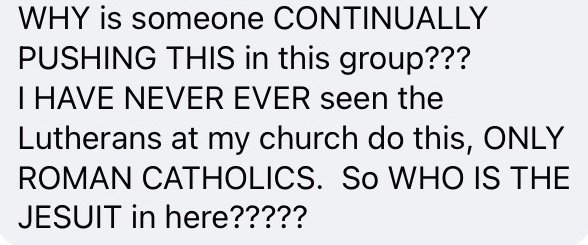
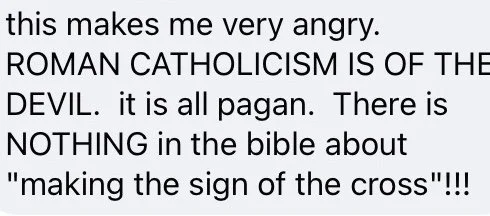

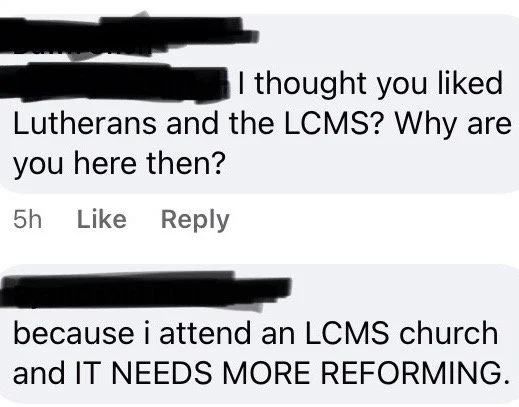
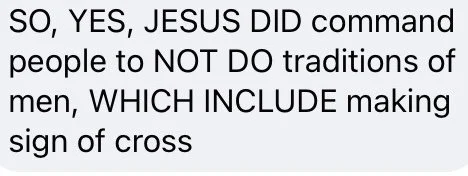
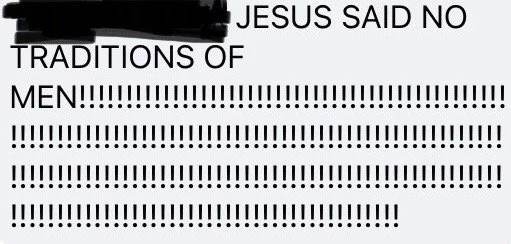
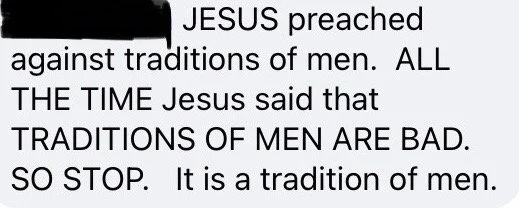
A member of an LCMS congregation posted with great gusto and passion on a Facebook group concerning the Sign of the Cross, of which he disapproved, because it is a “tradition of men.” I’ve included some of his remarks as screenshots with names redacted.
Certainly, our Lord has something to say about “traditions of men”:
“Now when the Pharisees gathered to him, with some of the scribes who had come from Jerusalem, they saw that some of his disciples ate with hands that were defiled, that is, unwashed. (For the Pharisees and all the Jews do not eat unless they wash their hands properly, holding to the tradition of the elders, and when they come from the marketplace, they do not eat unless they wash. And there are many other traditions that they observe, such as the washing of cups and pots and copper vessels and dining couches.) And the Pharisees and the scribes asked him, “Why do your disciples not walk according to the tradition of the elders, but eat with defiled hands?” And he said to them, “Well did Isaiah prophesy of you hypocrites, as it is written,
“‘This people honors me with their lips,
but their heart is far from me; in vain do they worship me,
teaching as doctrines the commandments of men.’
You leave the commandment of God and hold to the tradition of men.”
And he said to them, “You have a fine way of rejecting the commandment of God in order to establish your tradition!”

Notice that our Lord’s criticism is that the Pharisees took a tradition and elevated it to equality to, and even superiority over, the Word of God. Jesus is not condemning handwashing in and of itself (which would certainly put Him on the Wrong Side (as the kids say) of personal hygiene). The idea here is that traditions of men should not be taught as if they had divine command.

Our Lutheran Confessions often clarify that traditions which uphold the Word of God and the Gospel are laudable, and the Lutheran default position is to retain them from pre-Reformation times as our own heritage, while at the same time we make it clear that such traditions don’t justify a sinner before God or earn salvation. One such example is AC15 - Of Ecclesiastical Usages:
“Of Usages in the Church they [our churches] teach that those ought to be observed which may be observed without sin, and which are profitable unto tranquility and good order in the Church, as particular holy days, festivals, and the like.
Nevertheless, concerning such things men are admonished that consciences are not to be burdened, as though such observance was necessary to salvation.
They are admonished also that human traditions instituted to propitiate God, to merit grace, and to make satisfaction for sins, are opposed to the Gospel and the doctrine of faith. Wherefore vows and traditions concerning meats and days, etc., instituted to merit grace and to make satisfaction for sins, are useless and contrary to the Gospel.”
All traditions are not bad. Not by a long shot. In fact, tradition is literally the “handing over” from one generation to the next. This is one of the literal meanings of the verb “trado” in Latin. So really everything that has been going on since before our own births is a matter of tradition. Representing words in the form of 26 letters and using subjects and verbs is a human tradition, (not to mention exclamation points!) as the English language was certainly not a divine ordinance, and it was “handed over” to us by our parents and teachers. Similarly, celebrating Christmas on the 25th of December is a “tradition of men.” Doing so would only become sinful if we were to say that honoring Christmas as a holiday merits justification, or is commanded by God when we lack a clear mandate from God.
Family recipes are a “tradition of men,” and they are indeed handed over from one generation to the next. Family customs, such as particular traditions for holidays, or going to a favorite restaurant after church on Sunday are all traditions. Jesus nowhere condemns such things. The coin toss at the beginning of the game, the presentation of the colors when a military unit meets, the precise steps of the guard at the Tomb of the Unknown Soldier, decorating one’s house for Christmas, eating pancakes on “Shrove Tuesday” (or attending parades on Mardi Gras), having an Easter egg hunt for children, beginning the work day with a staff meeting - perhaps with a ritual of coffee and donuts, etc. These are all examples of “traditions of men” that one would be hard-pressed to find condemned by Jesus and the Scriptures.
The use of red, yellow, and green lights on the streets to indicate right-of-way is a “tradition of men.” The use of a red octagon for a stop sign is an international tradition of men. Driving on the right side of the road in America, and on the left in many other countries are also examples of traditions that are not commanded in Scripture. The use of a white flag on the battlefield to indicate a truce, or one bearing a red cross to symbolize a doctor or medic is likewise a “tradition of men.”
In the church, and even among those who are not liturgical, there are many traditions: steeples, wooden benches, the passing of an offering plate, bowings one’s head and folding one’s hands for prayer, Sunday School and VBS, the singing of favorite hymns, the church picnic on a certain Sunday every year are all examples of “traditions of men.”
And so are ceremonies, such as crossing oneself, or not crossing oneself. For not doing something is also a form of ceremony, a tradition received from those who handed it over to those in the present. When the Baptist minister recites the Words of Institution of the Lord’s Supper and doesn’t bow or genuflect or cross himself, he is exercising a “tradition of men” that has been handed over to him from within his Baptist tradition. And it is consistent with his theology that the elements are symbolic. To show reverence would be a betrayal of Baptist theology, and would be seen as idolatry.
Similarly for Lutherans, ceremony regarding the Eucharist that downplays the reality of Christ’s incarnational, miraculous presence in the elements would be a “tradition of men” incongruous with our theology of the Sacrament of the Altar.
So crossing oneself, and not crossing oneself, are both examples of “traditions of men.” And if either crossing or not crossing were to be taught as having the divine command of God, or is a ceremony that merits salvation, both of these “traditions of men” would be precisely the thing that Jesus warned against.
This hysterical bias against tradition in general, and in the sign of the cross in particular, reflects the Radical Reformation, not the Lutheran Reformation. We retain ceremonies and customs unless there is a good reason to get rid of them. Which is why our confessions (both Catechisms, both authored by Luther) encourage us to make the sign of the holy cross, in our morning prayers, evening prayers, and “when anything monstrous or terrible is seen or heard.”
It is indeed a “tradition of men” that has no command of Jesus. But likewise, not crossing oneself is also a tradition of men without Scriptural origin. Not responding bodily to the name of the Most Holy Trinity is also a ceremony. “Traditions of men” that point us to our Lord and His cross are laudable and edifying.
This is most certainly true.