

The Experience of Christ
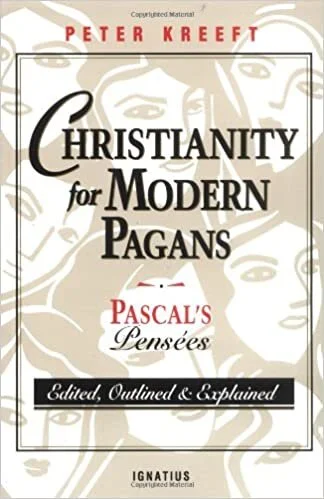
“Christ is our God. Experience is not our God. Contemporary psychobabble substitutes experience for Christ, pop psychology for revealed religion. Yet we need to experience Christ, meet Christ, touch Christ, not just believe correct theology about Christ. What we need is not experience without Christ, nor Christ without experience, but the experience of Christ; not psychology or theology but religion, lived relationship. ”
Commenting further upon Blaise Pascal’s Pensée #913, Dr. Peter Kreeft says:
certainly the closest [pensée] to Pascal’s heart, figuratively and even literally, since he kept it sewn into his coat pocket. He kept it close to his heart physically at all times because he kept it close to his heart spiritually at all times. It is of all the pensées the most intimately revealing and the most mystically exalted.
In this reflection, Pascal describes God as “Fire” - upon which Kreeft comments:
The key word. It is like a sacrament, it effects what it signifies. It penetrates and burns into our heart, this word—like fire itself. What a shocking word for God, yet what a true one. God is not a pale light but a life-creating and consuming fire, a volcano. Those who frown or sniff at this crude God prefer the beautiful perfume to the beautiful woman, the portrait to the person, as the Pharisees did (Jn 5:39-40).
Our Lord in His mercy gave us sacraments: tangible means of grace, experiential worship that is objective. And God the Son, as in His conception, birth, life, death, and resurrection, the Word Made Flesh, continues to come to us incarnationally in space and time. This is indeed a mystery - which is the root meaning of the word “sacrament.”
Too often, we Lutherans fall into either the camp of intellectualism: reducing the faith to doctrinal propositions of the mind, or run to the other ditch of emotionalism: downplaying or fleeing the sacramental by adopting the non-liturgical worship - and even the hymnody - of churches which deny both the Real Presence in the Sacrament of the Altar and baptismal regeneration.
The former leads to a kind of sterile rationalism, and the latter leads to a ginned up emotionalism. In a crass vindication of the principle of Lex Orandi, Lex Credendi, I have even seen an actual “altar call” in the video of a recent LCMS Divine Service. Indeed, like the tragedy of our Old Testament fathers taking foreign wives, looking to worship forms outside of our tradition - alien to “Scripture and the Church Catholic” - leads to “ungodly doctrine” creeping into our churches.
The solution to avoiding the both the Scylla of cold Rationalism and the Charybdis of unhinged Pietism has been with us all along: the traditional liturgy in its richness. It is correct doctrine lived out in correct worship. It is a both/and instead of an either/or. And yes, we Lutherans are not postmodernists on the issue of worship. There is a right way and a wrong way to worship - that is if we still believe our own Book of Concord (AC 21:15 otherwise identified as paragraph 6 of Articles in Which Are Reviewed the Abuses Which Have Been Corrected per the Triglot):
But it can readily be judged that nothing would serve better to maintain the dignity of ceremonies, and to nourish reverence and pious devotion among the people than if the ceremonies were observed rightly in the churches [Latin: rite fiant in ecclesiis]. Emphasis added.
And far from being cold and inexperiential, traditional worship delivers the true “fire” about which Pascal writes, how we “experience Christ” in Kreeft’s words. It isn’t emotion, but it may (or may not) arouse an emotional response (which it certainly did in Pascal’s case). It is genuine, not contrived, because it is the very Presence of our Lord Jesus Christ in the means of His choosing: His Word and Sacrament. And unlike both the psychobabble of the world that lacks belief in the One True God, and the ecclesiobabble of Pentecostal-influenced Pietist pop-Christianity that refuses to confess the Sacramental Presence - the Divine Liturgy breaks through the curse of Babel by speaking the very Word of God in the tongues of men, handed over through the ages, speaking and singing the Scriptures themselves, the very Bible inspired by the same Holy Spirit that brought the tongues of fire to the Holy Apostles and empowered them to preach the Good News to a world in dire need of the Spirit’s true flame.
Let us indeed, in Kreeft’s words: “experience Christ, meet Christ, touch Christ, not just believe correct theology about Christ.” And with Pascal, we are bold to confess and pray:
And this is life eternal, that they might know Thee, the only true God, and Jesus Christ whom Thou hast sent.